



Menstrual cup and toxic shock syndrome (TSS): what you need to know
29 de June de 2026
Menstrual cup for virgins: everything you need to know
1 de July de 2026
Discover everything about polycystic ovaries, PCOS, and its impact on menstruation and fertility with the complete guide from PapayaCup. Expert tips, clear steps, and answers to your most frequent questions.
Inhaltsverzeichnis
- Polycystic Ovaries: What They Are, How They Affect Your Menstruation, and What You Can Do
- What are Polycystic Ovaries? Clear Definition
- How PCOS Affects the Menstrual Cycle: The Real Mechanism
- Symptoms and signs: when to suspect you have PCOS
- PCOS and fertility: everything you need to know
- How to manage PCOS in daily life
- Frequently asked questions about polycystic ovaries
⚕️ This article is for informational purposes only and does not substitute for medical consultation. Always consult your gynecologist with any questions.
Polycystic Ovaries: What They Are, How They Affect Your Menstruation, and What You Can Do
The period that arrives every 45 days, or every three months, or that simply disappears for weeks without warning. The acne that has no explanation at 28 years old. The blood test that confirms what you already suspected: polycystic ovaries, or Polycystic Ovary Syndrome (PCOS). The diagnosis finally arrives, but the questions about menstruation, fertility, and how to manage all this daily do not disappear with it.
In this guide, you will find out exactly what polycystic ovaries are, how they affect your cycle and fertility, and what real options you have to live better with this syndrome. No unnecessary technicalities, with verified information and the perspective of thousands of people who have already gone through this.
What are Polycystic Ovaries? Clear Definition
If you have just received the diagnosis, the first thing you feel is that you need someone to explain it to you properly, not with the doctor's note that you don't fully understand. Let's get into it.
Definition and Characteristics of PCOS
The Polycystic Ovary Syndrome (PCOS) is the most common hormonal disorder in individuals with ovaries of reproductive age. It affects between 8% and 13% of the global female population, according to the World Health Organization, making it one of the most common causes of menstrual irregularities and difficulty conceiving.
Despite its name, PCOS does not necessarily mean you have cysts on your ovaries. The "cysts" that appear on the ultrasound are actually immature follicles that have not released an egg — in other words, ovulation has not occurred. Understanding this is important because it completely changes the mental image you have of the problem.
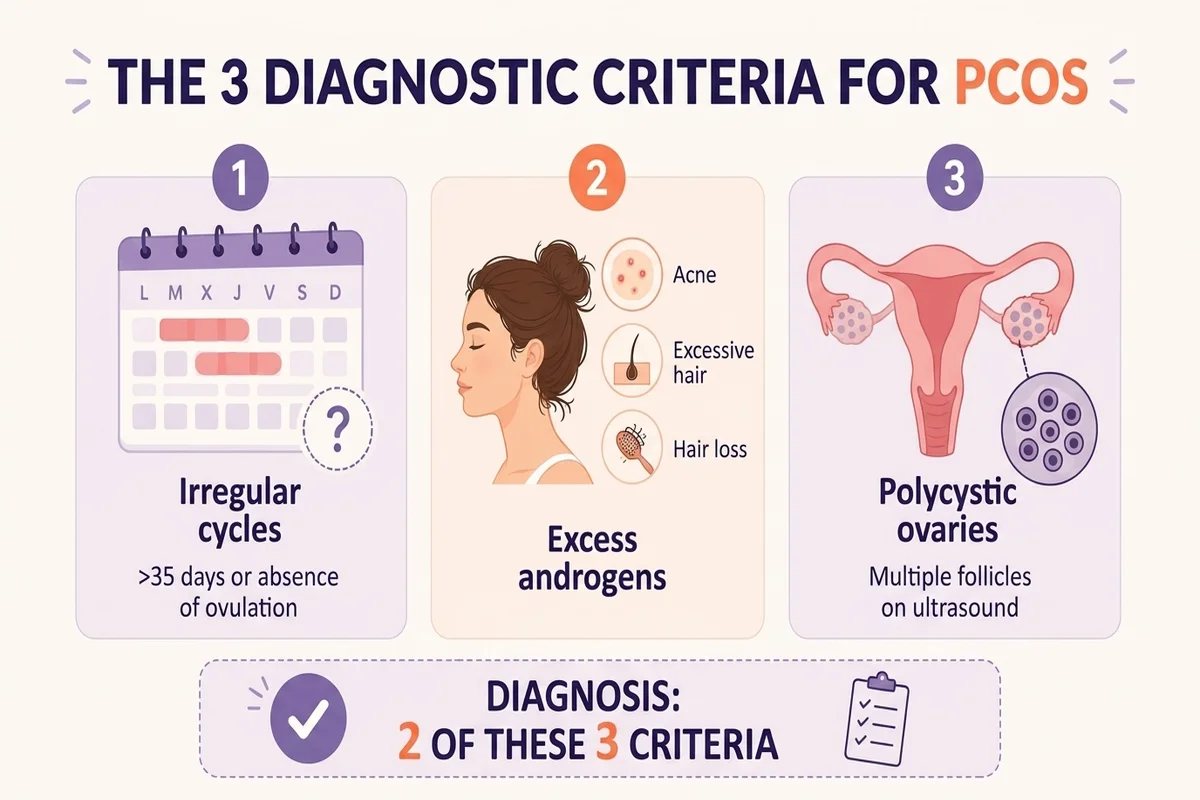
To diagnose PCOS, the so-called Rotterdam criteria are used: at least two of the following three criteria are needed:
- Irregularities in the menstrual cycle (very spaced or absent periods)
- Excess androgens (male hormones), either in blood tests or with visible symptoms such as acne or excessive hair
- Polycystic-appearing ovaries on ultrasound
Who does PCOS affect?
PCOS can appear at any time from the first period until menopause. However, it is most frequently diagnosed between the ages of 20 and 30, often when the individual starts trying to get pregnant or when their cycle draws attention due to its irregularity.
There is also a significant genetic basis: if your mother or sister has PCOS, your chances of having it are significantly higher. Chronic stress and premenstrual emotional imbalances may also be related to the intensity of symptoms, although they are not the direct cause of the syndrome.
How PCOS Affects the Menstrual Cycle: The Real Mechanism
When your period arrives whenever it wants, or doesn't arrive at all, your mind tends to seek a simple explanation. With PCOS, the explanation lies in a hormonal imbalance that affects the entire axis regulating your cycle.
In a normal cycle, FSH (follicle-stimulating hormone) causes the ovarian follicles to mature, one of which releases an egg, and if there is no fertilization, menstruation occurs. In PCOS, this process is interrupted:
- The ovaries produce too many androgens (testosterone, among others)
- This excess prevents the follicles from maturing properly
- Ovulation does not occur or is irregular (anovulation or oligovulation)
- Without ovulation, the endometrium continues to thicken without shedding, leading to irregular, very light, or absent periods for months
There is another factor that exacerbates all of this: insulin resistance, which appears in a significant portion of individuals with PCOS. When cells do not respond well to insulin, the pancreas produces more, and this excess insulin further stimulates androgen production in the ovaries. It is a self-reinforcing cycle.
And what does this have to do with bloating during your period or with the pain being worse than usual? When menstruation finally arrives after a long absence, the endometrium is thicker than normal, which can result in heavier, longer, and more painful periods.
Symptoms and signs: when to suspect you have PCOS
PCOS does not have a single face. Some people discover it by chance during an ultrasound, while others have been experiencing symptoms for years without knowing they were related. Here are the most common signs:
Irregular cycles
Fewer than 8 periods a year, cycles longer than 35 days, or amenorrhea (absence of periods for 3 months or more).
Excess androgens
Persistent adult acne, hair in typically male areas (hirsutism), or hair loss at the temples.
Weight difficulties
Insulin resistance can make it hard to maintain or lose weight, especially in the abdominal area.
Mood swings
Anxiety, irritability, and fluctuating mood, especially related to the cycle.
Fatigue
Persistent tiredness, especially after meals, which may be related to insulin resistance.
Follicles on ultrasound
12 or more follicles measuring between 2 and 9 mm in one or both ovaries, or increased ovarian volume.
Marta, 31 years old, nurse in Seville, spent five years visiting doctors for severe acne and periods that came every two or three months. They always told her it was stress. When they finally did hormonal testing and an ultrasound, PCOS was there. "The most liberating thing was understanding that it wasn't my fault or due to my habits," she told us. Now she manages her symptoms with dietary changes and regular gynecological follow-ups.
Marta · 31 years old · nurse, SevillePCOS and fertility: everything you need to know
This is the part that causes the most fear when you receive the diagnosis. The good news is that having PCOS does not mean you won't be able to get pregnant. The reality is more nuanced, and more hopeful, than what the initial diagnosis sometimes suggests.
Does PCOS affect fertility?
PCOS is the most common cause of ovulatory infertility: approximately 70-80% of people with PCOS who have difficulty conceiving have this syndrome as the main factor. However, it is important to differentiate between difficulty getting pregnant naturally and inability.
The main issue is irregular or absent ovulation. If there is no egg released, there can be no fertilization. But with the right treatment, many people with PCOS are able to ovulate and conceive without the need for assisted reproductive techniques.
Lifestyle changes
Reducing insulin resistance through diet and exercise can resume spontaneous ovulation in many cases.
Ovulation induction
Letrozole or clomiphene stimulate ovulation. They are the first line if lifestyle changes are not sufficient.
Metformin
Improves insulin sensitivity and can help regulate the cycle, especially with insulin resistance.
Assisted reproduction
If the previous steps do not work, IVF has very good success rates in PCOS due to high ovarian reserve.
What if I don't want to get pregnant right now?
If you are not trying to conceive, managing PCOS focuses on regulating the cycle (usually with hormonal contraceptives), controlling symptoms from excess androgens, and reducing the risk of long-term complications like endometrial hyperplasia, which can occur when there are very long periods without menstruation.
Elena, 34 years old, yoga teacher in Barcelona, tried to get pregnant for a year and a half without success. She was diagnosed with PCOS with insulin resistance. With guidance from her gynecologist, she changed her diet, started taking metformin, and adjusted her exercise intensity. After eight months of treatment, she was able to conceive naturally. "The body has an incredible capacity when you give it the right tools," she told us.
Elena · 34 years old · yoga teacher, BarcelonaHow to manage PCOS in daily life
Having a diagnosis is the first step, but what matters is what you do with it. At PapayaCup, we have been supporting people with all types of menstruation for years, and PCOS frequently comes up in the inquiries we receive. Here’s what really works.
Before you start: what you need to be clear about
PCOS has no cure, but it can be managed. This means that the goal is not to eliminate it, but to reduce its impact on your daily life and long-term health. Each person responds differently, so what works for your friend may not be optimal for you.
The most important thing before making any changes is to have a good diagnosis: complete hormonal analysis (FSH, LH, testosterone, SHBG, fasting insulin, glucose), transvaginal ultrasound, and if there are symptoms of insulin resistance, a glucose tolerance test. With that foundation, your gynecologist can personalize the treatment.
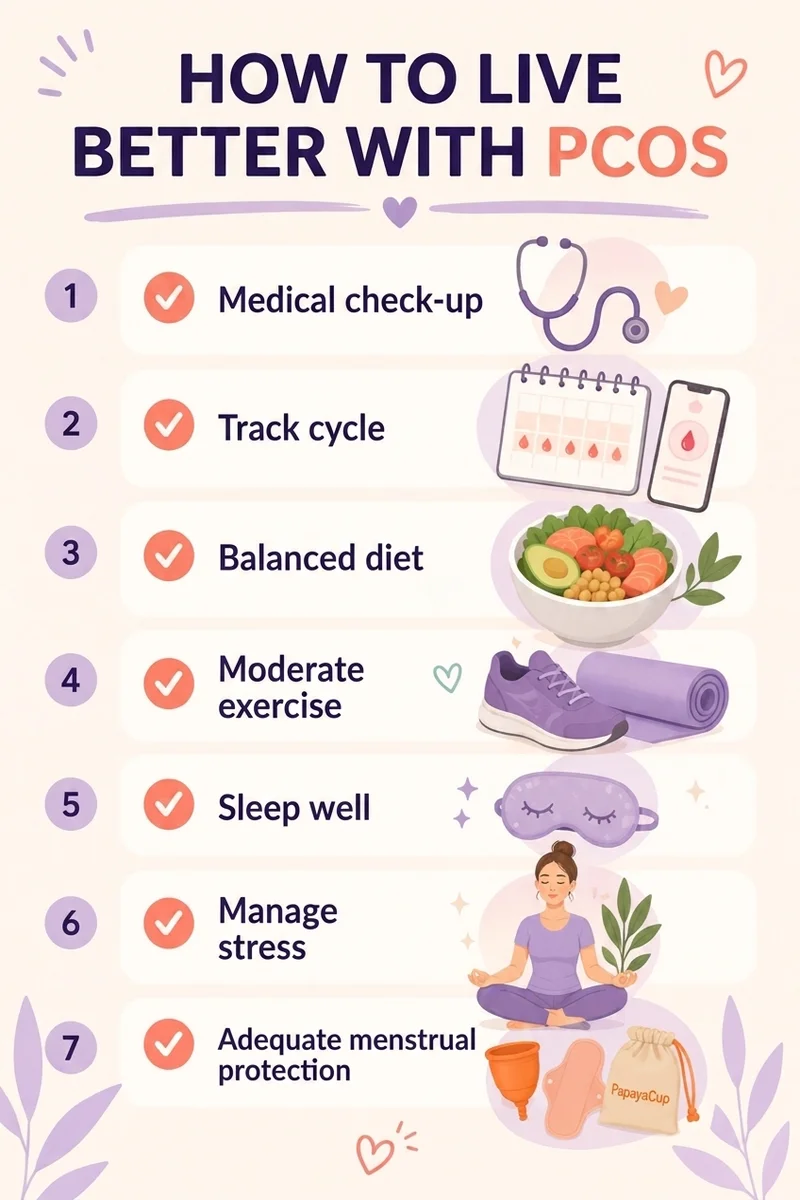
Step by step: what you can do today
- Track your cycle. Use an app or a notebook to note when your period starts, how long it lasts, what the flow is like, and how you feel. That information is gold for your doctor and for you.
- Anti-inflammatory diet. Reducing ultra-processed foods and simple sugars improves insulin sensitivity and can help regulate your cycle. There's no need for a restrictive diet: it's about making better choices, not starving yourself.
- Regular exercise, but without excess. Moderate exercise (150 minutes per week of moderate activity) reduces insulin and androgen levels. Be careful: overtraining can also disrupt your cycle.
- Manage stress. Elevated cortisol worsens hormonal balance. Meditation, yoga, or simply going for a walk have evidence behind them.
- Adapted menstrual protection. When your period arrives, it can be heavy and unpredictable. The PapayaCup menstrual cup lasts up to 12 hours without changes and has a greater capacity than conventional tampons, making it ideal for irregular but heavy flows. If you prefer something with even more capacity, the menstrual disc is a great option.
- Follow medical guidance. People with PCOS have a higher risk of type 2 diabetes, hypertension, and, in the long term, endometrial cancer if their cycles are very irregular for years. Annual follow-up with blood tests is essential.
| Area | What you can do | Expected impact |
|---|---|---|
| Nutrition | Reduce simple sugars, increase fiber and protein | Improves insulin resistance, can help regulate cycle |
| Exercise | 150 min/week of moderate activity | Reduces androgens and insulin in the blood |
| Stress management | Meditation, breathing, sleep routines | Reduces cortisol and its effect on the cycle |
| Medical treatment | Hormonal contraceptives, metformin, letrozole | Regulates cycle, reduces symptoms, improves fertility |
| Menstrual protection | High-capacity menstrual cup or disc | Covers heavy and unpredictable flows without discomfort |
| Follow-up | Annual blood tests + periodic ultrasound | Prevention of long-term complications |
Lucía, 26 years old, medical student in Granada, has been diagnosed with PCOS for three years. At first, she tried to manage the uncertainty of her cycle with pads, which left her with chafing when her period arrived suddenly and was very intense. Since she started using the PapayaCup menstrual cup, she says the unpredictability of her cycle causes her much less stress: "I put it in at the first symptom and I no longer have to worry for hours."
Lucía · 26 years old · medical student, GranadaThe menstrual protection that adapts to your cycle, whatever it may be
With PCOS, your period can arrive suddenly and be more intense than normal. The PapayaCup menstrual cup and disc are made from certified medical silicone, last up to 12 hours without changes, and you can forget about them while they forget about you.
Certified medical silicone · Up to 10 years of lifespan · Shipping across Spain
Frequently asked questions about polycystic ovaries
Polycystic ovaries or Polycystic Ovary Syndrome (PCOS) is a hormonal disorder that affects 8-13% of people with ovaries of reproductive age. It is characterized by an excess of androgens, irregular menstrual cycles, and immature follicles in the ovaries. It is not a curable disease, but it can be effectively managed to significantly reduce its symptoms and long-term consequences.
Not always, although it is one of the most common symptoms. There are people with PCOS who have relatively regular cycles but present excess androgens or the typical ovarian pattern on ultrasound. However, the most common scenario is cycles longer than 35 days, fewer than 8 periods a year, or periods of amenorrhea (absence of menstruation for 3 months or more).
PCOS is the most common cause of ovulatory infertility, but it does not prevent pregnancy. Many people with PCOS conceive naturally or with relatively simple treatments like ovulation induction. If you have been trying for more than 12 months without success (6 months if you are over 35), consult a fertility specialist.
Yes, absolutely. The menstrual cup is made of certified medical silicone, is hypoallergenic, and does not interfere with PCOS or its treatments. It is especially useful when the flow is heavy or unpredictable: it can hold up to 12 hours and has a greater capacity than conventional tampons. If you also use an IUD, consult your gynecologist before using the cup, although in the vast majority of cases, there is no incompatibility.
People with PCOS often have periods that, when they arrive, are heavier than usual. The PapayaCup menstrual cup and the menstrual disc are excellent options: high capacity, up to 12 hours of continuous use, and medical silicone that does not cause irritation. The size depends on anatomy, not flow. In our store, you will find the size guide and personalized assistance.
If PCOS is controlled and there is no immediate intention of pregnancy, it is usual to have an annual gynecological check-up with hormonal analysis and glucose and insulin monitoring. PCOS increases the risk of type 2 diabetes and endometrial hyperplasia in the long term, so follow-up is important even if you feel well.
Directly at PapayaCup, where you will find menstrual cups and menstrual discs made of certified medical silicone, priced between €20 and €25 and with a lifespan of up to 10 years. We ship throughout Spain with a guarantee included and personalized support to resolve any questions about use, size, or specific situations like PCOS.
Your cycle, even if irregular, deserves the best protection
Now you know how PCOS affects your menstruation and what you can do about it. The next step is to have protection that suits you: certified medical silicone, up to 12 hours without changes, and a guarantee included. At PapayaCup, we help you choose yours.
See PapayaCup products →Certified medical silicone · Guarantee included · Shipping throughout Spain