



Premenopause Symptoms: Complete Guide
3 de August de 2026
How to talk to your daughter about her period without it being awkward
3 de August de 2026
Itching, burning, irritation... is it an allergy to the menstrual cup or something else? We explain what the evidence says and how to tell the difference.
Inhaltsverzeichnis
- Itching, burning, irritation... is it an allergy to the menstrual cup?
- Does the menstrual cup allergy really exist?
- Materials of the menstrual cup and their relation to allergies
- What to check before buying a menstrual cup
- Symptoms of menstrual cup allergy
- Allergies to sanitary products: a broader context
- How to perform a tolerance test before using it
- Myths and realities about menstrual cup allergies
- How to choose and use a menstrual cup safely
- Medical silicone, no surprises
- Frequently asked questions
Itching, burning, irritation... is it an allergy to the menstrual cup?
You start using the cup and within a few days you notice itching, redness, or burning. The first question that arises is always the same: do I have a menstrual cup allergy? The short answer is that it is possible, but much less common than is often thought, and in most cases, there is a different explanation behind the discomfort. In this article, we review what the available evidence says about allergies and intimate hygiene materials, how to differentiate a real allergy from simple irritation, and what to do if you suspect your body does not tolerate the material well.
Does the menstrual cup allergy really exist?
Yes, but it is rare. Most menstrual cups on the market are made from medical-grade silicone, a material considered hypoallergenic because it rarely triggers immune system reactions. True allergic reactions usually occur with specific materials, not with medical silicone itself, which is an inert material: it does not release particles or interact significantly with vaginal tissues.
This does not mean that every discomfort should be dismissed outright. What is true, and worth keeping in mind before drawing conclusions, is that the body can react poorly to many things surrounding the use of the cup without the material itself being the problem.
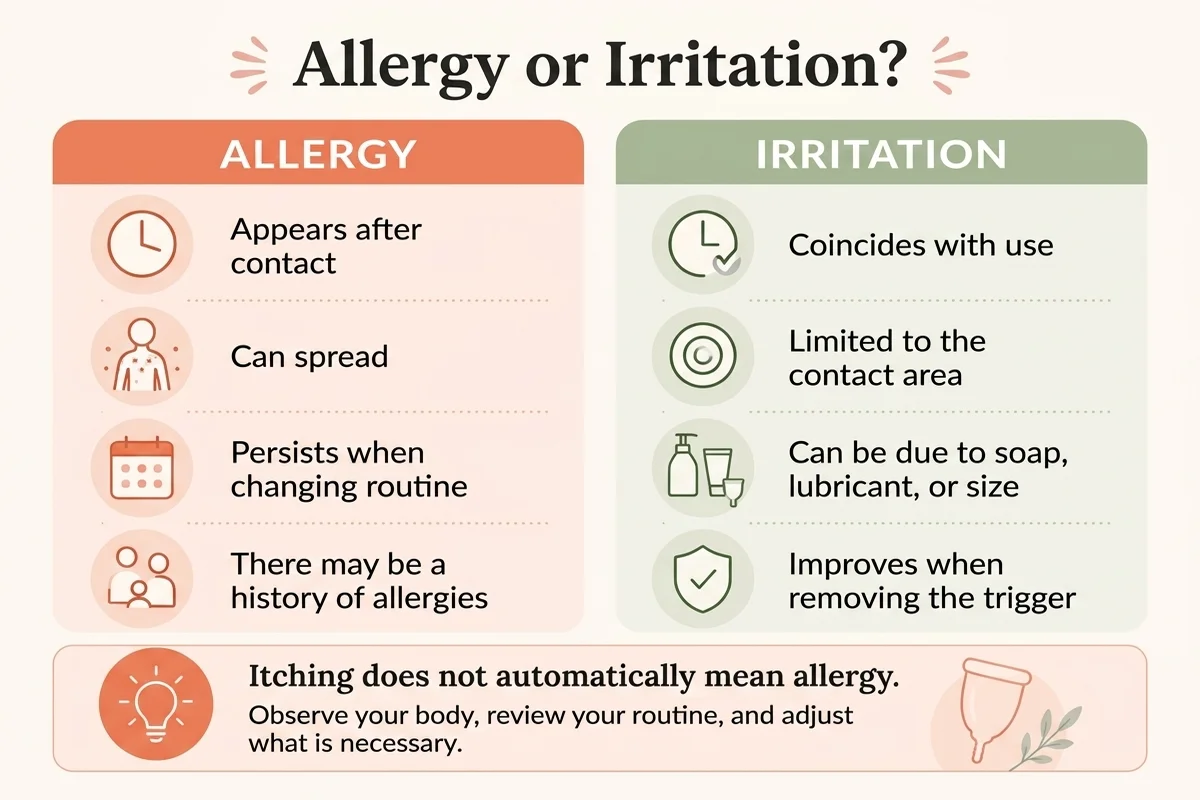
Many of the discomforts attributed to "menstrual cup allergy" are actually contact irritations. Reactions to soap, lubricant, residues from sterilizers, or simply to an incorrect size or placement technique. A real allergy involves an immune system response. Irritation does not, and that is why its management is also different.
Materials of the menstrual cup and their relation to allergies
Not all menstrual cups are made from the same material, and this makes a real difference in the risk of reaction. Before buying any cup, it is worth checking the technical specifications and not assuming that "silicone" always means the same thing, as there are also lower quality blends with additives that can indeed cause discomfort.
Biocompatible and inert material. True allergies are extremely rare.
Thermoplastic elastomer, also inert. Allergies are even rarer than with silicone.
The material with the most documented cases of real allergy mediated by the immune system.
*Qualitative guideline scale (low/medium/high), not a statistical percentage of actual incidence.
People with a known latex allergy —or with cross-allergies to foods such as avocado, banana, kiwi, or chestnuts— are more likely to also develop a reaction to latex intimate products. Therefore, the general recommendation from professionals is to avoid latex and opt for medical-grade silicone if there is a history of allergy to this material. It is also important to pay attention to additives: some accelerators used in the rubber manufacturing process can cause reactions even in people without a prior allergy to natural latex.
What to check before buying a menstrual cup
More than a long list of precautions, there are two specific checks that are supported by what we know about the material and by reports from other users with similar discomfort.
This is the same type of silicone used in medical devices and implants, evaluated under biocompatibility standards such as ISO 10993. If the product description only says "silicone" without further detail, you have no way of knowing if it meets that standard.
Intimate soap, lubricant, or the sterilizer itself can come into contact with your skin just as much as the cup does, and they're often left out of the equation when irritation appears. Diario Femenino points out that this is one of the most common sources of confusion: the cup gets blamed when the real trigger was actually another product in the routine.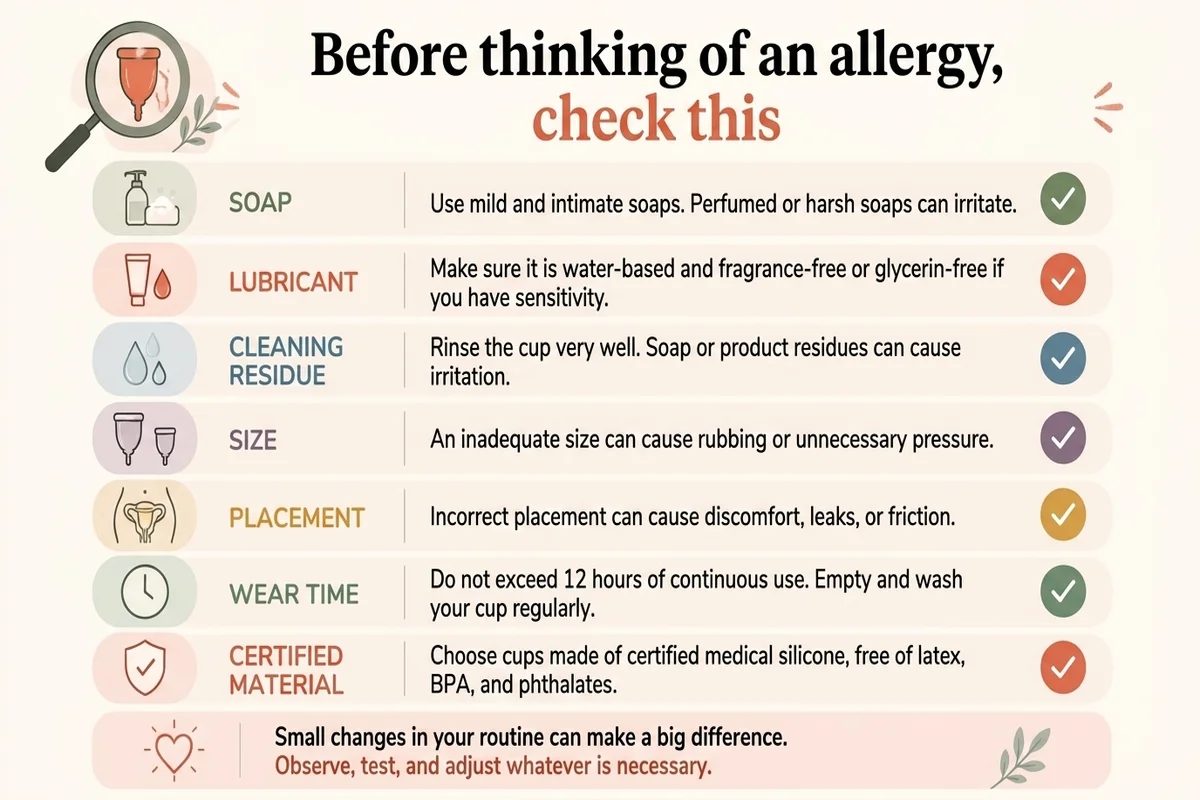
Outside of these two points, any other purchase recommendation (brand, color, specific country of origin) is a reasonable preference, but not something that the available evidence directly relates to the risk of allergy.
Beatriz
I had been using tampons for years and always ended up with itching. I thought it would be the same with the cup, but after switching to medical silicone, the irritation completely disappeared. It wasn't the cup: it was the previous material.
33 years · Madrid
Symptoms of menstrual cup allergy
The symptoms of a true allergy and those of simple irritation can seem very similar at first, but there are nuances that help distinguish them with some observation.
- Appears hours or even days after contact
- Can extend beyond the area of contact
- History of latex or certain food allergies
- Persists even if you change soap or lubricant
- Coincides in time with the actual use
- Limited to the area of direct contact
- Does not depend on previous allergic history
- Improves by changing soap, lubricant, or size
The most common symptoms, whether of one type or another, include redness, itching, burning, or small rashes on the vulva or vagina, and sometimes in the groin area. Less frequently, localized swelling or a feeling of heat in the area may also occur. If the symptoms are intense, accompanied by significant swelling or difficulty breathing, this is a medical emergency and immediate attention should be sought, as it could be a systemic reaction and not just local.
Allergies to sanitary products: a broader context
The menstrual cup is not an isolated case. Allergies to sanitary products —gloves, catheters, pads, medical devices— are a well-studied topic in allergology, and latex is by far the most implicated material. According to the Spanish Society of Allergy and Clinical Immunology (SEAIC), latex reactions occur due to prior sensitization to its proteins and typically manifest with hives and angioedema in the area of contact, potentially affecting the respiratory tract in cases of more intense exposure.
Healthcare personnel, individuals with frequent exposure to gloves or medical devices, and those allergic to certain fruits (banana, avocado, kiwi, chestnut) are at greater risk of latex sensitization, according to SEAIC.
This information is relevant for allergies in general related to intimate products: if you already know that your skin reacts poorly to latex from gloves or balloons, it is reasonable to extrapolate that caution to the menstrual cup and directly choose a medical-grade silicone model. The same applies to other intimate hygiene products that may have caused you issues in the past: scented pads, tampons with certain additives, or even your regular intimate soap may be the true source of discomfort that is mistakenly attributed to the cup.
How to perform a tolerance test before using it
Clean the cup
Before the test, wash and sterilize the cup following the manufacturer's instructions.
Hold it against the skin
Place it in contact with the skin of your arm or thigh for several hours, secured with some clothing or hypoallergenic tape.
Observe the reaction
If redness, itching, or swelling appears in that area, it is a sign of a possible allergy to the material.
If there is no reaction, insert it for just a few hours
The first time, use the cup for only a couple of hours and gradually increase the time in the following cycles, paying attention to any new discomfort.
Before assuming you are allergic to the cup, check if the soap, lubricant, or the sterilizer itself could be the real cause of the irritation. Changing one variable at a time helps a lot in identifying the true source of the problem.
Myths and realities about menstrual cup allergies
Nuria
I have been allergic to latex for years, so before buying the cup, I did quite a bit of research. Once I confirmed it was 100% medical silicone, I felt much more at ease, and in fact, I have never had any reaction.
29 years · Zaragoza
How to choose and use a menstrual cup safely
Beyond the material, much of the discomfort that is confused with an allergy is due to incorrect use: improper size, poor hygiene, or excessively long usage times. At PapayaCup, we manufacture our cups from surgical-grade silicone, in Germany, and we work to ensure that each user finds the size and care routine that best suits their body. Check our size guide before purchasing, and review our user manual to ensure that cleaning and sterilization are done correctly.
If you have doubts about whether the placement is correct, this article on how to know if you have placed the menstrual cup correctly helps you distinguish a correct placement from one that may be causing unnecessary discomfort. And don't forget to always respect the maximum recommended usage time: in our guide on toxic shock syndrome and the menstrual cup, we explain why it's important not to exceed 12 hours without emptying it, regardless of the material you use.
And if after checking size, hygiene, and usage time the discomfort continues, don't keep wondering alone: a consultation with dermatology or gynecology can quickly confirm whether it is an allergy, another dermatological cause, or an infection that needs specific treatment.
In summary
Allergy to the menstrual cup exists, but it is much less common than it seems at first glance. In most cases, what is perceived as an allergy is actually irritation from other easily correctable factors. Choosing a cup made of certified medical silicone, following usage instructions, and paying attention to your body are the best guarantees. Discover the range of PapayaCup menstrual cups or explore the entire selection at PapayaCup.
PapayaCup
Medical silicone, no surprises
We manufacture our menstrual cup in Germany, using certified surgical silicone.
Frequently asked questions
No. It is uncommon, especially with medical silicone or TPE cups. Most discomfort attributed to allergy is actually irritation from other factors.
Allergy usually takes longer to appear and can extend beyond the area of direct contact. Irritation usually improves by changing soap, lubricant, or size, while allergy persists with similar materials.
Yes, as long as you choose a medical silicone model without latex, which is the recommended option for people with this allergy.
Stop using it, perform a skin tolerance test on your arm, and if symptoms persist or are intense, consult a dermatologist or allergist.
It is possible but extremely rare, as it is an inert and biocompatible material. Most actual cases of allergy are related to latex, not medical silicone.