


Itching, burning, irritation… is it an allergy to the menstrual cup?
3 de August de 2026
Menstrual cup in summer, the most comfortable way to manage your period when the heat is on
31 de August de 2026
Sooner or later, the moment arrives: your daughter is going to have her first period, and probably sooner than you think. Talking about the period naturally, before it happens, is one of the best ways to help her experience it without fear or shame.
Inhaltsverzeichnis
- How to Talk to Your Daughter About Her Period Without It Being Awkward
- Why Talk About Menstruation Before It Arrives
- When to Start the Conversation
- What to explain about the menstrual cycle
- The first period: what to expect
- Her first menstrual products
- Can a teenager use a menstrual cup or disc?
- Myths and realities about the first period
- When to consult a professional
- Support her every step of the way
- Frequently Asked Questions
How to Talk to Your Daughter About Her Period Without It Being Awkward
Sooner or later, the moment comes: your daughter is going to have her first period, and probably sooner than you think. Talking about menstruation naturally, before it happens, is one of the best ways to help her experience it without fear or shame. In this guide, we will cover when to start the conversation, what to explain based on her age, how to discuss sexual education in this context, and how to support her in choosing her first period managed with products like the menstrual cup or menstrual disc, if the time comes to try them.
Why Talk About Menstruation Before It Arrives
Many girls discover their first period without having received any prior explanation, and that lack of information is what turns a normal biological process into a frightening experience. Starting the conversation early, gradually and without waiting for her to ask, is the most repeated recommendation among pediatrics and sexual education professionals.
It is more effective to provide information in small doses over the months leading up to it than to reserve everything for a single formal conversation. This normalizes the topic, and she knows she can ask questions whenever she wants.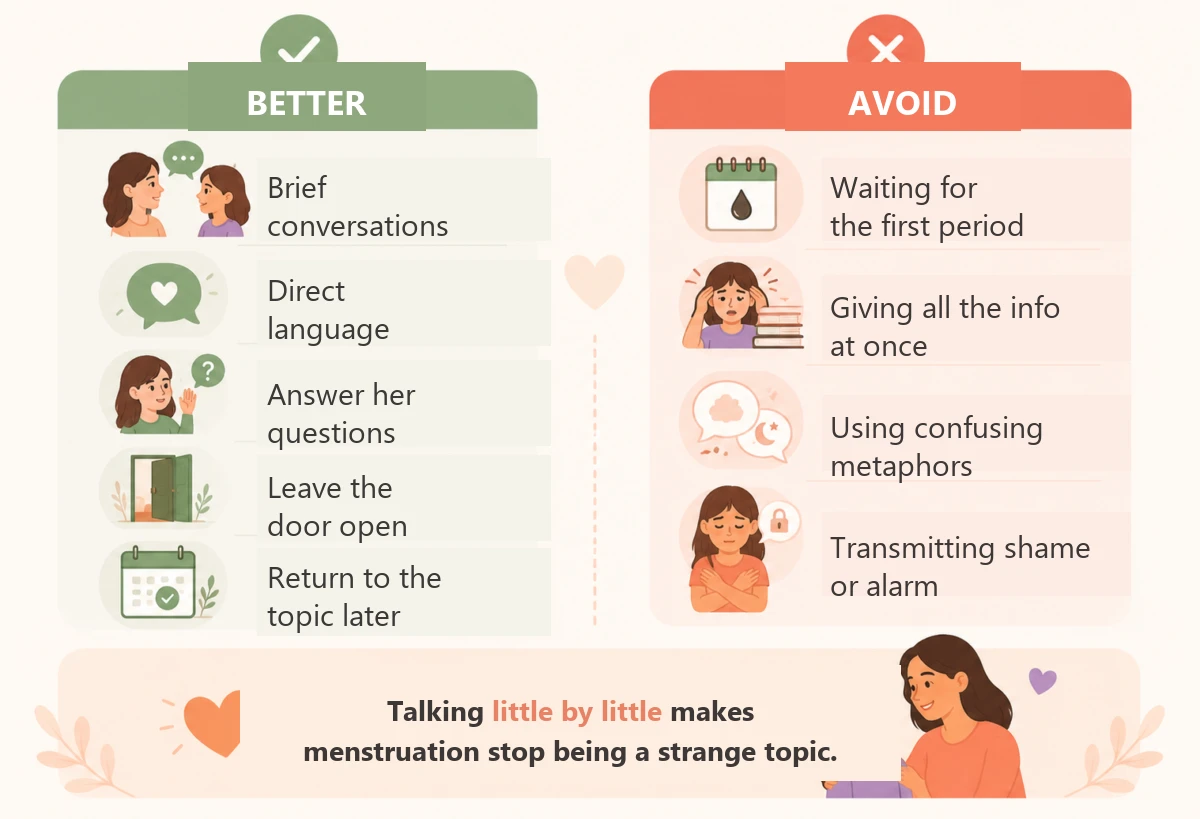
When to Start the Conversation
There is no need to wait for obvious signs of puberty to appear. The sooner the topic is normalized, the less surprise and embarrassment it will generate when the real moment arrives.
According to KidsHealth, a resource from the Nemours Foundation specializing in children's health, it is advisable to start the conversation early and gradually delve deeper as the girl grows, rather than leaving it all for a single moment.
What to explain about the menstrual cycle
It is not necessary to dive into all the hormonal details at once. The important thing is to convey the key ideas in straightforward language, without confusing metaphors or euphemisms that may raise more questions than answers.
What menstruation is
The uterus sheds its lining each month if there is no pregnancy, and that blood exits through the vagina.
Why it is cyclical
Hormones (estrogen and progesterone) prepare the uterus each month in a cycle that repeats.
What is normal
It is not an illness or something to be ashamed of: it is a sign that her body is functioning properly.
Answering her questions directly and without beating around the bush is more helpful than offering vague explanations. This is also a good time to introduce, in an age-appropriate manner, basic concepts of sexual education: for example, that menstruation is related to the body's reproductive capacity, without needing to go deeper than she asks.
Marta
I started talking to her about the topic at age 9, in small, casual conversations. When she got her period at 11, she already knew exactly what was happening and was not scared at all. She experienced it with much more calm than I did at her age.
Mother of an 11-year-old girl · Valencia
The first period: what to expect
It is helpful for both you and your daughter to know what is typical in the first cycles, so as not to panic over variations that are perfectly normal at that age.
| Aspect | What is typical at first |
|---|---|
| Duration of bleeding | Between 3 and 7 days in the first years |
| Cycle regularity | Irregular during the first 1-2 years is normal |
| Pain | At first, it is usually mild or non-existent |
| Flow amount | Variable from one cycle to another as the body adjusts |
The way you react when she gets her first period greatly influences how she will experience it. Avoid negative or pitying comments, and convey that it is a sign that her body is working well, helping her see it as a natural process rather than a problem.
Her first menstrual products
Before the moment arrives, it may be helpful to teach her what options exist, so she doesn't have to make a rushed decision on the first day.
The simplest option to start with, no insertion needed. A good way to become familiar with her own flow.
They require a bit more practice. It's important to clearly explain the maximum usage time to avoid risks.
Reusable and offers more hours of protection. It requires patience to learn how to insert it.
An alternative to the cup, with a different placement that some teenagers find more comfortable.
There is no single correct option to start: what matters is that she feels comfortable trying and knows she can switch products if the first one doesn't suit her.
Can a teenager use a menstrual cup or disc?
Yes. According to PapayaCup in their guide on how to choose a menstrual cup, there are no medical contraindications for teenagers to use a menstrual cup, regardless of whether they have had sexual relations or not. In general, it is recommended to start with a size S, designed to facilitate learning.
Review the information together
The menstrual cup size guide and the menstrual disc size guide explain how to determine which size to try first.
Practice outside of your period
Getting familiar with the fold and insertion without the pressure of bleeding makes learning much easier. The beginner's guide to the menstrual cup explains the simplest folds to start with.
Review the user manual together
The menstrual cup manual and the menstrual disc manual detail how to insert, clean, and sterilize them correctly.
Be patient with the learning curve
It's common to need two or three cycles to feel comfortable with the cup or disc. It's okay if it’s difficult at first.
Elena
My daughter started with pads, but after a few months, she wanted to try the cup because she swam and didn't want to depend on changes. We practiced together outside of her period, following the manual, and by two cycles, she was handling it on her own.
Mother of a 13-year-old teenager · Seville
Myths and realities about the first period
When to consult a professional
Most variations in the early cycles are normal, but there are signs that should be discussed with pediatrics or gynecology.
Breast development before age 8, absence of the first period beyond age 15, cycles lasting less than 24 days or more than 38, very intense menstrual pain, or bleeding so heavy that it raises suspicion of anemia risk.
In summary
Talking about menstruation and the period with your daughter before the time comes is one of the best ways for her to experience it without fear. Explain the essentials naturally, accompany her in choosing her first products, and don't rush: every girl has her own learning pace, both in conversation and in using products like the menstrual cup or the menstrual disc. Discover all the information and product range at PapayaCup.
PapayaCup
Support her every step of the way
Menstrual cup and disc made of German surgical silicone, with guides designed for beginners.
Frequently Asked Questions
It is recommended to start around ages 8-9, before signs of puberty appear, and gradually deepen the conversation over time.
Generally between ages 10 and 15, with an average age around 12, although the normal range is broad.
Yes, there are no medical contraindications related to age or sexual activity. It is recommended to start with size S and practice outside of her period the first few times.
Yes, irregularity during the first or second year after menarche is common as the body adjusts hormonally.
If she has not had her first period by age 15, if the pain is very intense, if the bleeding is excessive, or if the cycles are significantly outside the range of 24 to 38 days.