



Exercising on Your Period with a Menstrual Disc
3 de August de 2026
Itching, burning, irritation… is it an allergy to the menstrual cup?
3 de August de 2026
Discover the most common symptoms of perimenopause, why they occur, and how to manage them calmly. Complete guide with tables and practical tips.
Inhaltsverzeichnis
Symptoms of Perimenopause: Complete Guide
If your cycles have started to behave differently, if you notice mood changes that you didn't have before, or if sleep is no longer what it used to be, you may be entering perimenopause. It is not a disease or an end, but rather a hormonal transition that almost all women go through sooner or later. In this guide, we review the most common symptoms of perimenopause, why they occur, and what you can do to navigate this stage with more information and less uncertainty.
What is perimenopause?
Perimenopause, also called perimenopause, is the hormonal transition stage that precedes menopause. During these years, the ovaries gradually reduce their production of estrogen and progesterone, leading to hormonal fluctuations that affect the menstrual cycle and other body systems.
Age of onset
Typically appears between the ages of 40 and 50, according to data from Dexeus Midlife.
Duration
Its onset and duration can last around 5 years, depending on the individual.
Main cause
Progressive and fluctuating decline of estrogen and progesterone due to ovarian aging.
There is no single hormonal test that confirms the onset of perimenopause: the diagnosis is usually based on the symptoms reported by each woman, combined with the assessment of a gynecological professional. Therefore, keeping a record of your cycles and how you feel each month can be a very useful tool for detecting patterns even before visiting a doctor.
During perimenopause, you still have your period, although it is irregular and unpredictable. Menopause, on the other hand, is confirmed when you go 12 consecutive months without bleeding. It is precisely in this prior phase —with periods that still come, but without warning— where products like the menstrual cup or menstrual disc are most useful: they do not depend on a regular cycle to make sense.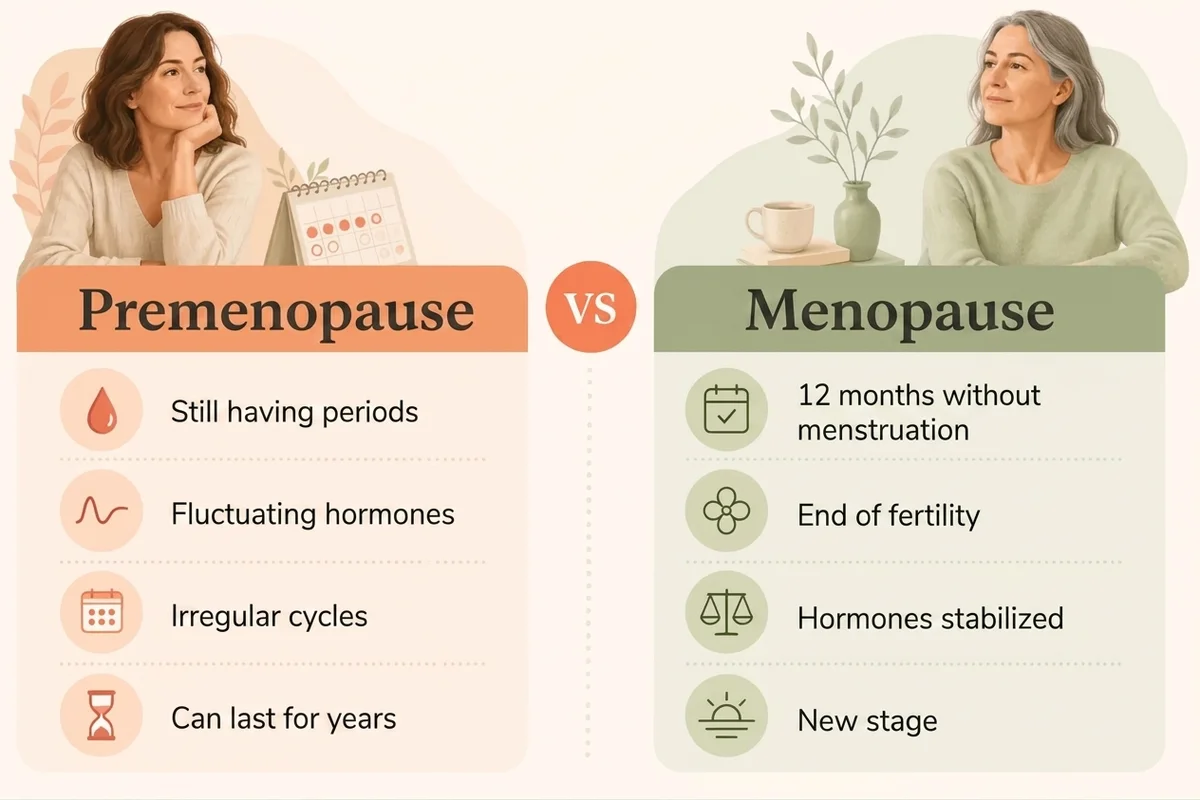
Most common symptoms of perimenopause
These symptoms vary greatly from woman to woman, both in intensity and combination. Some women barely notice changes beyond cycle irregularity, while others experience multiple symptoms at once, sometimes simultaneously and other times intermittently. To understand them better, it is helpful to group them by type.
- Hot flashes and night sweats
- Irregular cycles
- Vaginal dryness
- Joint pain
- Palpitations
- Mood swings
- Irritability
- Anxiety
- Feeling sad
- Lower stress tolerance
- Difficulty concentrating
- Occasional memory lapses
- Brain fog
- Persistent fatigue
- Insomnia or nighttime awakenings
- Daytime fatigue
- Lower overall energy
| Symptom | Approximate Frequency | Hormonal Relationship |
|---|---|---|
| Irregular cycles | Very frequent | Fluctuation of estrogen and progesterone |
| Hot flashes | Frequent | Disruption of the thermoregulatory center |
| Mood swings | Frequent | Decrease in estrogen, which affects serotonin |
| Vaginal dryness | Moderate | Lower local estrogen production |
| Insomnia | Moderate | Nighttime hot flashes and changes in progesterone |
Cristina
I started to notice that my cycles were no longer the same: some months I barely bled, and others the flow was much heavier than usual. It took me a while to connect it to perimenopause, but understanding what was happening to me relieved a lot of my anxiety.
46 years · Valencia
Changes in the Cycle and Menstrual Flow
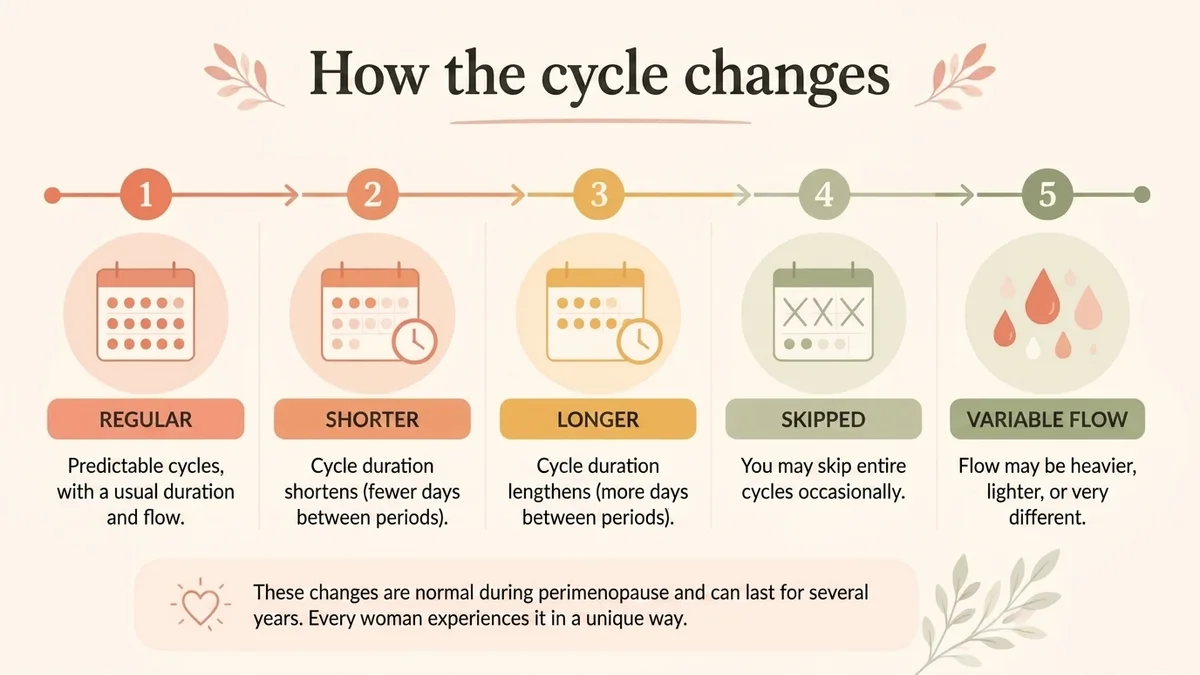
One of the changes that worries many during this stage is the irregularity of the cycle: periods may shorten, lengthen, be skipped entirely, or come with a much heavier or lighter flow than usual. This is because ovulation becomes less predictable as the reserve of ovarian follicles decreases, which also explains why some months there are anovulatory cycles and bleeding behaves differently than expected.
These changes in flow make many women reconsider which menstrual product to use. As long as you continue to have periods —even if they are irregular— both the menstrual cup and the menstrual disc allow for better adaptation to this variability: since they are not single-use products, they do not depend on calculating how many pads or tampons you will need in a cycle that no longer follows a fixed pattern, and their collection capacity is especially helpful during heavier bleeding months. Only when menopause is confirmed —and bleeding completely stops— do they cease to have this use.
If your cycles have become irregular, always carrying a cup or a menstrual disc with you reduces the uncertainty of not knowing when or how much you will bleed.
Myths and realities about perimenopause
When to consult a professional
Very heavy or prolonged bleeding
If you soak a pad or cup every hour for several hours, or if the bleeding lasts more than 7 days.
Symptoms affecting your daily life
When hot flashes, insomnia, or mood swings significantly interfere with your daily life.
Bleeding between periods
Any bleeding outside your usual cycle warrants a gynecological check-up to rule out other causes.
Questions about hormonal treatment
If these symptoms are intense, there are medical options that can help you manage them.
Rosa
The night sweats left me exhausted, but what I struggled with the most was the irritability. Talking to my gynecologist and understanding that it was part of perimenopause helped me not to blame myself for feeling this way.
49 years · Bilbao
Caring for Your Well-Being During Perimenopause
These changes are not just physical: the emotional impact of this stage is real and deserves the same attention. Taking care of rest, maintaining an active social life, and seeking calm spaces helps navigate these years with more stability, just as it does with other hormonal transitions throughout a woman's life.
If you are interested in delving deeper into how other aspects of your body change during this transition, our blog also explains how female libido changes and what hormonal factors influence sexual desire throughout life. And if you are looking for tools to support your emotional well-being during this stage, this selection of books on female emotional well-being can be a good starting point.
According to specialists from Dexeus Midlife, a medical unit specialized in women's health during this stage of life, the intensity and combination of perimenopausal symptoms depend on the body, lifestyle, and life stage of each woman, so a personalized medical assessment is key to distinguishing these changes from other possible causes.
In Summary
Perimenopause is a transitional stage, not a problem to be solved all at once. Understanding it allows you to anticipate, talk to your doctor with more information, and adapt practical tools, such as the menstrual cup or menstrual disc, to a cycle that no longer follows the same rules as before. There’s no need to go through this stage with resignation or alarm: it’s simply another phase of the body, with its own rhythms and needs. Discover the full range of menstrual products at PapayaCup.
PapayaCup
Adapt Your Cycle to This New Stage
Menstrual cup and disc made from German surgical silicone, designed to support you even when your cycle becomes unpredictable.
Frequently Asked Questions
Generally between the ages of 40 and 50, according to data from Dexeus Midlife, although some women notice the first changes before that age.
They usually last around 5 years, until a full year passes without menstruation and menopause is confirmed.
Yes, some symptoms overlap with thyroid issues or chronic stress, so a medical assessment is advisable before assuming everything is due to perimenopause.
Yes, in fact, they are often more practical than pads or tampons during this stage, as you don’t have to calculate in advance how much flow you will have.
No. Many mild symptoms can be managed with healthy lifestyle habits, but if they are intense or affect your quality of life, there are medical options that should be evaluated with a professional.