



Why does your period hurt? Causes and how to relieve it
17 de April de 2026
Healthy Breakfasts for Women Over 40: Everything You Need to Know
15 de May de 2026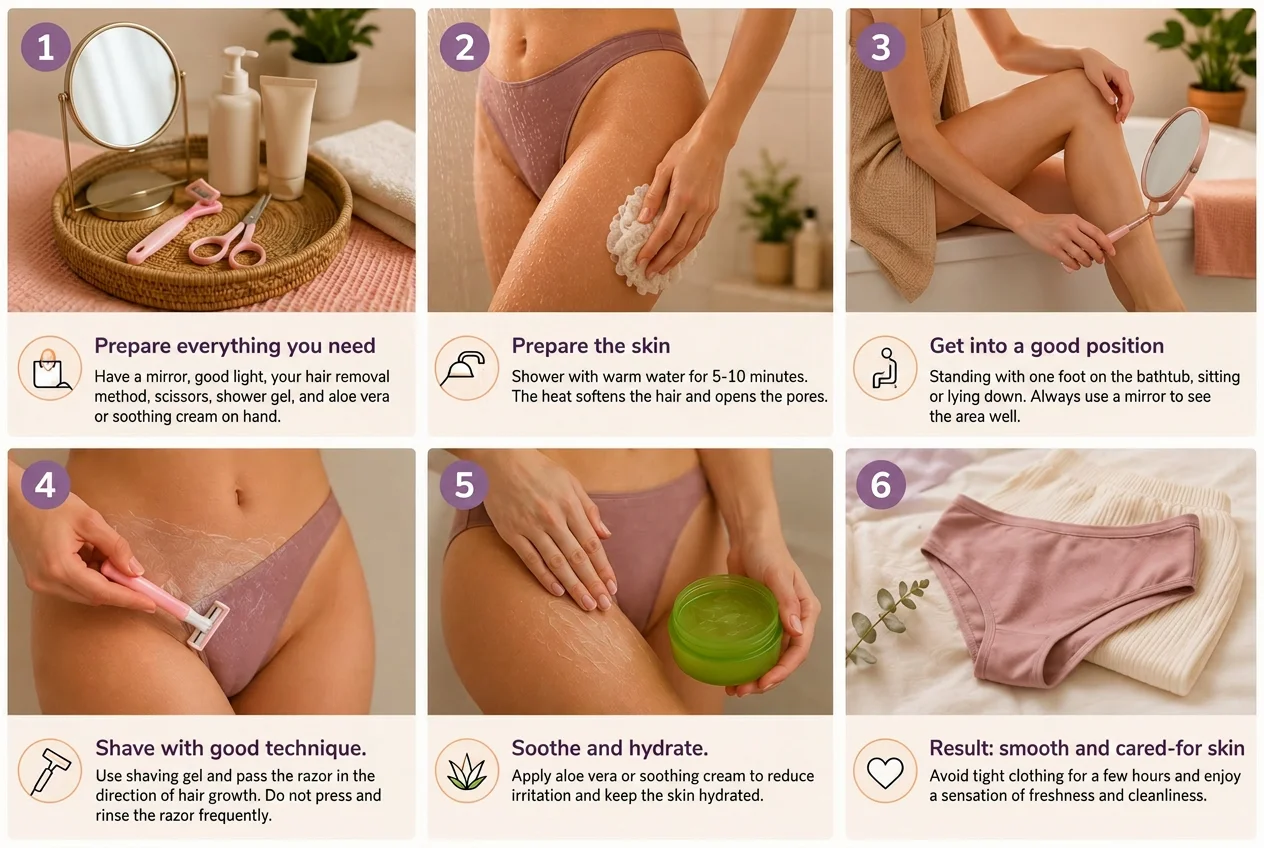
Sara is 31 years old and has been thinking about this for months. She has tried several times, but always ends up with itching, bumps, or some cuts in very inconvenient places. If this story sounds familiar, don’t worry: in this guide, I’ll tell you how to remove female pubic hair at home without it being a drama. What do you need, how to do it step by step, what happens when something goes wrong, and how to avoid it next time? No beating around the bush.
What You Need Before You Start
Before touching anything, there’s one step that almost everyone skips, and it makes all the difference: preparing the area. At PapayaCup, we’ve been talking to women about intimate care for years —menstrual cups, cycles, everything— and what we hear most often is that no one ever explained this to them. So we start here.
The first thing is to choose how you’re going to shave. There isn’t a universally better method; there’s one that fits you best:
- Razor: the quickest and simplest. The results last a short time (2 to 3 days), but it’s the least aggressive option if your skin is very sensitive.
- Hair removal cream: no blades, no pulling. It works well if everything irritates you, but always do a patch test on your forearm 24 hours before just in case.
- Wax: the results last much longer, up to four weeks. It hurts more than the other options, but with good technique, it’s very manageable.
- Electric epilator: results similar to waxing, without the heat. Perfect for maintenance.
Comparison of Pubic Hair Removal Methods at Home
Method | Duration of Results | Pain | Ideal For | Approx. Price |
Razor | 2-5 days | None | Very sensitive skin, first-timers | 5-15 € |
Hair Removal Cream | 5-10 days | None | Sensitive skin, no prior experience | 5-10 € |
Cold Wax Strips | 3-6 weeks | Medium-high | Those seeking long-lasting results | 5-15 € |
Hot Wax | 3-6 weeks | Medium | Those with some experience | 10-25 € |
Electric Epilator | 3-4 weeks | Medium | Frequent use and maintenance | 30-80 € (one-time purchase) |
Once you have a clear method, prepare these things before heading to the bathroom:
- A handheld mirror (without this, you’re literally going in blind)
- Good lighting
- Blunt-tip scissors if the hair is long, to trim it first
- Shower gel or gentle exfoliator
- Whatever you are going to use for hair removal
- Aloe vera or soothing cream for afterward
One detail that very few people know: the pubic area is one of the most delicate parts of the body, and hair removal without the proper technique can cause irritation, ingrown hairs, or folliculitis, according to a study published in PMC on complications of pubic hair removal. That's why you can't treat it the same way as your legs, even though it may sometimes seem that way.
If you also use a menstrual cup or menstrual disc, keep in mind that the hair in the area can influence how you place and remove the device. Many users tell us that after hair removal, they feel the area is clearer and the process is easier for them.
We explain step by step how to do it right
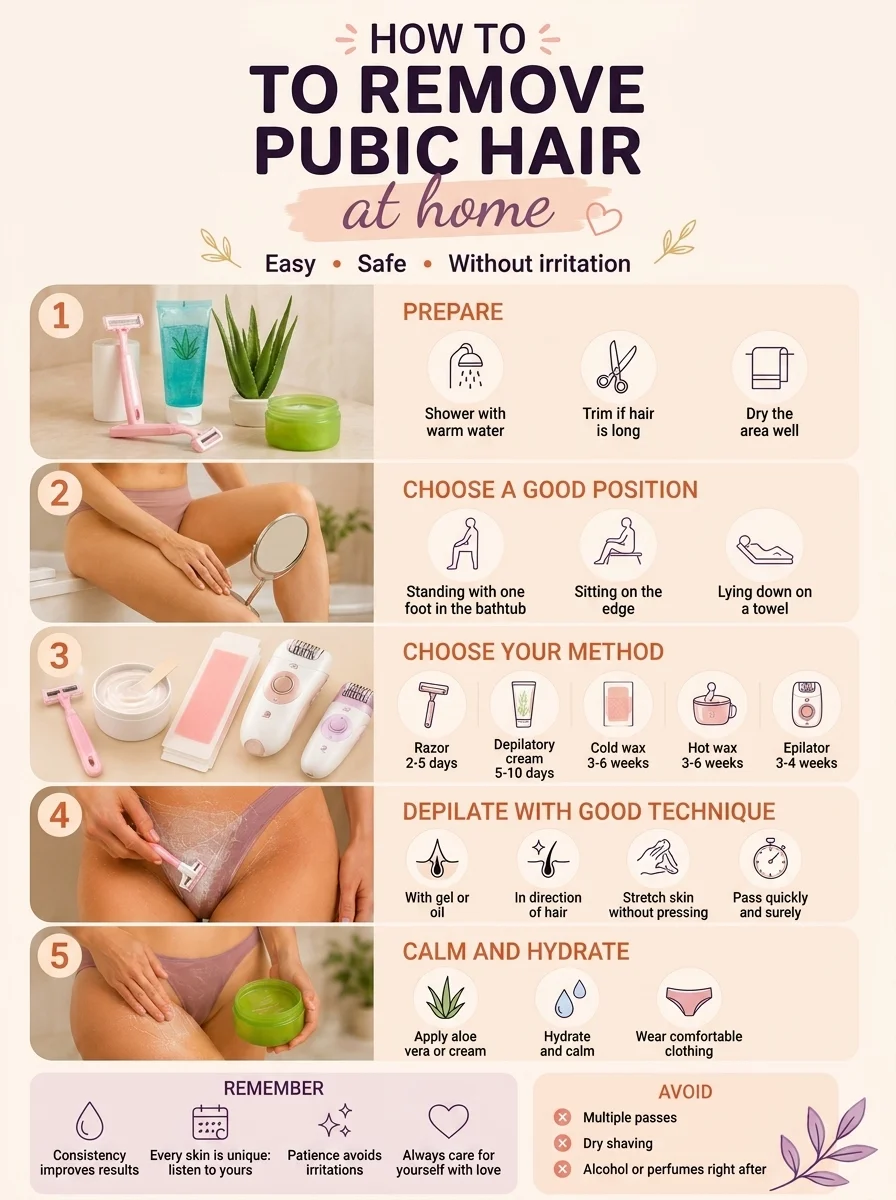
Marta is 26, studying nursing in Seville, and wrote to us fed up with always ending up with irritated skin. When we asked her how she was doing it, the problem was crystal clear: she was skipping almost everything that comes below.
Step 1: Prepare the skin
Take a warm shower before you start, at least five to ten minutes. The heat softens the hair and opens the pores, making everything much easier. If the hair is long, trim it with scissors before moving on to any method, because otherwise, wax won't grip properly and razors get clogged.
When you get out of the shower, dry yourself thoroughly. Damp skin makes the razor slip and prevents cream from working as it should.
Step 2: Get into a good position
This sounds silly, but it's not. The area has curves and folds that, if you don't stretch the skin properly, cause the razor to pull instead of glide. Try this:
- Standing with one foot propped on the edge of the tub: opens up the angle and you can see much better. This works best.
- Sitting on the edge of the tub: comfortable for the lower part and the folds of the groin.
- Lying on the floor on a towel: ideal if you're using cold wax strips, because you can control the pressure better.
And the hand mirror, always. Removing hair without seeing what you're doing is the surest way to end up badly.
Step 3: Remove hair with good technique
This changes a bit depending on what you use:
- Razor: apply shaving gel or coconut oil first, it creates a protective layer. Always go with the direction of hair growth the first time. If you want a closer shave, a second pass against the grain, but only where the skin is well stretched. Don't press down, let the blade do its job on its own.
- Hair removal cream: apply it without rubbing and respect the time indicated on the package, between five and eight minutes. Remove it with the spatula or sponge that's included, not with water sprayed directly on the area.
- Cold wax strips: warm it between your palms, place it in the direction of hair growth, stretch the skin with one hand and pull off with the other in a quick movement close to the skin. The secret is speed, not force.
- Electric epilator: use it on dry skin and move it slowly against the direction of hair growth.
Step 4: Care for the skin afterward
This is the step that's most often forgotten and the one that matters most. As soon as you finish, rinse with cold water to close the pores and reduce redness. Then apply pure aloe vera or a fragrance-free soothing cream. That day, cotton underwear, nothing synthetic that rubs. And no cologne or products with alcohol on the area for the next 24 hours.
If you use a menstrual cup and you're on your period, wait a couple of hours before inserting it to let the skin settle a bit.
When things go wrong the most common problems
Claudia is 34, works as an esthetician in Barcelona, and when she started hair removal at home, she made exactly the same mistakes she now sees in her clients every week. The most frequent ones have easy solutions.
Bumps and irritation
It almost always comes down to one of these three things: going over the same spot too many times with the razor, not using any protective product beforehand, or wearing tight clothes right after. Once it's happened, a cold compress for five minutes helps a lot. And for next time: fresh razor, shaving gel, and cotton clothing that day.
Ingrown hairs
Hair grows inward when it can't find a way out, especially if the skin is dry or after waxing. The solution is to exfoliate gently two or three days after hair removal, never the same day. If you can already see the hair trapped under the skin, release it with a sterilized needle or tweezers, without squeezing. Moisturizing the area between hair removal sessions also helps prevent it from happening again.
Razor cuts
They usually happen for three reasons: skin not stretched, old blade, or movement too fast. If you cut yourself, press with paper towel for thirty seconds. To prevent it from happening again: always stretch the skin with your free hand, use a razor with three or more blades with a flexible head, and change the blade every five to seven uses. Many women use them much longer than they should.
How to make it hurt less
The question we get most at PapayaCup about this topic is always the same: how do I make it hurt less? The good news is that pain is almost never inevitable—it has a cause and therefore has a solution.
- Choose the right time of the month. Right before your period and the first few days, skin is more sensitive due to hormonal changes. If you can choose, remove hair in the second week of your cycle, around day 8 to 14, which is when pain threshold tends to be highest.
- Never on dry skin. Without gel, oil, or foam, the blade drags the skin instead of gliding. That's where the immediate burning comes from.
- Wax on warm skin. If you apply it on cold skin, it hurts more. The pre-shower is important for this reason too.
- Exhale when pulling. It's not a yoga thing: releasing your breath right at that moment relaxes the muscle and the pain really does decrease. Try it and you'll see.
- Moisturize between sessions. Well-hydrated skin gives better and you need fewer passes with whatever method you use. An unscented cream every two or three days on the area makes a big difference.
- Don't force it too soon. With wax especially, wait until the hair is at least 3 or 4 millimeters long. Trying to remove hair that's too short hurts more and the results are worse anyway.
Conclusion: take care of that area as well as the rest
Removing pubic hair at home can be completely normal and drama-free, as long as you do it at your own pace, with what works well for your skin, and without skipping the steps that truly make a difference.
And if you are close to your period or already have it, keep in mind that your skin may be more reactive than usual. Sometimes the irritation you feel in that area is not only related to hair removal: the skin irritation during menstruation can stem from other causes that are also worth knowing.
At Papayacup, we have been supporting women in caring for their intimate area without taboos and without beating around the bush for years. If you haven't tried the menstrual cup yet, after reading this, it might be a good time to give it a chance. It's comfortable, sustainable, and once you get the hang of it, there's no turning back. If you have any questions, our team is here to help you personally.
Frequently asked questions about pubic hair removal at home
Not at all. It's a completely personal decision, and there is no medical reason that says you have to do it. Pubic hair exists for a reason: it protects the area from friction and external agents. If you decide to remove it, let it be because you want to. And if you choose not to, that's also a valid option.
Yes, if you do it carefully. The area is more delicate than other parts of the body, so it deserves a little more attention. The most common issues—irritation, ingrown hairs, some cuts—can almost all be avoided by following the correct steps. If you have any skin condition in the area, consult your dermatologist first.
A razor with protective gel is the least painful option. Depilatory cream also doesn't hurt if there is no allergy. Waxing is the most uncomfortable at the moment, but it provides the most long-lasting results. If you are very sensitive, start with the razor and see if you want to try other methods.
It depends on what you use. With a razor, the result lasts between two and five days. With cream, between five and ten. With wax, between three and six weeks depending on how your hair grows. The important thing is not to force it before the hair reaches the minimum length for the method you are using, because that will only lead to more irritation and worse results.
Yes, no problem. Just wait a couple of hours for your skin to settle before putting it on. Many Papayacup users tell us that removing hair makes it much easier to insert and remove the menstrual cup, especially at first. If you notice any unusual discomfort, consult your gynecologist.