


How to know if you’ve inserted your menstrual cup correctly? Complete guide with signs and troubleshooting tips.
18 de May de 2026
Premenstrual syndrome (PMS) vs. premenstrual dysphoric disorder (PMDD): what’s the difference?
29 de June de 2026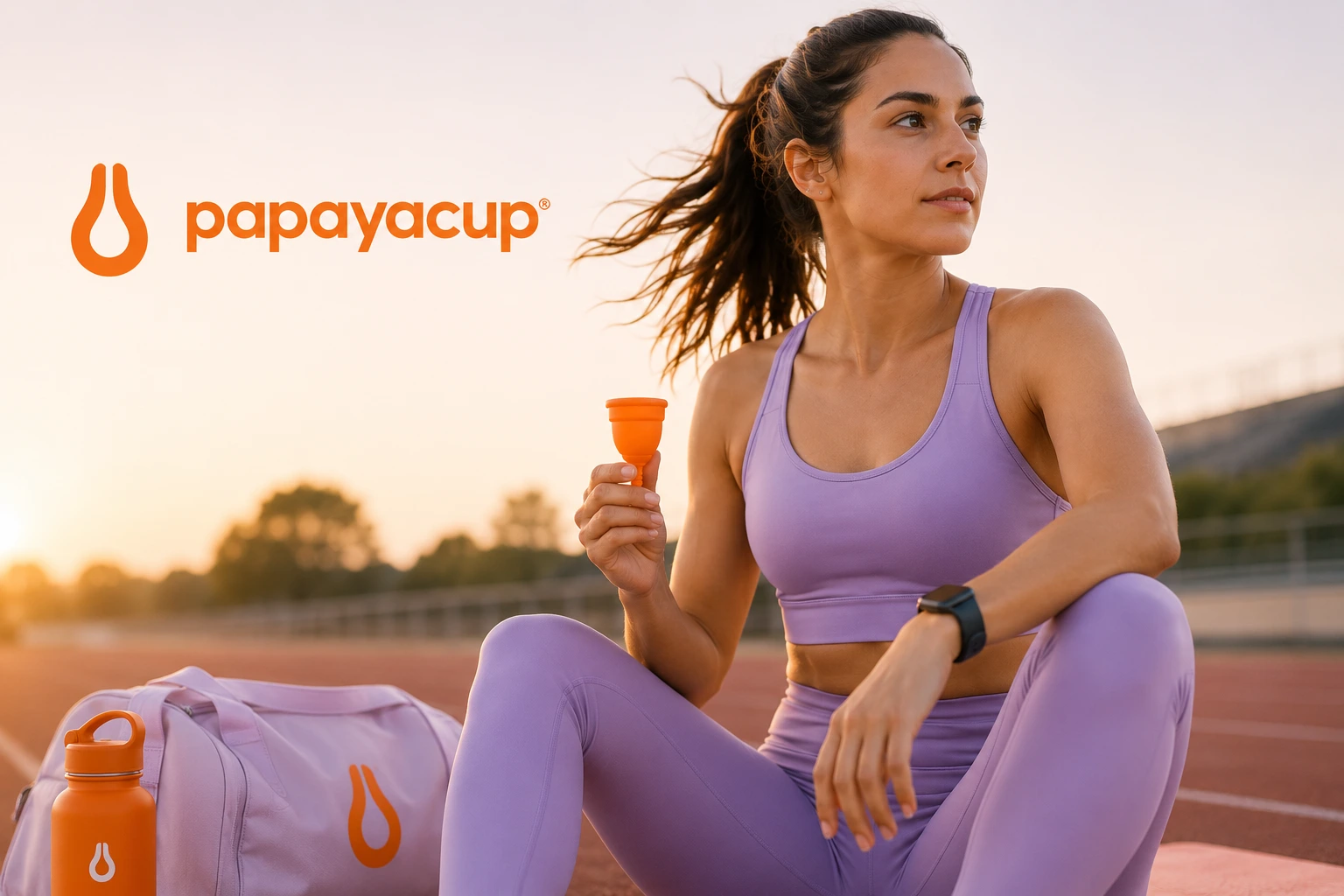
Here you will learn to understand your menstrual cycle as a performance tool, to adapt your training and nutrition to each phase, and to choose the most comfortable protection for training without limitations.
Inhaltsverzeichnis
- Menstruation and High-Performance Sports — Cup, Disc, and Cycle: Everything You Need to Know
- Can You Train at Maximum During Menstruation?
- The 4 phases of the cycle and what they mean for your training
- How to use the menstrual cup or menstrual disc if you train at a high level
- Table: training according to the cycle phase
- Common Mistakes Athletes Make Regarding Menstruation and Training
- Common Questions Athletes Have About Menstruation and Performance
- The menstrual protection that adapts to your performance
⚕️ This article is for informational purposes and does not replace medical consultation. Always consult your gynecologist with any questions.
Menstruation and High-Performance Sports — Cup, Disc, and Cycle: Everything You Need to Know
There are weeks when you soar in training and others when your body simply doesn't respond the same way. The load is the same, the rest is too, and yet something feels off.
Can You Train at Maximum During Menstruation?
This is the question we receive most from athletes at Papayacup: do I need to lower the intensity when I have my period? The short answer is that it depends — and the long answer is much more interesting.
There is no scientific evidence indicating that menstruation is an impediment to high-performance sports. In fact, a systematic review published in Frontiers in Physiology (2021) on the menstrual cycle and female athletic performance concluded that hormonal fluctuations affect performance differently depending on the athlete, and that the menstrual cycle is a relevant factor to consider in the individualization of training.
Claudia, a 22-year-old swimmer from the Club Natació Barcelona, told us that for years she thought her low energy during the first days of her cycle was a lack of willpower. When she started tracking her training alongside her cycle, she discovered a clear pattern: those days she wasn't training less, but rather needed a different type of effort to achieve the same result.
What does change are the energy levels, pain tolerance, and recovery capacity, and you can use that to your advantage. The key is not to train less: it’s to train better according to the phase of your cycle.
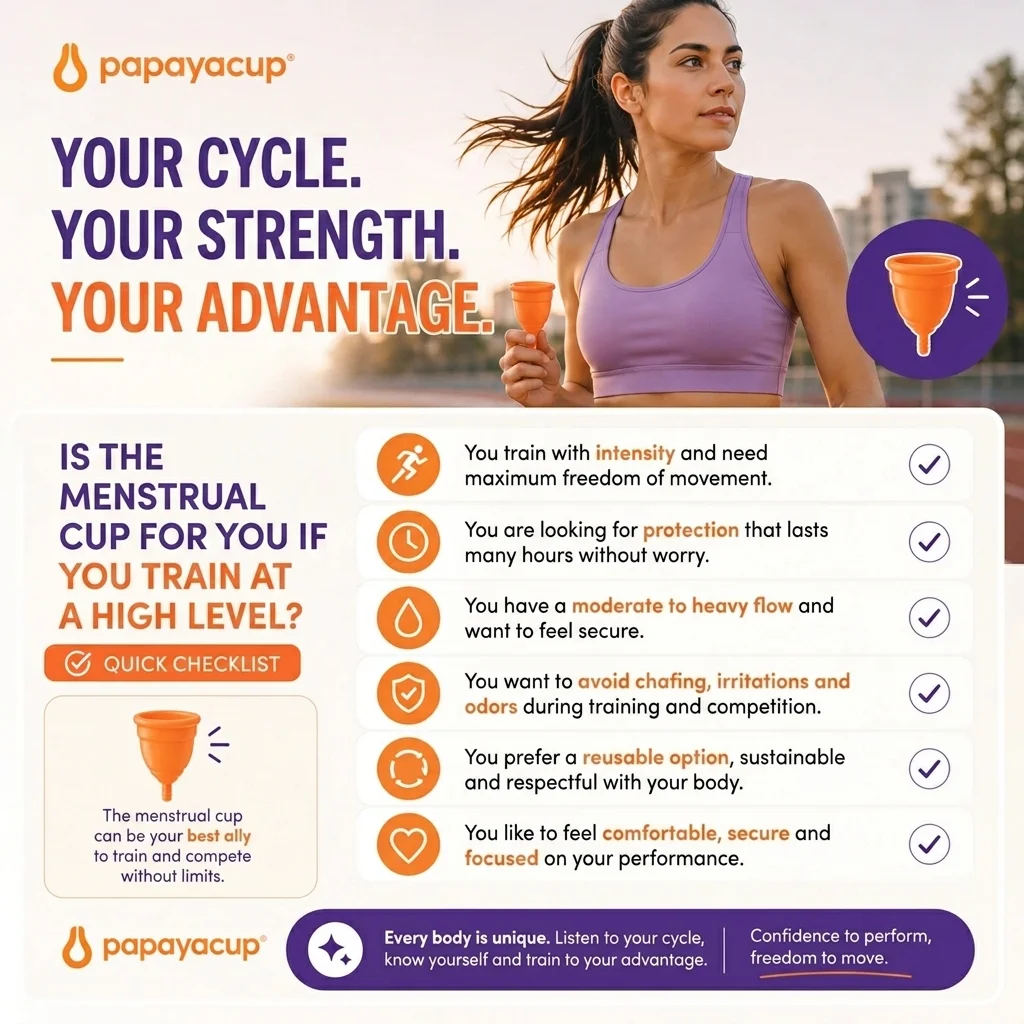
Regarding menstrual protection, the menstrual cup is the favorite option for most athletes because it doesn’t move, doesn’t cause chafing, lasts up to 12 hours without needing to be emptied, and is completely discreet under any gear. If you have doubts about whether it’s right for you, in our article on menstrual cup or menstrual disc: which fits better you will find all the information.
The 4 phases of the cycle and what they mean for your training
Understanding your cycle is like having a personalized performance calendar. Each phase has a distinct hormonal profile that directly affects your strength, endurance, recovery, and mood.
Low estrogen and progesterone. Reduced energy, increased sensitivity to pain. Ideal for mobility, technique, and low intensity.
Rising estrogen. Increasing energy, better muscle recovery. Perfect for increasing load and intensity.
Peak estrogen and LH. Strength and endurance at their highest. The best time for personal bests and competitions.
High progesterone. Increased body temperature, fluid retention. Maintain the load but prioritize recovery.
What is different for high-performance athletes
Elite female athletes often have cycles that are disrupted by training volume, caloric deficit, and physical stress. Hypothalamic amenorrhea (loss of menstruation due to excessive training or low caloric intake) is more common in this profile and is a warning sign that should not be ignored. If you have not had your period for more than three months and are training at high intensity, consult your gynecologist. More information in the guide on the Triad of the Female Athlete.
What is the same for everyone
Regardless of the sports level, all women experience the same four hormonal phases. What changes in high-performance athletes is the magnitude of the impact: high-energy days can be explosive, and low-energy days may require more noticeable adjustments. Tracking your cycle alongside your training diary is the most powerful tool available.
How to use the menstrual cup or menstrual disc if you train at a high level
Many athletes ask us if the menstrual cup or menstrual disc can withstand intense training. The answer is yes in both cases — in fact, they are the options we recommend the most for athletes, precisely because they are designed for you to forget about them.
What size to choose (cup or disc) if you are an athlete
The pelvic floor of a high-performance athlete may be more toned than usual, which sometimes makes a firmer cup work better. Before choosing, check our complete size guide where you will find the selector by physical activity. If you practice impact sports (running, jumping, CrossFit), it is especially important to check the position of your cervix.
If you are attracted to the idea of the menstrual disc, which some athletes prefer for its higher position and greater capacity, you can consult the complete size guide for the menstrual disc or directly the PapayaDisc in size S/L.
Correct position for training with cup or disc
The menstrual cup should be completely inside the vaginal canal, with the stem not protruding. The menstrual disc is placed higher, behind the pubic bone — many athletes prefer it for this reason, as it reduces the feeling of pressure during high-intensity exercise. In both cases, check the seal before starting your workout. Some athletes prefer to insert the protection before leaving home, not in the locker room, to verify it calmly.
Table: training according to the cycle phase
This table helps you plan your training weeks based on where you are in your cycle.
| Phase | Approx. Days | Load Level | Ideal Trainings | Key Nutrition |
|---|---|---|---|---|
| Menstrual | 1–5 | Low-medium | Mobility, yoga, technique, gentle swimming | Iron, natural anti-inflammatories (omega-3) |
| Follicular | 6–13 | Medium-high | Strength, HIIT, progressive endurance | High protein, complex carbohydrates |
| Ovulation | 14 | Maximum | Competition, PBs, high intensity | Quick carbohydrates pre-effort, hydration |
| Early luteal | 15–21 | Medium-high | Maintenance strength, moderate endurance | Magnesium, more total calories |
| Late luteal | 22–28 | Medium | Active recovery, flexibility, technique | Reduce sodium (retention), increase fiber |
Common Mistakes Athletes Make Regarding Menstruation and Training
At PapayaCup, we have been supporting athletes of all levels for years, and there are mistakes that are repeated time and again. Here are the most common ones so you don't make them.
- Ignoring the cycle in planning: scheduling the toughest workouts without considering the late luteal phase or the first days of the cycle can lead to overexertion and poorer recovery. The cycle is information, not an obstacle.
- Using inadequate protection: tampons dry out with the heat and dehydration from intense exercise, causing discomfort. Pads can chafe. The menstrual cup or menstrual disc prevent both issues and can handle longer workouts without you having to think about them.
- Not adjusting nutrition: the luteal phase significantly increases basal metabolism — a review in PLOS ONE (2020) with 26 studies and 318 women confirms this. Ignoring this can lead to unwarranted fatigue. Eat more on those days: it’s not a whim, it’s physiology.
- Comparing yourself to teammates: the cycle is as individual as a fingerprint. What works for your teammate may not work for you. Keep your own record.
- Training with pain without consulting: intense dysmenorrhea (menstrual pain that prevents functioning) is not normal. If the pain seriously interferes with your life or performance during the first days of the cycle, consult your gynecologist — there may be a treatable cause.
Irene, a 29-year-old cyclist from Zaragoza, spent two seasons using tampons during competition stages. The chafing and dryness were so frequent that she ended up thinking the problem was her body. Since she started using the PapayaCup menstrual cup in competition, she hasn’t had that problem again. "It's like I'm not wearing anything," she told us.
Common Questions Athletes Have About Menstruation and Performance
Does the cup or disc move during exercise?
No, if they are correctly placed and have created a seal. Both the cup and the disc use negative pressure to stay in place, without relying on gravity or body position. You can run, jump, swim, or do inverted yoga without them moving. If you have issues, check that the seal is properly created or consult the guide on discomfort with the menstrual cup.
Can I swim with the cup or disc during competition?
Yes. Both the menstrual cup and menstrual disc are completely safe in the water — unlike tampons, they do not absorb water or deteriorate. Many swimmers and triathletes from PapayaCup use them in competition without any problems.
Does menstruation affect my performance?
It depends on the phase. During ovulation, most athletes reach their peak performance. During the late luteal phase and the first days of the cycle, performance may drop slightly. Instead of fighting against it, use it: plan your most demanding sessions during the phases of highest energy.
How often should I empty the cup during a long workout?
```The cup lasts between 8 and 12 hours depending on your flow, which covers most training sessions without needing to empty it. On heavy flow days (usually the first 1–2 days), you may need to empty it halfway through a very long session. For ultras, triathlons, or competitions lasting more than 8 hours, plan to empty it at aid stations.
Where can I buy the PapayaCup menstrual cup or disc?
Directly from our online store. The price is around €20–25, with a lifespan of up to 10 years. We ship throughout Spain with a guarantee and personalized support to answer any questions about use in sports.
Is losing your period due to excessive training normal?
No, it is not normal even though it is common among high-performance athletes. Hypothalamic amenorrhea is a sign that the body is under energy stress and can have serious consequences for bone and hormonal health. If you have not had your period for more than 3 months and are training at high intensity, consult your gynecologist or sports doctor as soon as possible.
María, a 26-year-old handball player in the first division, started tracking her cycle alongside her training diary a year ago. Her coach noticed an improvement in the consistency of her matches. "Now I know exactly when I can push harder and when I need to take more care of myself. It's information, not an excuse," she explained to us.
Cup or disc — you choose
The menstrual protection that adapts to your performance
Now you know how to use your cycle to your advantage. The next step is to have the protection that doesn’t bother you: certified medical silicone, up to 12 hours without changes, and a guarantee included. At PapayaCup, we help you choose yours.
See the PapayaCup menstrual cup →Certified medical silicone · Guarantee included · Shipping throughout Spain