



How much does a menstrual cup cost? Calculate your real savings.
16 de April de 2026
Women’s intimate health: everything you need to know
16 de April de 2026
If you have an IUD and are considering switching to a menstrual cup, you’ve probably come across conflicting answers. Some websites say it’s fine, others say absolutely not, and your gynecologist may have given you a different opinion than your friend. The confusion is real and makes sense: it’s a nuanced topic that deserves an honest explanation.
Inhaltsverzeichnis
- What is the IUD and how does it work
- Where is the IUD and where does the cup go?
- The real risk: what can happen
- How to use the menstrual cup with an IUD safely
- Menstrual cup vs menstrual disc with IUD: which is the better option?
- What if I have a hormonal IUD with light flow?
- Warning signs: when to see a doctor
- Conclusion: make an informed decision, with your gynecologist and the right product
- Frequently asked questions about IUD and menstrual cup
This is what we know today, without alarm and without minimizing.
⚕️ Important: This article is for informational purposes and does not replace medical consultation. If you have an IUD and want to use a menstrual cup, always talk to your gynecologist first. She is the only person who can assess your specific case.
What is the IUD and how does it work
The IUD (intrauterine device) is a contraceptive method that is placed inside the uterus. There are two main types:
- Copper IUD: It does not contain hormones. It works as a contraceptive thanks to the effect of copper on sperm. It usually increases menstrual flow, especially in the first few months.
- Hormonal IUD (Mirena, Kyleena, Jaydess, or others): It releases a small amount of hormone locally. Over time, it tends to reduce flow, and it can even make menstruation disappear or become very light.
Both types have thin threads that hang from the cervix into the vagina. They are used for the gynecologist to check that the IUD is still in place, and they are the central concern when discussing combining it with a menstrual cup.
Where is the IUD and where does the cup go?
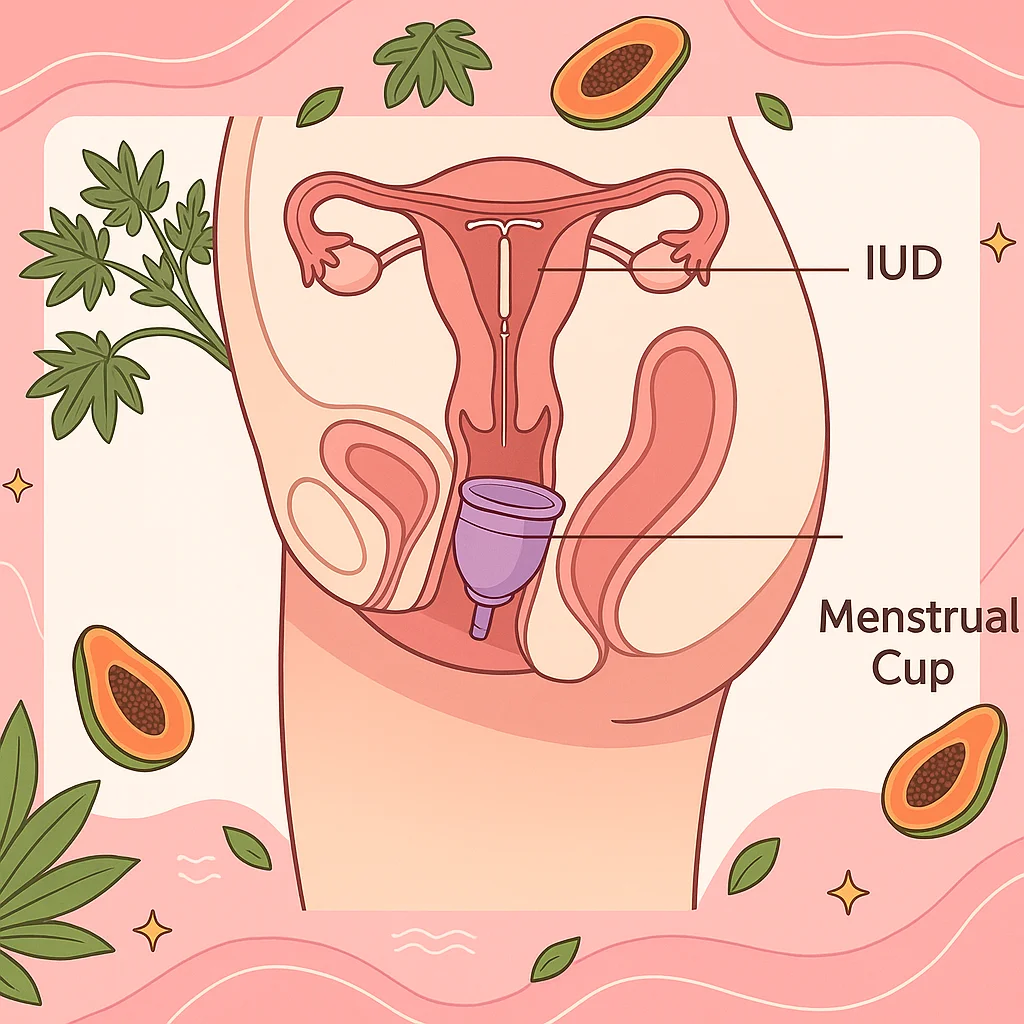
It is important to understand this so that the rest makes sense.
The IUD is placed inside the uterus. The menstrual cup is placed in the vagina. These are two anatomically separated spaces by the cervix, so under normal conditions, they do not come into direct contact with each other.
The strings of the IUD hang from the cervix to the top of the vagina. Here lies the key: if the cup is close to those strings when inserting it, or if it is removed carelessly, there may be interference.
The real risk: what can happen
The main concern has two mechanisms:
- The suction effect. When you remove a menstrual cup without breaking the vacuum seal it creates inside the vagina, that suction could transfer to the IUD strings and displace it.
- The trapped strings. If the IUD strings get caught between the cup and the vaginal wall when inserting the cup, you could unintentionally pull on the IUD when removing it.
Does it always happen? No. Can it happen? Yes, if not done carefully. The risk is not inherent to using a cup with an IUD, but mainly to removing it without breaking the vacuum first. With the correct technique, that risk is significantly reduced, although it does not disappear completely.
Factors that influence the risk:
- The length of the IUD strings: the longer they are, the more likely they are to be close to the cup
- The time you have had the IUD: the first months after placement are the most delicate
- Your cervix position: a low cervix brings the cup closer to the strings
- The size of the cup: a smaller cup is positioned further from the cervix
⚕️ Consult your gynecologist about the length of your strings and the position of your IUD before using a cup. This information greatly affects the level of risk in your specific case.
How to use the menstrual cup with an IUD safely
If your gynecologist has given the green light, here are the steps that minimize the risk:
Before you start
- Wait at least two or three cycles after the IUD placement. This is the period when the risk of spontaneous expulsion is highest, with or without a cup. Your gynecologist will tell you how long to wait in your case.
- Learn to locate your strings. Insert a clean finger into the vagina and check where the strings are. This way, you will know if anything has changed after using the cup.
- Ask if it's advisable to trim the strings. If they are very long, your gynecologist may trim them to reduce the risk of interference with the cup.
When inserting the cup
- Insert it carefully, without forcing
- Make sure the IUD strings are inside the cup, not between the cup and the vaginal wall
- Check after inserting that the strings are still where they should be
When removing it — this is the most important step
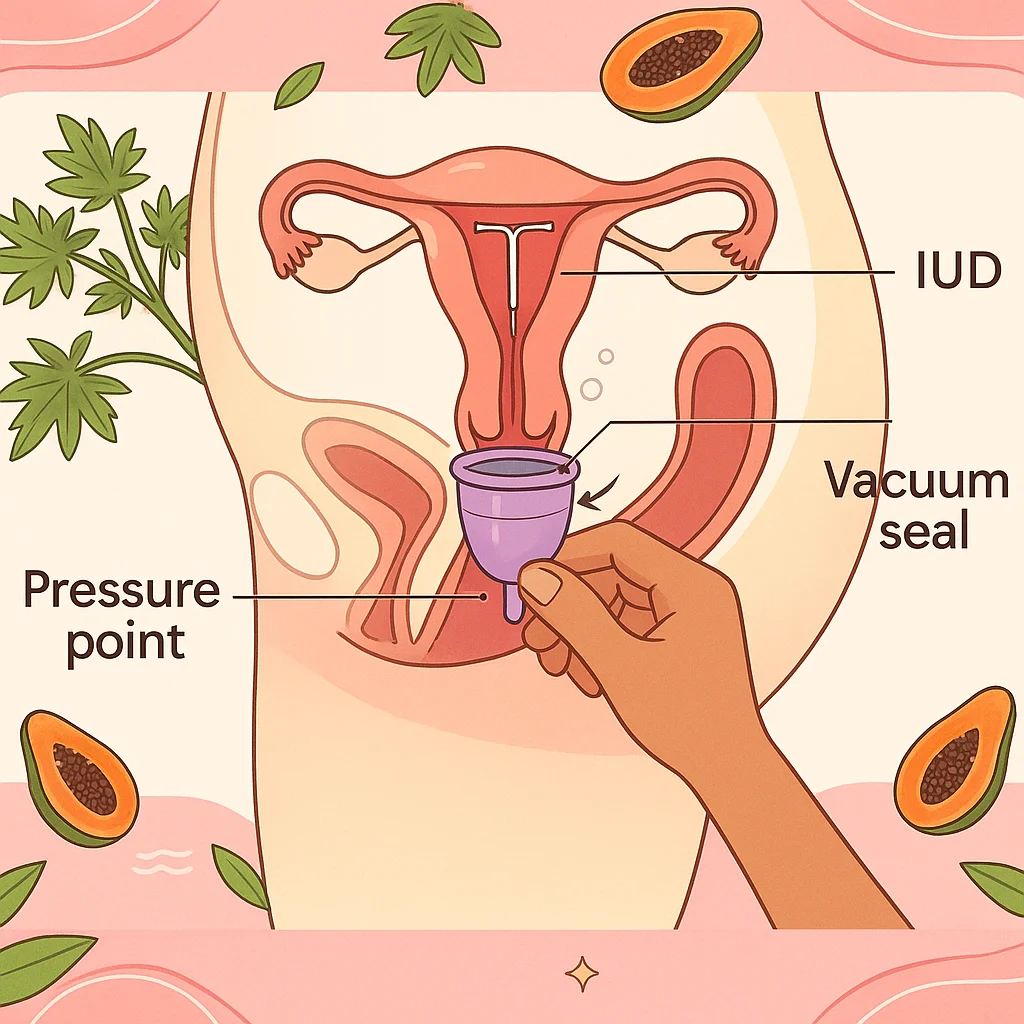
- Insert your index finger and thumb into the vagina
- Locate the base or stem of the cup
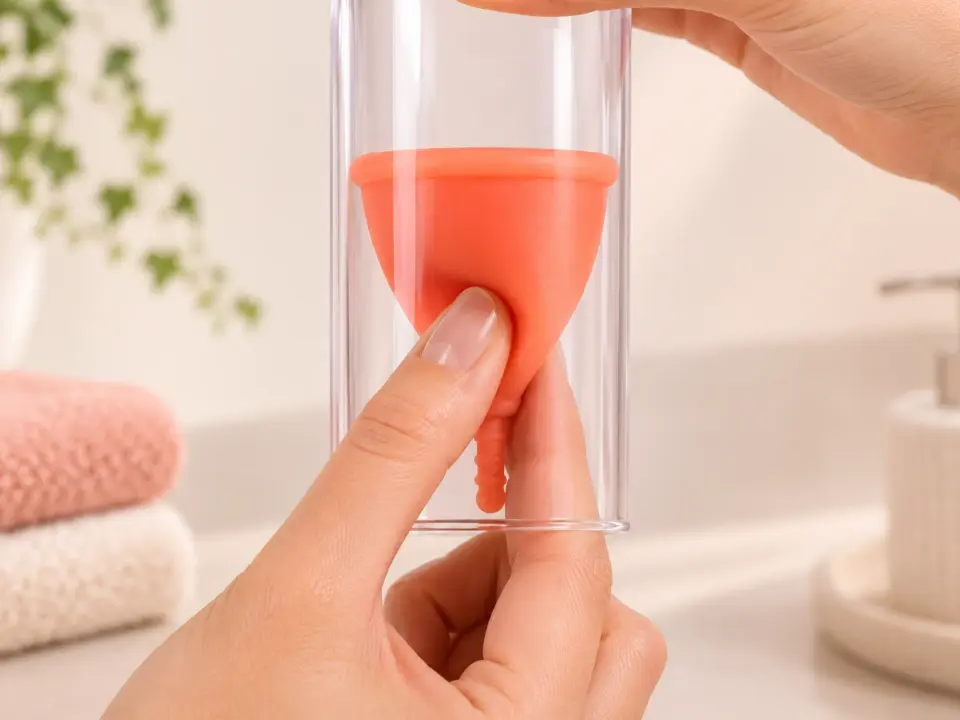
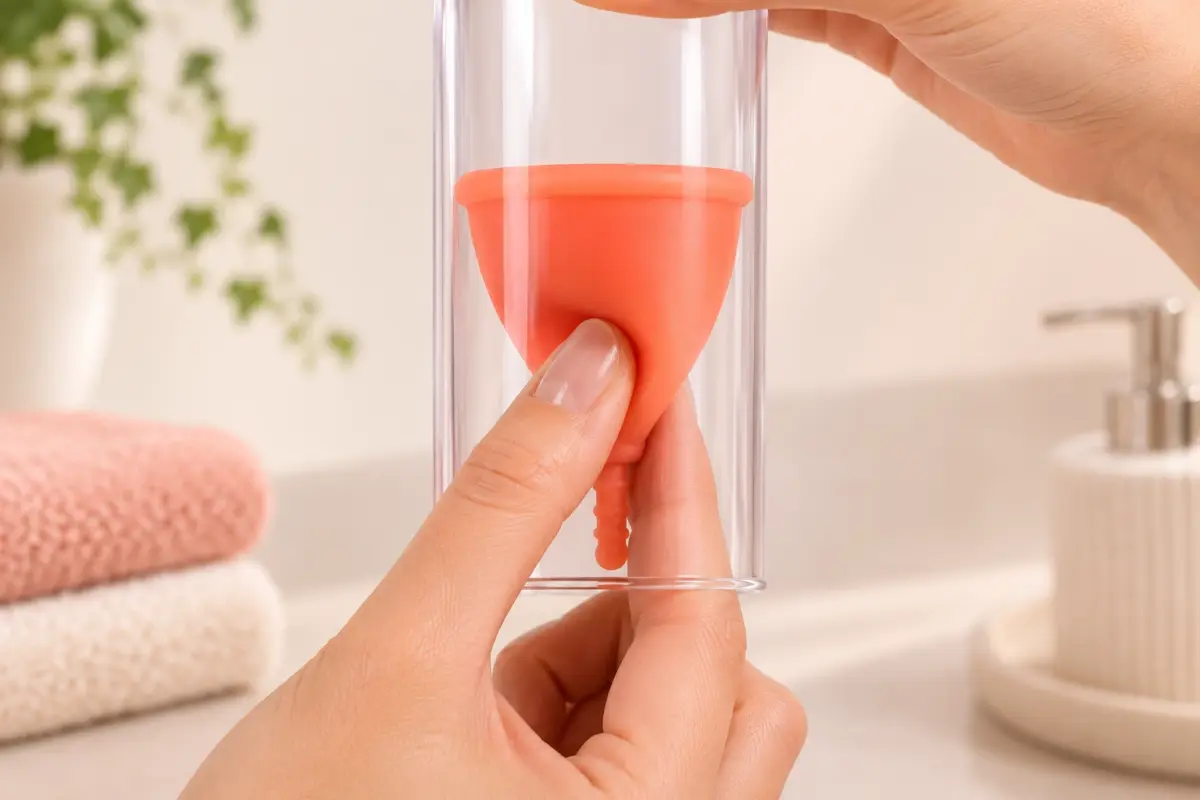
- Squeeze the base to break the suction before pulling it out. This step is non-negotiable
- Remove the cup at an angle, without pulling straight up
- After removing it, check that the IUD strings are still in their usual place
⚕️ If at any point you notice that the strings have changed in length, have disappeared, or you feel something different, see your gynecologist without waiting for the next cycle.
Menstrual cup vs menstrual disc with IUD: which is the better option?
The menstrual disc may be a more suitable alternative for people with an IUD, and it's something that is not mentioned enough.
Menstrual cup | Menstrual disc | |
Creates suction | Yes | No |
Risk of interfering with the IUD | Exists if removed incorrectly | Lower |
Position in the body | Vaginal canal | Vaginal fornix |
Capacity | High | High |
Learning curve | Medium | Medium-high |
The menstrual disc does not work by suction but by position: it is placed in the vaginal fornix, behind the pubis, and does not create the suction effect that a cup does. This eliminates the main risk mechanism associated with the IUD.
That said, there is also not enough evidence to claim that the disc is completely safe with an IUD. Caution and medical consultation apply equally.
If you want to better understand the differences between the two products before deciding, at Papayacup you have a complete guide.
What if I have a hormonal IUD with light flow?
This is a common situation. The hormonal IUD reduces flow over time, and many people who have it barely menstruate. In that case, the menstrual cup may be impractical not so much due to the risk of the IUD, but simply because there is not enough flow to make using it sensible.
If you still have some flow and want to use a cup, the same safety criteria apply. And if your flow has almost completely disappeared, you may not need any collection product.
Warning signs: when to see a doctor
If you use a menstrual cup with an IUD, pay attention to these signs:
- The IUD strings have disappeared or you notice them longer or shorter than usual
- You feel the tip of the IUD with your finger
- You notice unusual pain when inserting or removing the cup
- You have pelvic pain outside of menstruation
- You see the IUD inside the cup when removing it
⚕️ Any of these signs requires a visit to the gynecologist. Don't wait for the next cycle.
Conclusion: make an informed decision, with your gynecologist and the right product
Using a menstrual cup with an IUD is not ruled out, but it requires more attention than without it and, above all, the approval of your gynecologist. The most important factor is the extraction technique: always break the suction before removing the cup. The second most important thing is not to skip the medical consultation, which is not a formality but a real necessity.
If you prefer an option with a lower risk of interference, the menstrual disc is an alternative worth considering.
At PapayaCup you will find both menstrual cups and menstrual discs so you can choose the product that best fits your body and situation.
Frequently asked questions about IUD and menstrual cup
Many people do. The key is to always break the suction before removing the cup and to have consulted beforehand with your gynecologist, who can assess your specific case.
The general recommendation is to wait at least two or three cycles. During that period, the IUD is settling, and the risk of expulsion is higher. Your gynecologist will tell you how long to wait in your case.
In principle, it has less risk because it does not create a suction effect, but there is also not enough evidence to guarantee that it is completely safe. Medical consultation applies equally. You can see the menstrual disc from Papayacup here.
It can happen, especially if removed without breaking the suction or if the strings get caught between the cup and the vaginal wall. With the correct technique, the risk is lower, but it does not disappear. Therefore, consulting with your gynecologist beforehand is essential.
The strings change in length or disappear, you can feel the tip of the IUD with your finger, or you have pelvic pain. If you suspect it has moved, see your gynecologist without waiting for the next cycle.
In principle, yes, the risk mechanism is the same in both cases: the strings and the suction effect. The difference between the two types of IUD does not change how you should use the cup, although the hormonal one can reduce flow so much that the cup may no longer make sense.
It is an option with a lower risk of suction effect, but it is not without precautions. Consult with your gynecologist before using it. You can see the menstrual disc from Papayacup here.