



How to break the seal of the menstrual cup without pain
31 de August de 2026
Menstrual disc stuck up: how to remove it without forcing
5 de October de 2026
What is myth and what is statistical coincidence, with the cup as a way to better manage the cycle even if it doesn't sync with anyone.
Inhaltsverzeichnis
- Why is it said that periods synchronize among friends? Myth, statistical coincidence, and how to manage it better
- Where does the idea that periods synchronize among friends come from?
- What science says today about menstrual synchronization
- So, why does it seem like our periods come at the same time? Statistical coincidence
- Factors that can bring cycles closer, without being real synchronization
- Living with friends or roommates: why the topic comes up so often in conversation
- Synchronized or not, what matters is knowing your own cycle
- Practical tips for managing your period, synchronized or not
- Frequently asked questions about period synchronization
Why is it said that periods synchronize among friends? Myth, statistical coincidence, and how to manage it better
Myth, science, and tips for navigating your cycle more calmly, whether you sync with others or not.
You've probably experienced it: your period starts, and without having discussed it, a few days later your roommate or that friend you meet every week also gets her period. It's a classic conversation among friends: "Did your period come this week too?" The idea that menstruation synchronizes among women who spend a lot of time together has been circulating for decades, but how true is it? We review where this belief comes from, what science says about synchronized menstruation, why it’s likely statistical coincidence, and most importantly, why the key is not to sync with anyone but to know your own cycle, whether you have your period at the same time as your friends or not.
In this article
- Where does the idea that periods synchronize among friends come from?
- What science says today about menstrual synchronization
- Statistical coincidence: why it seems to align
- Factors that can bring cycles closer
- Living with friends or roommates
- What matters is knowing your own cycle
- Practical tips
- Frequently asked questions
Where does the idea that periods synchronize among friends come from?
The belief that menstruation synchronizes among roommates, sisters, or close friends is not new. Almost all of us have said at some point, "my period comes at the same time as my friends'," as if it were a biological rule written somewhere. It's an idea passed down from generation to generation, almost like an urban legend with the appearance of scientific basis.
The specific origin has a name and date: 1971, a study by psychologist Martha McClintock published in the journal Nature. In it, McClintock tracked 135 students living in a university dormitory and concluded that, over time, their menstrual cycles tended to align in timing. Her hypothesis was that pheromones —chemical signals we emit without realizing— could influence the cycles of those around us. Thus, the concept known today as the "McClintock effect" was born, along with the popular idea of menstrual synchronization that we still repeat among friends.
What science says today about menstrual synchronization
For years, the McClintock effect was taken for granted, along with the idea that several friends could start their periods at the same time just by living together. The problem arose when other research teams tried to replicate the experiment and failed to achieve the same results. Studies published in Psychoneuroendocrinology in 1991 and 1992 pointed out significant methodological errors in the original work, including the exclusion of participants without a clear reason, which may have artificially inflated the results.
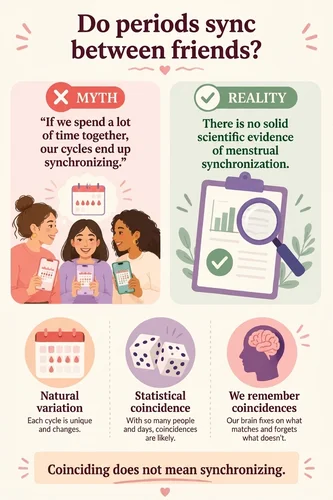
Later, research with students in Poland and China in 2006 also found no evidence that cycles synchronized by living together, pointing out that the feeling of coincidence could be explained by the natural variation of each cycle. That same year, a review published in the journal Human Nature analyzed eight studies on human pheromones and found serious methodological issues in all eight, concluding that there were "serious doubts" that these substances actually modulate the menstrual cycle.
To this day, the scientific community agrees that there is no solid evidence that menstruation synchronizes among friends. Gynecologists explain that the cycle primarily responds to internal hormonal signals, not external pheromones —whose existence in humans, in fact, is not even confirmed—.
📎 If you want to delve deeper, you can read this review of studies on menstrual synchronization on Verificat, which reviews step by step how the myth was debunked.
So, why does it seem like our periods come at the same time? Statistical coincidence
If science does not support synchronization, why do so many women claim it happens to them? Here comes into play something we almost never consider: probability.
A "standard" menstrual cycle lasts between 21 and 35 days, with an average of 28. This means that, in any given month, the first day of someone's period can fall within a fairly wide range of dates. If two friends have cycles of similar length, sooner or later their start dates will draw closer purely by probability, simply because the calendar has a limited number of possible days.
It's a principle similar to the famous "birthday paradox": in a group of just 23 people, there is more than a 50% chance that two share the same birthday, even though there are 365 possible dates. With menstruation, something similar occurs: since cycles always hover between three and five weeks, date coincidences among friends are much more frequent than intuition suggests.
| Matching Window | Approximate Probability of Overlapping Dates by Chance |
|---|---|
| ± 1 day | ~7% |
| ± 2 days | ~14% |
| ± 3 days | ~21% |
| ± 5 days | ~33% |
Additionally, we tend to remember coincidences and forget the times when it didn't coincide. If this week you and your roommate got your period at the same time, you laugh about it and it sticks in your memory. If it didn't coincide last month, you simply didn't think much of it and don't remember. It's a classic confirmation bias: we see a pattern of synchronized menstruation where there is actually just statistical noise.
Three Friends, Three Cycles: This is How Random Coincidences Are
Illustrative simulation of the period days of three friends over three months. Notice that they only clearly coincide in month 2, purely by chance.
«When my roommate and I realized that our periods were coming almost on the same day for three consecutive months, we were both amazed. Now I know it was probably just a coincidence, but we still joke about it every month.»— Marta, 27 years oldIllustrative testimonial
Factors that can bring cycles closer, without being real synchronization
Although pheromone synchronization has not been proven, there are shared factors that can make the cycles of two cohabiting people resemble each other more than expected, without any mystery:
- Shared stress: the same exams or work problems can advance or delay ovulation similarly in those going through the same situation.
- Schedules and light: sleeping and waking at similar times affects melatonin, which interacts with the hormonal axis that regulates the cycle.
- Shared diet and habits: roommates often eat similarly and share exercise routines, two factors that influence the regularity of menstruation.
- Social placebo effect: when we expect to synchronize, we pay more attention to coincidences and less to differences.
Living with friends or roommates: why the topic comes up so often in conversation
It doesn't matter if you share an apartment, office, or gym: when you spend a lot of time with the same people, it's natural for periods to become a regular topic of conversation. You share pads, tampons, or emergency menstrual cups and compare calendars. This social context makes coincidences more noticeable and discussed than if you were living separately.
However, it's important to remember that each cycle is unique. Stress, diet, exercise, certain contraceptives, or stages like perimenopause can make your cycle shorter, longer, or unpredictable, unrelated to your friends'. If your menstruation varies significantly from month to month, you might be interested in our guide on irregular periods, where we explain the most common causes.
«I was convinced that my cycle was synchronized with my three roommates until I started tracking it in an app. It turned out that each of us had a different cycle, but some months we coincided for a couple of days.»— Cristina, 24 years oldIllustrative testimonial
Synchronized or not, what matters is knowing your own cycle
Whether you synchronize with your friends or not, what’s truly useful is learning to know your own body. Noting when your period starts and ends, what your flow is like, or what symptoms accompany you provides much more valuable information than any calendar coincidence, and allows you to anticipate trips, plans with friends, or a weekend in a shared apartment with the bathroom occupied by several people at once.
This is where having a menstrual method that suits you —and not the other way around— makes a difference. A menstrual cup can be worn for up to 12 hours, doesn’t dry you out like a tampon, and makes those days when you share a bathroom with several roommates much more bearable. If you’re considering it, you have a size guide available to choose the right menstrual cup according to your anatomy and flow, without having to guess.
For those who prefer an option compatible with sexual activity during their period, the menstrual disc is another increasingly popular alternative, also with its own size guide for the menstrual disc if you want to compare which fits your body better.
| Method | Change Frequency | In Shared Bathroom |
|---|---|---|
| Pad | Every 4–6 hours | Depends on always having stock on hand |
| Tampon | Every 4–8 hours, dries out | Risk if caught outside the house |
| Menstrual cup | Up to 12 hours | Less dependence on shared bathroom |
| Menstrual disc | Up to 12 hours, compatible with sex | Discreet and flexible |
Discover PapayaCup
At PapayaCup, we design menstrual cups and discs intended to adapt to your cycle, no matter what: regular, irregular, "synchronized" with your friends, or completely independent. Medical-grade silicone, no added toxins, designed to accompany you for years, not just a few days a month.
Practical tips for managing your period, synchronized or not
- Track your cycle with an app or calendar for at least three months to understand your real pattern, beyond what happens with your friends.
- Always carry your menstrual cup or disc in your bag or travel kit, so your period never catches you off guard.
- Listen to your body’s signals —pain, mood changes, energy— in the days leading up to your menstruation.
- Don’t turn the lack of synchronization into a problem: every cycle is different, and that’s normal.
- If your cycle is very irregular or symptoms are intense, consult a gynecology professional.
Frequently asked questions about period synchronization
Is it true that periods synchronize among friends living together?
There is no solid scientific evidence to confirm this. The so-called “McClintock effect” has not been consistently replicated in subsequent studies, and recent research suggests that the coincidence of dates is mainly statistical chance.
Why does it sometimes seem like menstruation comes at the same time?
Because menstrual cycles last, on average, between 21 and 35 days, so the start dates have a good chance of aligning by chance. Additionally, we tend to remember coincidences more than the times it didn’t align.
Does living with more women affect my menstrual cycle?
There may be shared factors —stress, schedules, diet— that slightly influence it, but there is no real hormonal synchronization due to cohabitation or pheromones proven in humans.
What should I do if my cycle is very irregular and never matches anyone else's?
It's completely normal; every body has its own rhythm. If the irregularity is very pronounced or worries you, we recommend reading our guide on irregular periods and, if it persists, consulting with your gynecologist.
Does the menstrual cup help if my cycle is unpredictable?
Yes. Since it can be worn for up to 12 hours and doesn't rely on constant changes, the menstrual cup provides more flexibility when your period arrives earlier or later than expected, which is especially useful if your menstruation is irregular.
Where can I buy a PapayaCup menstrual cup or disc?
You can see the entire range available at the PapayaCup store, along with size guides to choose the product that best suits you.
Having your period at the same time as your best friend is a cute anecdote to share, not a biological signal of anything. What really matters is that you know your own cycle and have the right tools to experience it comfortably, whether synchronized with the rest of the world or not. This article is for informational purposes only and does not replace a medical consultation; the testimonials included are illustrative. Discover at papayacup.com the entire range of menstrual cups and discs that can accompany you during your menstruation.