



Cutting the menstrual disc stem, when and how to do it
5 de October de 2026
What is known about the menstrual disc and sexually transmitted infections, how the most common ones are treated, and what to ask during a consultation before using it.
Inhaltsverzeichnis
Can I use the menstrual disc if I have an STI?
You have been diagnosed with a sexually transmitted infection, you are starting treatment, and a few days later your period arrives. The question is logical, and there is rarely time to ask it during a consultation. Here we gather what has been published on the subject, which is less than we would like.
This article is for informational purposes only. It does not replace medical consultation, diagnosis, or treatment. If you have an STI or symptoms of one, make the decision to use or not use the menstrual disc with your doctor, gynecologist, or the STI center handling your case.
What studies say
The most cited trials on reusable menstrual products and sexually transmitted infections were conducted with cups in Kenya, involving school-aged girls.
In the first study, published in BMJ Open in 20161, the girls who received a cup or pads during a school year had fewer STIs than those in the control group. Among those who continued in the study for nine months or more, cup users also had less bacterial vaginosis than those who used pads.
The second study, published in eClinicalMedicine in 2023 with over 4,000 participants2, measured as a primary outcome a combination of HIV, genital herpes type 2, and school dropout, and found no differences between groups. Separately, herpes type 2 appeared in 8.6% of girls using cups compared to 12% in the control group, a difference that the authors consider on the edge of statistical significance. There were no cases of toxic shock syndrome.
Within that same trial, a sub-study with 436 participants analyzed vaginal flora. Cup users more frequently had a flora dominated by Lactobacillus crispatus, the bacteria associated with a healthy vagina, and a 24% lower likelihood of having bacterial vaginosis than those in the control group2.
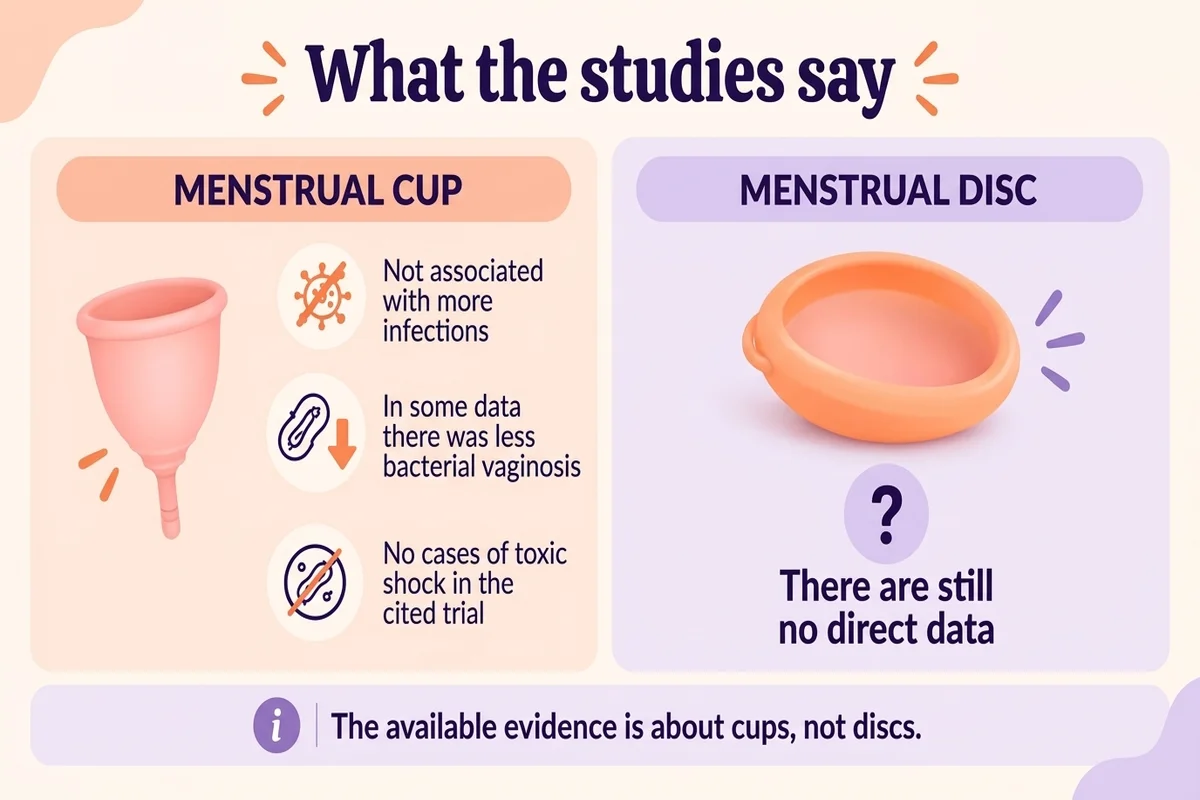
These studies were conducted with cups and not discs, in a context very different from ours. What they allow us to say is that the cup was not associated with more infections. We have not found data on the disc.
How STIs are usually treated
At PapayaCup, we are not healthcare professionals, and treatment should always be indicated by a professional. Each infection has its own protocol, but sexual health guidelines agree on some general ideas3 that help know what to expect and what to ask.
Many STIs are treated with medication, which depending on the infection can be in pills, injections, or applied inside the vagina. Others require a different follow-up that will be explained to you in consultation.
It is advisable to complete the treatment as indicated, even if symptoms disappear earlier.
In general, it is recommended not to have sexual relations until the treatment is finished, to avoid reinfection or infecting someone else.
In many STIs, recent partners should also get tested and treated, even if they do not have symptoms.
If your treatment is applied inside the vagina, ask your healthcare provider if you can use the menstrual disc at the same time.
If you have just been diagnosed with an STI
A diagnosis is usually accompanied by more tests. In the case of trichomoniasis, for example, CDC guidelines recommend also testing for HIV, syphilis, gonorrhea, and chlamydia4. Ask during your appointment if you need any additional tests.
They also recommend notifying your recent sexual partners so they can get tested and receive treatment, except in situations of partner violence3. Many infections do not show symptoms, so a partner may have one without knowing and transmit it again.
And in some infections, such as gonorrhea or trichomoniasis, it is advised to repeat the test some time after treatment, as reinfections are common3,4. Your doctor will tell you when.
What to ask during your appointment
Bringing written questions saves time and uncertainty. Here are the most relevant ones if you are using a menstrual disc:
Can I continue using the disc during treatment? What if the treatment is applied inside the vagina? If I have lesions or sores, when can I use it again? Is there anything special I need to do when cleaning it? If I am going to have a test or procedure on my cervix, how long do I need to wait?
What the PapayaCup disc guide says
The menstrual disc usage guide and the disc manual provide several instructions that still apply with an infection. The disc should be inserted with clean hands, emptied and rinsed every 8 to 12 hours depending on flow, never exceeding 12 consecutive hours, and at the end of your period, it should be washed with warm water and mild soap. To sterilize it, the microwave sterilizer should have three fingers of water and a maximum of 3 minutes, as longer may damage the silicone.
The guide also makes it clear that the disc is not a contraceptive method and does not protect against sexually transmitted infections. If you experience persistent pain, it indicates that it should be removed, as it may not be positioned correctly, and you should try again with lubricant. If the pain continues, you should consult a doctor.
To keep in mind
- Always insert and empty the disc with clean hands
- Never more than 12 consecutive hours
- At the end of your period, wash and sterilize it (maximum 3 minutes in the microwave)
- The disc does not protect against STIs
What about sex during treatment?
Although the disc allows for sexual activity during your period, CDC guidelines3 recommend not having sex while treating infections such as chlamydia, gonorrhea, or trichomoniasis, and until partners have also been treated. If your partner is a woman, you can find more information about infections among women in the article on sex between women during their period.
When to remove it and consult
If you feel pain while using the disc that does not go away when repositioning it, remove it and consult, as indicated in the disc guide. And for any new symptoms during treatment, or if symptoms do not improve, return to your health center or STI clinic.
A disc that sterilizes in three minutes
The PapayaDisc is made of latex-free surgical silicone, and the Comfort Pack includes sizes S and L along with the microwave sterilizer.
Frequently Asked Questions about the menstrual disc and STIs
Are there studies on the menstrual disc and STIs?
We have not found any. The most cited trials were conducted with menstrual cups in Kenya, and they found no more infections among cup users.
Does the menstrual disc protect against STIs?
No. As indicated in the disc guide, it is not a contraceptive method and does not protect against sexually transmitted infections.
Can I use the disc while undergoing treatment?
We have not found studies that answer this question. Consult with your healthcare provider, especially if the treatment is applied inside the vagina or if you have lesions in the area.
Can I have intercourse with the disc in during treatment?
The CDC guidelines recommend not having intercourse during treatment for chlamydia, gonorrhea, or trichomoniasis, and until all partners have been treated.
How do I clean the disc after my period?
According to the Papaya disc guide, use warm water and mild soap, and if you want to sterilize it, use the microwave sterilizer with three fingers of water for a maximum of 3 minutes.
Do menstrual cups increase the risk of infections?
In the trials in Kenya, no. In the first one, cup users had fewer STIs than the control group, and in the second, there were no differences in the main outcome, with fewer cases of herpes type 2 in the cup group and no cases of toxic shock.
We have found very few data on the menstrual disc and STIs, and the available data comes from studies with cups. If you have an infection, bring your questions to your consultation and follow the complete treatment prescribed. If you want to learn about the disc, you can find the usage guide, manual, and pack with sterilizer at papayacup.com.
Sources
- Phillips-Howard PA et al. Menstrual cups and sanitary pads to reduce school attrition, and sexually transmitted and reproductive tract infections: a cluster randomised controlled feasibility study in rural Western Kenya. BMJ Open, 2016. bmjopen.bmj.com/content/6/11/e013229
- Zulaika G et al. Menstrual cups and cash transfer to reduce sexual and reproductive harm and school dropout in adolescent schoolgirls in western Kenya: a cluster randomised controlled trial. eClinicalMedicine, 2023. doi.org/10.1016/j.eclinm.2023.102261
- Centers for Disease Control and Prevention. Sexually Transmitted Infections Treatment Guidelines, 2021. cdc.gov/std/treatment-guidelines
- Relias Media / Clinician.com. What Clinicians Should Know About Trichomoniasis Treatment (summary of the 2021 CDC guidelines on trichomoniasis). clinician.com. Original guide: cdc.gov/std/treatment-guidelines/trichomoniasis.htm
- PapayaCup. Menstrual disc: placement, use, and sexual relations guide. papayacup.com/disco-menstrual-guia