

Cystitis Symptoms and Common Causes
6 de March de 2026
How much does a menstrual cup cost? Calculate your real savings.
16 de April de 2026
Your body changes, your emotions fluctuate, and many times no one explained it to you well. Female emotional well-being is not an abstract concept or a luxury: it is the foundation for making informed decisions about your health, your cycle, and your daily life. And one of the most accessible ways to start that journey is through reading.
This selection of female well-being books brings together titles that address everything from self-compassion and emotional management to the connection between body and mood. These are not generic self-help manuals, but works with a scientific, experiential, and practical focus, designed for women who want to understand themselves better through information and not through noise.
Why reading about women's emotional wellness changes the perspective
The majority of the information we receive about our bodies during adolescence is incomplete. Topics such as hormonal fluctuations, the emotional impact of the menstrual cycle, or the relationship between diet and mood are often left out of formal education. This creates a disconnect between what we feel and what we know about ourselves.
Books on women's wellness fill that gap. They allow us to name processes we experience but do not always understand, and provide tools that go beyond superficial advice. They do not replace professional support, but they do open a door to self-knowledge that many women do not find in other formats.
Understanding how your body works is, in itself, an act of self-care. And that understanding reflects in more conscious decisions about your menstrual health, your diet, your routines, and your way of relating to stress.
Books to understand your body and its emotional connection
How to Improve Your Menstrual Cycle — Lara Briden
Lara Briden is a naturopathic doctor with over twenty-five years of experience in women's health. This book is one of the most comprehensive guides in English on hormonal health. It covers everything from what a healthy period should be like to natural protocols for treating imbalances such as polycystic ovary syndrome or endometriosis.
It is a dense but practical book, especially useful if you experience irregularities in your period and want to understand what might be behind them. Its emotional value lies in something many women discover while reading it: that much of the discomfort we attribute to stress or personality has a hormonal root that can be addressed.
The Gifts of Imperfection — Brené Brown
Brené Brown is a researcher at the University of Houston, specializing in vulnerability, shame, and human connection. In this book, she proposes letting go of self-demand and the need for approval to embrace a more authentic life. It starts from a simple yet transformative premise: imperfection is not a flaw, it is a human condition. Through ten keys related to courage, compassion, and connection, Brown offers a framework for cultivating self-esteem without falling into perfectionism.
Be Kind to Yourself — Kristin Neff
Kristin Neff is an Educational Psychology professor at the University of Texas at Austin and a pioneer in the study of self-compassion. Her book challenges the idea that self-esteem is built by being harder on oneself, and proposes the opposite: treating ourselves with the same kindness we would offer a friend in a tough moment. Neff combines scientific evidence with practical mindfulness and reflection exercises, explaining how self-compassion reduces anxiety, improves emotional resilience, and strengthens relationships.
Books on emotional management and self-knowledge
Women Who Run with the Wolves — Clarissa Pinkola Estés
A classic in literature about the female psyche. Pinkola Estés, a psychoanalyst and poet, uses stories and myths to explore the instinctive strength of women, that part often silenced by social norms. It is not an instruction manual, but an invitation to reconnect with creativity, intuition, and authenticity. Its reading is especially valuable during personal transitions or when you feel disconnected from what you truly need.
You Should Talk to Someone — Lori Gottlieb
Lori Gottlieb is a psychotherapist, and in this book, she narrates both her experience supporting patients and her own therapeutic process. What’s interesting is that she dismantles the idea that going to therapy is a sign of weakness or extreme crisis, presenting it instead as a tool for emotional exploration that can benefit anyone. It is an honest, relatable, and very useful read for those considering working on their emotional wellness with professional support.
The Power of Now — Eckhart Tolle
Although not specifically aimed at women, this book has a particular impact on those who tend to live with high levels of self-demand and mental rumination. Tolle proposes an approach based on mindfulness of the present moment as a way to reduce anxiety and emotional discomfort. Its content connects with mindfulness practices that have proven effective for managing stress, something many women experience cyclically.
Summary: the 6 books at a glance
| Book | Author | Main Focus | Ideal if… |
|---|---|---|---|
| How to Improve Your Menstrual Cycle | Lara Briden | Hormonal health and body-emotion connection | You want to understand how your hormones affect your mood |
| The Gifts of Imperfection | Brené Brown | Vulnerability, self-esteem, and authenticity | You need to let go of self-demand and perfectionism |
| Be Kind to Yourself | Kristin Neff | Scientifically-based self-compassion | You tend to be very hard on yourself |
| Women Who Run with the Wolves | Clarissa Pinkola Estés | Female psyche and instinctive reconnection | You seek a deep and transformative read |
| You Should Talk to Someone | Lori Gottlieb | Therapy and emotional exploration | You are considering working on your emotional wellness |
| The Power of Now | Eckhart Tolle | Mindfulness and stress management | You need tools for anxiety and mental rumination |
What to look for in a good women's wellness book:
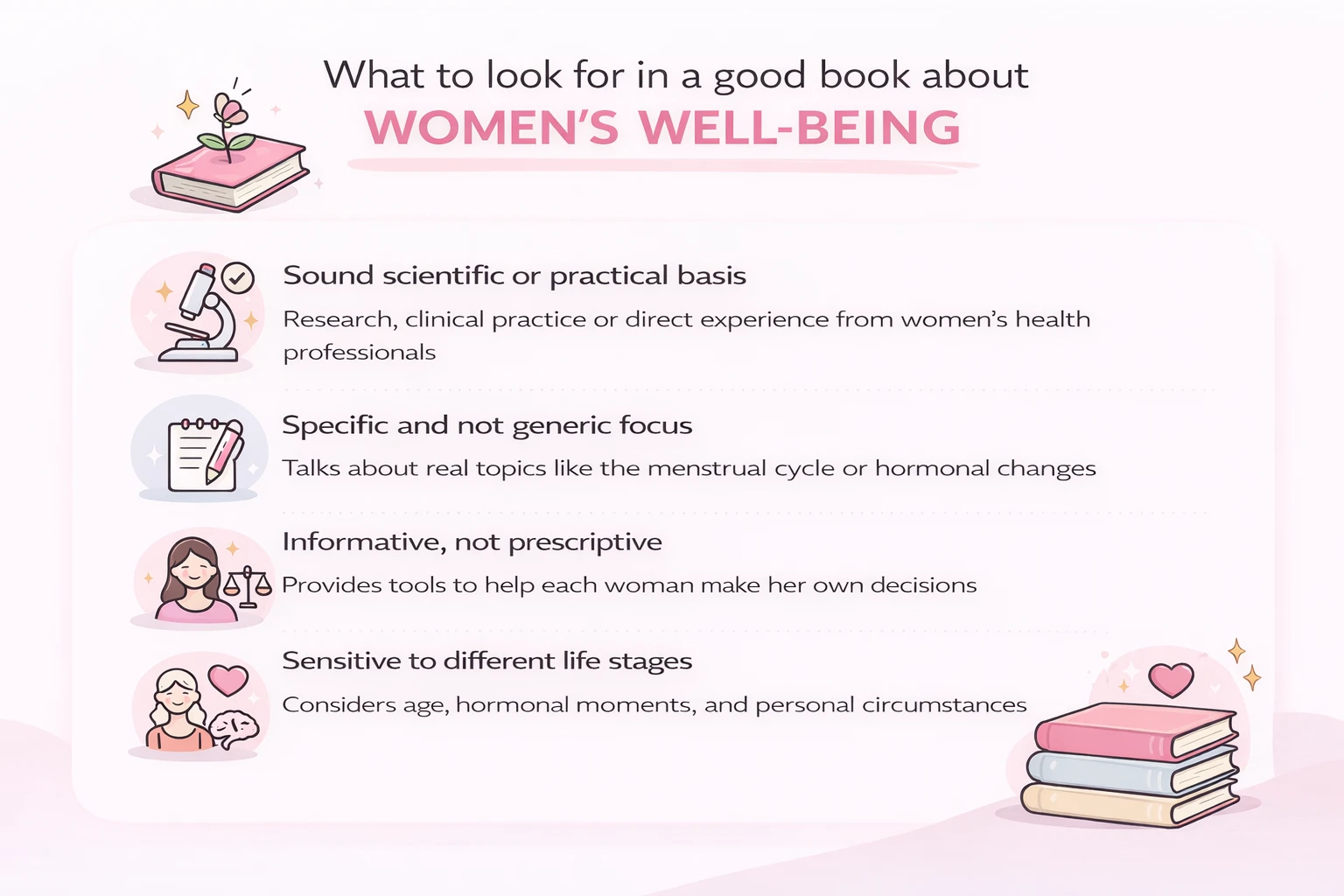
Not all books labeled as "wellness" provide the same value. When choosing, it's important to consider some criteria that differentiate a useful read from one that remains superficial:
- Proven scientific or experiential foundation: the most valuable books are based on research, clinical practice, or the direct experience of female health professionals.
- Specific and not generic approach: a good women's wellness book discusses real processes like the menstrual cycle, hormonal changes, or the relationship between body and emotions, rather than universal formulas.
- Informative tone, not prescriptive: the best reads offer tools for each woman to make her own decisions, rather than imposing a single path.
- Sensitivity to different life stages: a comprehensive book takes into account that women's wellness varies greatly depending on age, hormonal timing, and personal circumstances.
- Connection between body and mind: the most interesting titles are those that do not separate the physical from the emotional, because in the female experience, both planes are deeply intertwined.
How to integrate reading into your self-care routine
Reading about women's wellness shouldn't feel like a chore. There's no need to finish a book in a week or read them all at once. What's important is that reading becomes part of a personal space, those moments you dedicate to caring for yourself without hurry.
You can start with the book that resonates most with what you're experiencing right now. If you're in the midst of exploring your cycle and trying alternatives like the menstrual cup or the menstrual disc, books on hormonal health can provide valuable context. If what you need is a broader space for reflection, titles on emotional management are a good starting point.
Reading pairs especially well with other self-care practices: a winter wellness routine, a quiet afternoon with an herbal tea, or even some time after preparing one of those recipes that nourish the mood. The goal is to create a sustainable habit, not another demand.
What reading does not replace
It's important to note that women's wellness books are a tool for self-knowledge and education, not a substitute for medical or psychological support. Hormonal conditions, mood disorders, and menstrual health issues require professional diagnosis and follow-up.
That said, arriving at a consultation having read about your body and emotions changes the conversation. It allows for more precise questions, a better understanding of available options, and active participation in decisions about your own health.
FAQ: women's wellness books
Self-Compassion by Kristin Neff is a good starting point due to its approachable tone and practical exercises. If you prefer something narrative, Maybe You Should Talk to Someone by Lori Gottlieb brings you closer to the emotional world through a real story.
No. Self-compassion, emotional management, and self-knowledge are relevant at any age. Some titles, like those by Lara Briden, also cover all hormonal stages of life.
Because menstrual health and emotional wellness are connected. Understanding your body and emotions is part of the same self-care process.
The difference lies in the backing. Scientifically-based books, like those by Kristin Neff or Brené Brown, are grounded in published research and verified data. Generic self-help books tend to rely on individual experiences without that support. Both can be valuable, but it's important to know what you're reading.
Yes, as long as you choose titles with a constructive and not prescriptive focus. The Gifts of Imperfection or Self-Compassion are safe options because they discuss personal growth without pointing out a specific problem.