



Menstrual cup and vaginal flora, why they work better together than you think
August 31, 2026
Why is it said that periods sync among friends or roommates: what’s myth and what’s statistical coincidence, with the menstrual cup as a way to manage your cycle even if it doesn’t sync with anyone.
August 31, 2026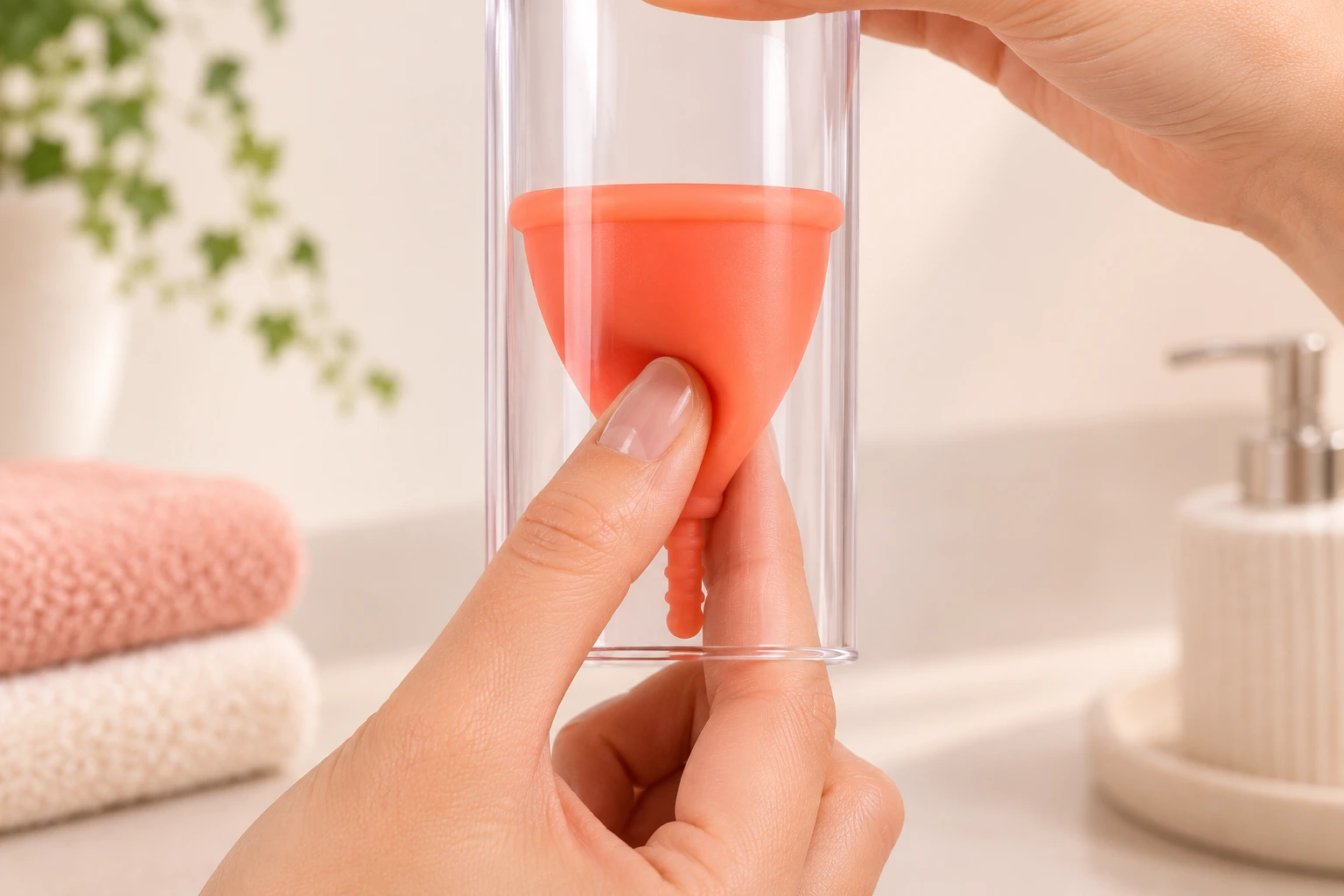
Search for "how to insert a menstrual cup" and dozens of videos and diagrams with every possible fold appear. Search for how to remove it without pain and the situation changes: a few scattered comments, a forum thread with fifteen contradictory answers, and not much else, as if the problem didn't exist for anyone but you.
Inhaltsverzeichnis
- Removing the menstrual cup painlessly: the guide that’s missing when it’s hard to break the seal
- Why there’s a guide for inserting it but almost none for removing it
- What the suction effect is and why it hurts to remove the menstrual cup
- How to break the vacuum step by step, without tugging
- Common mistakes that cause more pain when removing the menstrual cup
- When pain doesn’t just depend on the seal: size, placement, and pelvic floor
- Menstrual cup with IUD: why breaking the vacuum matters twice as much
- Frequently Asked Questions about How to Remove the Menstrual Cup Without Pain
Removing the menstrual cup painlessly: the guide that’s missing when it’s hard to break the seal
Why there’s a guide for inserting it but almost none for removing it
Insertion is the entry barrier, so it gets all the attention: if no one can get it in, there’s no second period with a menstrual cup. But the pain when removing the menstrual cup comes later, when you’ve been wearing it effortlessly for hours and it’s time to empty it for the first time. This delay explains why so many women post in forums asking what they’re doing wrong, two or three months after they’ve mastered the part that did have a step-by-step tutorial.
In comments on online stores and in Facebook groups, the same pattern repeats: someone shares that they insert it without issue, wear it for ten or twelve hours without noticing it, and the only moment they still struggle with is removing it. It’s almost never a matter of manual dexterity; it’s simply that no one explained to them that removing the menstrual cup requires a different technique than inserting it, with its own steps and its own margin of error.
What the suction effect is and why it hurts to remove the menstrual cup
The cup is held in place by suction, not by a mechanical closure. When it opens after insertion, it expels the air trapped between its walls and yours, and that vacuum is precisely what prevents it from leaking or moving on its own during hours of use. The problem arises if you pull on the stem with that seal still intact: instead of sliding out, the cup pulls tissue with it, as if you were trying to peel a suction cup off glass by pulling straight out instead of bending it first.
The pain when removing the menstrual cup almost always comes from there, from taking it out while the full vacuum is still in place. It’s described as a dry pinch or a tug that pulls inward, very different from the mild discomfort sometimes felt during insertion. And there’s a second factor that worsens it: at the moment the first attempt hurts, the body instinctively tightens the pelvic floor, the muscles close a bit more, and the second attempt is even harder than the first.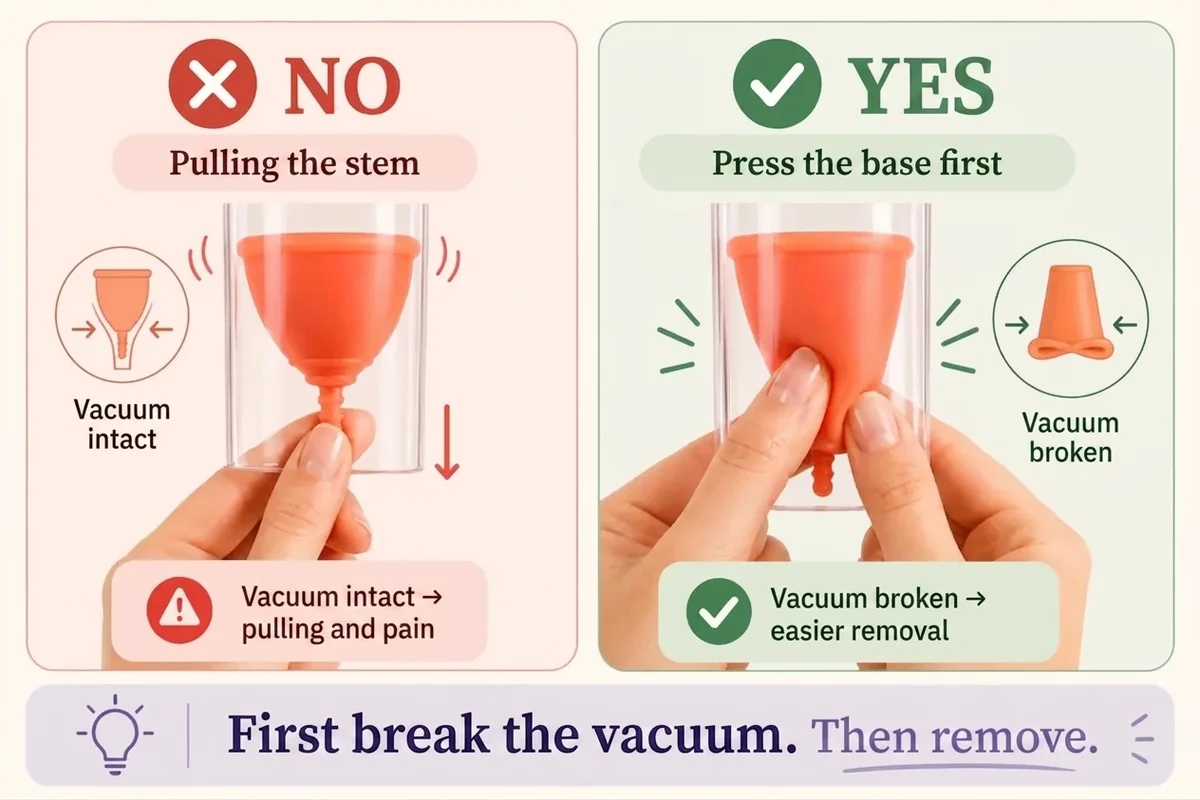
"The first three times I pulled on the stem directly because no video explained anything else. Each time it hurt a little more until I read in an Instagram comment that you have to break the vacuum first with your finger. I changed only that and the pain disappeared completely."
Irene, 26 years old, Alicante
How to break the vacuum step by step, without tugging
The action itself isn’t complicated, but it requires a specific order that’s almost never explained with the same detail as insertion:
The 5 steps to break the vacuum without pain
4 quick reminders before removing the menstrual cup
- Never pull the stem directly, always look for the base
- Pinch the entire base, not just a small point
- Go slowly, there’s no prize for doing it quickly
- If it hurts, stop and breathe before trying again
Common mistakes that cause more pain when removing the menstrual cup
Most cases of pain when removing the menstrual cup can be explained by two or three of these habits, often learned unintentionally during the first attempts:
| Common mistake | What it causes | What to do instead |
|---|---|---|
| Pulling the stem without breaking the seal | Dragging sensation and sharp pinch | Find the base with your fingers and press one side |
| Removing it while standing and in a hurry | The pelvic floor tenses and holds tighter | Sit down, elevate one foot, and breathe first |
| Pinching with one finger | The fold doesn’t break the entire seal | Use your index and thumb to pinch the entire base |
| Long nails or unwashed hands | Small scratches that are noticeable afterward | Trim your nails and wash your hands before starting |
| Cup too firm for your pelvic floor | The rim doesn’t give and rubs more during removal | Check the size guide and try a softer firmness |
| Repeating the same failed attempt multiple times | More muscle tension with each new attempt | Stop for a few seconds, relax your body, and start again |
"The first time it felt stuck, I thought something was really wrong. In the end, it was just that I was pulling straight down without folding it first. Since I learned to press the base before removing it, I don’t even remember that it used to be so difficult."
Paula, 33 years old, Vigo
When pain doesn’t just depend on the seal: size, placement, and pelvic floor
Mastering the technique to break the vacuum resolves most cases, but not all. If the pain when removing the menstrual cup continues after several cycles trying different positions, it's worth looking at two things before insisting on the same cup: the size and firmness you are using, and how you are inserting it.
A cup that is too large or too firm for your pelvic floor is more noticeable when passing through the vaginal canal, both when inserting and removing it. And if you are also wearing it very high, close to the cervix, removing it means a longer journey with the vacuum still active. The table below summarizes what to look for based on what you feel when removing it.
| What you feel when removing it | Possible cause | What to try |
|---|---|---|
| Strong friction at the edge when passing | Size or firmness too large for your body | Compare measurements in the size guide |
| Pulling that goes very deep inside | Inserted too high, close to the cervix | Review the insertion technique in the user manual |
| Excessive grip from the first minute | Pelvic floor in hypertonicity | Consult pelvic floor physiotherapy |
Regarding this last point, an article from Mubes Physiotherapy about menstrual cups and the pelvic floor explains that properly breaking the vacuum when removing it prevents traction on the uterus and vaginal walls, and that a softer cup reduces that friction for people with more sensitive muscles. If the pain recurs cycle after cycle despite using the correct technique, that consultation often clarifies more than continuing to switch cups just to try.
Menstrual cup with IUD: why breaking the vacuum matters twice as much
If you also have an IUD, breaking the vacuum before removing the menstrual cup becomes more than just a matter of pain. The same pull that drags tissue can displace the device or get tangled in its strings if the vacuum remains intact at the moment of removal. We explain this in more detail in this guide on menstrual cups with IUD, risks, and safe use, but the summarized rule is simple: first break the vacuum, then remove it, without rushing or exceptions no matter how late you are for something.
Designed to make removal easy too
A cup that folds effortlessly and has a base that is easy to locate makes breaking the vacuum almost automatic, not an exercise in patience every time.
- ✓ Soft medical silicone, folds effortlessly
- ✓ Textured base for quick location
- ✓ Various sizes and firmness options for your body
- ✓ Size guide and user manual included
Frequently Asked Questions about How to Remove the Menstrual Cup Without Pain
Is it normal to feel pain at first when removing the menstrual cup?
Some discomfort in the first cycles is common while learning to break the seal before pulling. If the pain doesn't decrease after two or three cycles of practicing the technique, it's worth checking the size, firmness, and placement.
What should I do if the menstrual cup gets stuck and won't come out?
Relax, sit down, and gently push as if you were going to have a bowel movement, to help it lower a bit. With the cup closer to the entrance, reach for the base with your fingers and pinch it; it’s almost never "lost," just a bit higher than expected.
Does the pain when removing the menstrual cup improve over time?
In most cases, yes, once the action of pressing the base before pulling becomes automatic. If after several months it still hurts the same as on the first day, it's worth looking into other factors like the firmness of the cup.
Can I remove the menstrual cup while standing?
You can, but when standing, the pelvic floor is usually tenser than when sitting or squatting, so it’s easier to learn the action while sitting on the toilet at first.
Is it more dangerous to feel pain when removing the menstrual cup if I have an IUD?
The risk lies more in another area: pulling without breaking the seal can displace the device or affect its strings. That's why breaking the seal well before removing it is even more important with an IUD.
Does a softer cup hurt less when removing it?
For sensitive or hypertonic pelvic floors, a softer cup usually offers less resistance. The right firmness depends on each person's muscle tone, not just on menstrual flow.
Removing the menstrual cup without pain doesn't depend on enduring more or having more manual practice; it depends on a very specific action that almost never appears in guides: breaking the seal before pulling. Once that is resolved, most cases of pain when removing the menstrual cup disappear within a couple of cycles. If yours persists, at papayacup.com you have the entire range of sizes and firmness to find a cup that is also easy to remove, not just to insert.