



First Time Using a Menstrual Cup: Beginner’s Guide
29 de June de 2026
Polycystic Ovary Syndrome (PCOS): impact on periods and fertility
1 de July de 2026
Surely you have heard something about toxic shock syndrome and you are left wondering: is it a real risk or an exaggerated alarm? In this article, you will find the honest answer. Here we explain exactly what toxic shock syndrome (TSS) is, why its association with internal menstrual protection products arose, what current scientific evidence says about the menstrual cup, and, above all, how to minimize any risk with a proper usage routine.
Inhaltsverzeichnis
- Everything You Need to Know About the Menstrual Cup and Toxic Shock
- What is toxic shock syndrome and how is it related to the menstrual cup?
- How TSS works with the menstrual cup: the real mechanism
- Menstrual cup and toxic shock: real advantages and disadvantages
- Practical guide: how to use the cup minimizing the risk of toxic shock
- The 7 most frequently asked questions about menstrual cups and toxic shock syndrome
- Frequently asked questions about menstrual cups and toxic shock syndrome
- The protection that doesn't let you down
⚕️ This article is for informational purposes only and does not substitute for medical consultation. Always consult your gynecologist with any questions.
Last reviewed: June 2026 · 8 min read
Everything You Need to Know About the Menstrual Cup and Toxic Shock
You’ve probably heard something about menstrual cup toxic shock and are left wondering: is it a real risk or an exaggerated alarm? In this article, you will find the honest answer. Here we explain exactly what toxic shock syndrome (TSS) is, why its association with internal menstrual protection products arose, what current scientific evidence says about the menstrual cup, and, most importantly, how to minimize any risks with a proper usage routine.
No alarmism, no unnecessary technicalities. Just the information you need to make an informed decision about your menstrual protection.
What is toxic shock syndrome and how is it related to the menstrual cup?
Before diving in, you need to be clear about one thing: the fear of TSS is understandable, but the information circulating on social media often mixes data from the 80s with the current reality. Let’s break it down.
What is TSS
Toxic shock syndrome (TSS) is a serious medical complication —though very rare— caused by toxins produced by certain bacteria, primarily Staphylococcus aureus and, to a lesser extent, Streptococcus pyogenes. These bacteria can release toxins that enter the bloodstream and trigger a systemic inflammatory response.
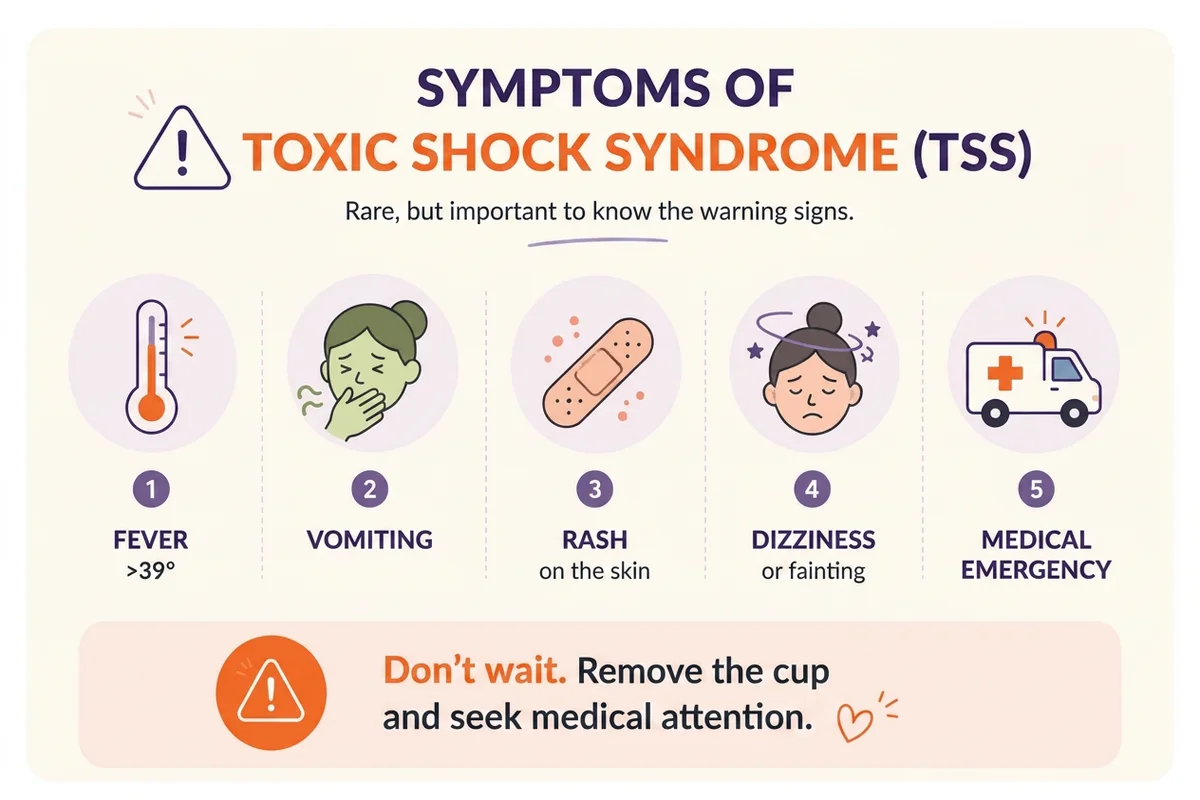
Symptoms include sudden high fever, low blood pressure, a rash resembling a sunburn, confusion, and, in the most severe cases, multi-organ failure. It is a medical emergency that requires immediate hospital attention.
The association of toxic shock with menstruation arose in the 1980s when certain highly absorbent tampons favored bacterial growth. Since then, tampon formulations have changed radically, and cases have drastically decreased. According to the systematic review by Berger et al. published in Lancet Infectious Diseases (2019), the incidence of menstrual TSS ranges from 0.03 to 0.50 cases per 100,000 people.
Who this information is relevant for
Anyone who menstruates and uses internal protection —tampons, discs, or menstrual cups— should be aware of the symptoms of TSS. Not to panic, but to act with knowledge. With the correct use of the cup, the risk is truly minimal, as you will see below.
How TSS works with the menstrual cup: the real mechanism
Understanding how toxic shock occurs is the best way to dismantle it. When you know what happens, irrational fear disappears and is replaced by an informed attitude.
The key lies in the environment created by the different menstrual protection products. Cotton or rayon tampons absorb blood and retain it in contact with the vaginal walls, creating a warm and humid medium that can promote bacterial proliferation if left too long or if the material retains microparticles.
The menstrual cup, on the other hand, collects the flow without absorbing it. Being made of hospital-grade medical silicone, it is non-porous, does not retain bacteria on its surface, and does not interact with the vaginal pH balance in the same way that cotton does. This does not mean that the cup is immune to any risk, but its mechanism of action places it in a different category.
The risk exists when the cup is not cleaned properly or when it is inserted with dirty hands, which can introduce external bacteria. That’s why hygiene during insertion and removal is the most important factor.
At Papayacup, we have been supporting thousands of users for years and have seen that most doubts about toxic shock syndrome are resolved simply by learning a good cleaning routine.
Real testimonial
Clara had been working as a nurse for years and initially had a lot of respect for the issue of TSS, precisely because of her healthcare training. When she understood that the mechanism of the cup is fundamentally different from that of the tampon, and that with well-sterilized medical silicone the risk is minimal, she became one of the most enthusiastic users —and the most rigorous with hygiene— that we know.
Menstrual cup and toxic shock: real advantages and disadvantages
As with any menstrual protection method, there are no absolute answers here. What exists are clear facts that allow you to make an informed decision.
Main advantages of the cup against the risk of TSS
Limitations to be aware of
- Hand hygiene is essential: inserting the cup with dirty hands is the main risk vector. No exceptions.
- Cleaning between emptying: rinsing with water is sufficient during the cycle, but it must be done every time.
- Sterilization between cycles: boiling the cup at the beginning and end of each menstruation is crucial to eliminate any bacteria.
- Not suitable with active infection: if you have an ongoing vaginal infection, consult your gynecologist before using it.
- Learning curve: the first few times may cause insecurity. Check our size guide to get it right from the start.
If you also find menstruation painful, you might be interested in our guide on menstrual pain: how to understand and relieve it.
Practical guide: how to use the cup minimizing the risk of toxic shock
Ana is a dentist in Valencia and works ten-hour shifts with hardly any breaks. The first thing she highlighted when she shared her experience was this: "What reassured me the most was understanding exactly what I had to do to be safe. Once you have the routine, it’s automatic." That is exactly the attitude we propose to you.
Before the first use
- Sterilize the cup before using it: boil it in water for 5-7 minutes or use a steam sterilizer suitable for medical silicone.
- Choose the correct size: a poorly fitted cup can create an incorrect vacuum. Check the PapayaCup size guide to get it right the first time.
- Practice insertion outside of your cycle: many users recommend practicing the folding technique before menstruation to gain confidence.
- Know the symptoms of TSS: not to be afraid, but to know what to pay attention to if something goes wrong.
Basic step-by-step during the cycle
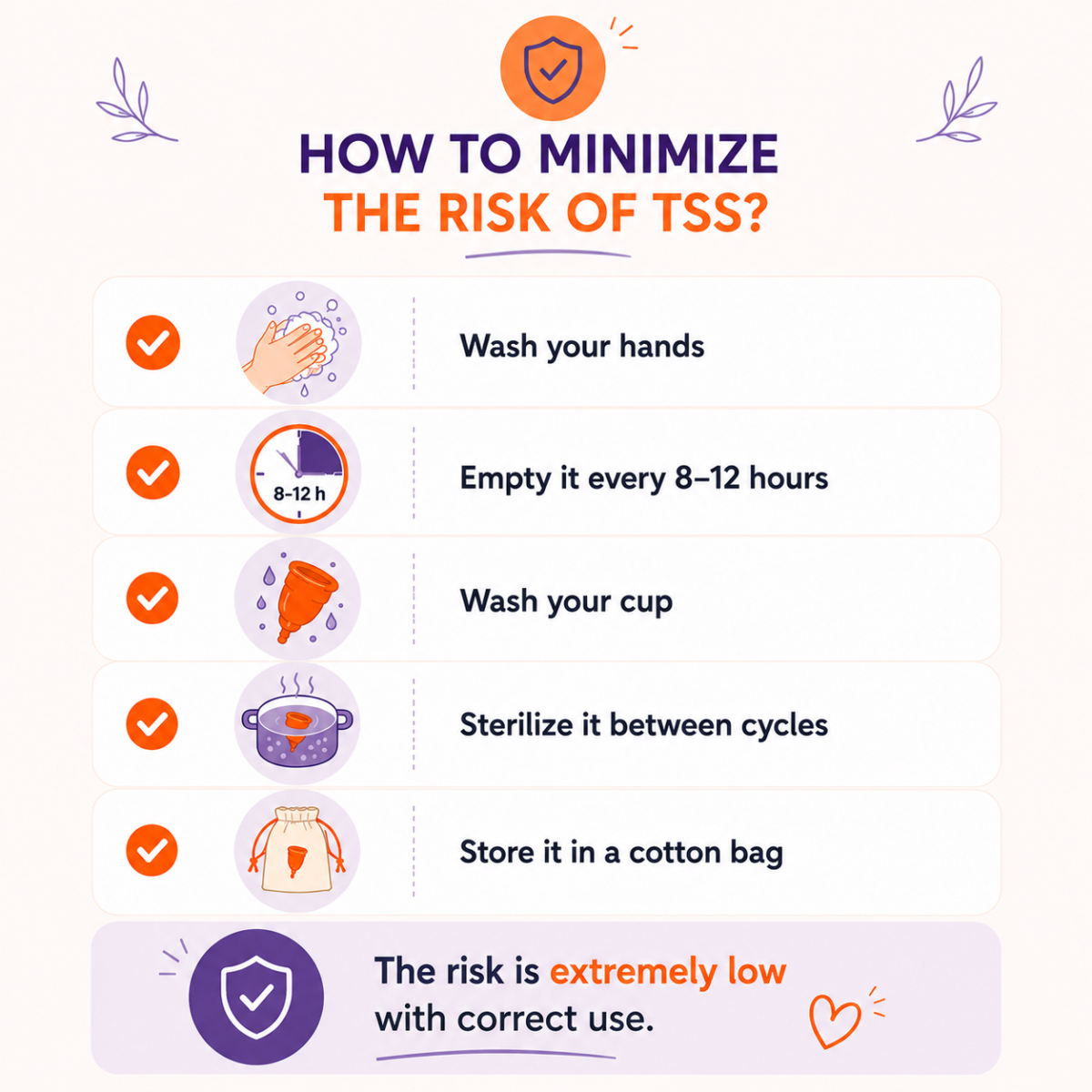
- Wash your hands with soap and water before each insertion or removal. This step is non-negotiable.
- Empty the cup every 8-12 hours at most, even if your flow is light. Do not leave it longer than recommended.
- Rinse it with cold or lukewarm water between uses. In a public restroom without access to water in the stall, clean it with unscented wet wipes and wash it thoroughly as soon as you can.
- Sterilize at the beginning and end of each cycle by boiling for 5-7 minutes.
- Store it in its cloth bag —never in an airtight bag— so it can breathe between periods.
Real testimonial
Lucía, a 33-year-old yoga teacher, told us that at first she felt overwhelmed thinking about "doing everything right." When she understood that the routine boils down to two things —clean hands and emptying every maximum 12 hours— she stopped overthinking it. "Now I couldn't go back to tampons," she said.
The 7 most frequently asked questions about menstrual cups and toxic shock syndrome
At Papayacup, we receive many questions on this topic, and it makes perfect sense: the information online is sometimes contradictory or alarmist without basis. Here are the direct answers to the questions we get the most.
| Question | Quick answer |
|---|---|
| Can I sleep with the cup in? | Yes, it can hold up to 12 hours. Empty it before going to bed and upon waking. |
| What should I do if I don't have clean water? | Clean it with bottled water or alcohol-free, unscented wipes. |
| Does the cup cause TSS with correct use? | The risk is extremely low. Documented cases are associated with poor hygiene or use beyond 12 hours. |
| Is medical silicone safe? | Yes. It is biocompatible, non-porous, and does not release substances upon vaginal contact. |
| Should I leave the cup in with an infection? | Yes, as long as the infection lasts. Sterilize it well before using it again. |
| How long does a cup last? | Between 5 and 10 years with proper care. Inspect it before each cycle. |
| What are the symptoms of TSS? | Sudden fever >39 °C, drop in blood pressure, reddish rash, confusion, vomiting. Remove the cup and go to the emergency room. |
Real testimonial
Sofía, a 27-year-old medical student in Salamanca, wrote to us after reading an alarmist article about TSS that filled her with doubts. After getting informed, her conclusion was clear: "With the data on the table, the risk is lower than with the tampons I've used my whole life. The difference is that with the cup, you have control over hygiene."
Ready to take the step?
Discover the menstrual cups from Papayacup — certified medical silicone, with an included size guide and personalized support to ensure you get it right the first time.
See the menstrual cups →Frequently asked questions about menstrual cups and toxic shock syndrome
What is toxic shock syndrome (TSS)?
Toxic shock syndrome is a serious medical complication caused by toxins from the Staphylococcus aureus bacteria. Its association with menstruation emerged in the 1980s with the use of certain super-absorbent tampons. The menstrual cup, by collecting the flow without absorbing it and being made from non-porous medical silicone, presents a different risk profile. With proper hygiene, the risk of TSS associated with the cup is extraordinarily low.
Is the menstrual cup safe regarding toxic shock?
Yes, with correct use. Hospital-grade medical silicone is biocompatible, non-porous, and does not alter vaginal pH. Cases of TSS associated with cups are extremely rare and are related to poor hygiene or usage times exceeding the recommended 12 hours. Washing your hands well before inserting and emptying it every 8-12 hours are the two most important measures.
How do I choose the right menstrual cup?
Choosing the right size is essential for comfort and safety. Consider your age, whether you have given birth, and the intensity of your flow. Check the Papayacup size guide and always opt for certified medical silicone. A well-chosen cup is comfortable, discreet, and safe.
How often should I use and clean the menstrual cup?
The cup should be emptied every 8-12 hours at most, rinsed with water between emptying, and sterilized by boiling for 5-7 minutes at the beginning and end of each menstrual cycle. With good care, it can last between 5 and 10 years. Never leave it in for more than 12 consecutive hours.
Where can I buy a quality menstrual cup?
You can purchase the menstrual cup directly at www.papayacup.com, with shipping available throughout Spain. The price of a quality medical silicone cup ranges from 20 to 35 euros — an investment that quickly pays off compared to the monthly expense on tampons or pads. Always buy from official channels that guarantee material certification.
Menstrual cup — you decide
The protection that doesn't let you down
Now you know everything you need about the menstrual cup and toxic shock. Certified medical silicone, up to 12 hours without changes, and warranty included. At Papayacup, we help you choose yours.
See the Papayacup menstrual cup →Certified medical silicone · Warranty included · Shipping throughout Spain