



Exercising with a menstrual cup: tips for training comfortably
10 de February de 2026
What is dopamine and how does it impact your daily motivation?
5 de March de 2026
The sexual desire doesn’t work like a switch. It doesn’t turn on and off for no reason, and certainly doesn’t remain stable throughout the month or over a lifetime. Female libido is a complex response influenced by hormones, emotions, context, and overall health, and understanding how it behaves can help you experience your sexuality with more ease and less judgment.
If you’ve ever wondered why there are weeks when you feel a strong desire and others when it seems to vanish, this article provides a clear insight into the mechanisms behind it and the factors that truly influence it.
What is libido and why is it not constant
Libido is, in simple terms, the drive or energy that guides us towards sexual desire. It’s not just about wanting to have sex: it includes fantasies, thoughts, receptiveness to physical contact, and emotional readiness for intimacy.
In women, this drive tends to be particularly variable. Not because something is wrong, but because it responds to a combination of hormonal signals, emotional states, and life circumstances that change constantly. Understanding this variability is the first step to stop perceiving it as a problem.
How female libido changes throughout the menstrual cycle
Hormonal fluctuations during the menstrual cycle have a direct influence on sexual desire. Not all women experience it the same way, but there are general patterns worth knowing.
Menstrual phase (days 1 to 5 approximately)
During menstruation, estrogen and progesterone levels are at their lowest. Many women feel less desire during these days, accompanied by fatigue or physical discomfort. However, others experience just the opposite: a surge in desire related to the release of accumulated tension and increased sensitivity in the pelvic area.
If this happens to you, it’s completely normal. The endorphins released during orgasm can even relieve headaches associated with menstruation or hormonal migraines, something many women are unaware of. Additionally, products like the menstrual cup or the menstrual disc allow for comfortable period management and maintaining intimacy without worries.
Follicular phase (days 6 to 13 approximately)
As this phase progresses, estrogen levels begin to rise gradually. This usually translates into a gradual increase in energy, mood, and sexual desire. Many women start to feel more receptive, more self-confident, and more interested in physical connection.
Estrogen promotes vaginal lubrication, sensitivity, and responsiveness to stimuli, which facilitates natural arousal.
Ovulation (around day 14)
The peak of estrogen and a temporary increase in testosterone coincide with ovulation. It’s the time in the cycle when, generally speaking, sexual desire reaches its highest point. From a biological perspective, it makes sense: the body is at its most fertile moment.
Although every woman is different, many report feeling more attractive, more confident, and with greater sexual initiative during these days.
Luteal phase (days 15 to 28 approximately)
After ovulation, progesterone takes center stage. This hormone has a rather inhibiting effect on desire in many women. It’s common to notice a gradual decrease in libido, sometimes accompanied by premenstrual symptoms such as irritability, bloating, or mood swings.
However, this phase does not affect everyone equally. Some women maintain stable desire or even experience moments of high arousal during the luteal phase. Individual variability is enormous, and no pattern should be taken as an absolute norm.
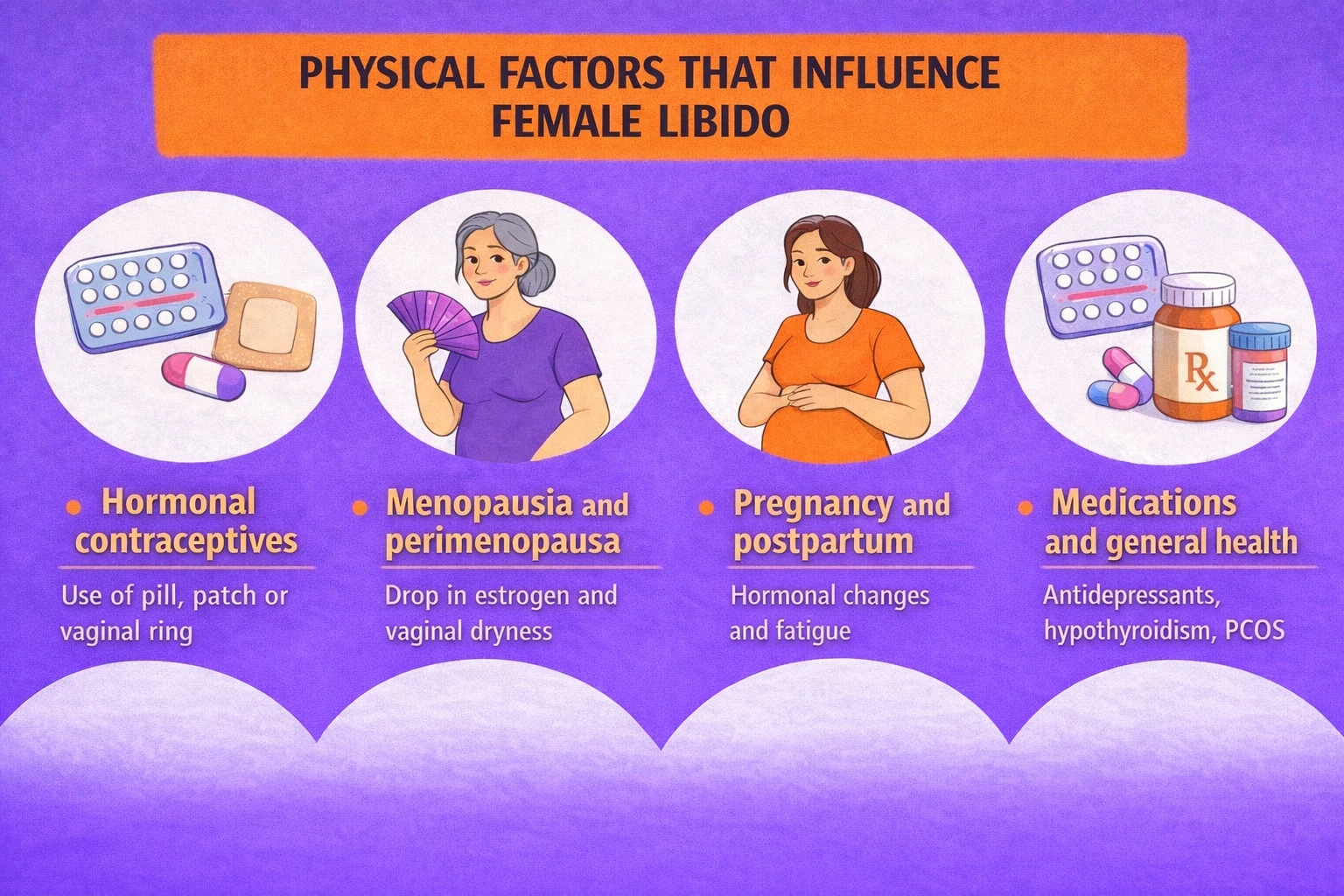
Physical factors that influence female libido
Beyond the menstrual cycle, there are physical conditions and circumstances that can significantly alter sexual desire.
Hormonal contraceptives
Some hormonal contraceptive methods, such as the combined pill, patch, or vaginal ring, can modify free testosterone levels and affect libido. This does not occur in all cases: most women do not perceive significant changes, but a significant proportion do notice a decrease in desire.
If you suspect that your contraceptive may be influencing your libido, it is advisable to discuss it with your gynecologist to consider alternatives.
Menopause and perimenopause
The drop in estrogen that occurs during the transition to menopause can cause vaginal dryness, decreased sensitivity, and a reduction in sexual desire. However, this does not mean that sexuality ends with menopause. Many women discover a more liberated relationship with their bodies and pleasure during this stage, free from the concerns associated with contraception.
Pregnancy and postpartum
Hormonal changes during pregnancy and lactation affect desire in very variable ways. Physical exhaustion, new responsibilities, and bodily adaptation are factors that add to the purely hormonal influences. It is a period where patience and communication with your partner are especially important.
Medication and overall health
Medications such as antidepressants, antihypertensives, and certain hormonal treatments can have side effects on libido. Conditions such as hypothyroidism, polycystic ovary syndrome, or diabetes can also influence desire. In the case of prolonged or concerning loss of desire, a medical consultation is always advisable.
Factors that can reduce female libido
Beyond the menstrual cycle, there are multiple physical, emotional, and contextual circumstances that can influence sexual desire. These are the most relevant according to clinical experience and available studies:
- Chronic stress and mental load. Elevated cortisol interferes with reproductive hormones and pushes desire to the background. Overload of responsibilities, lack of rest, and constant pressure are frequent inhibitors.
- Hormonal contraceptives. Methods such as the combined pill, patch, or vaginal ring can modify free testosterone levels.
- Menopause and perimenopause. The drop in estrogen can cause vaginal dryness, decreased sensitivity, and reduced desire. However, many women discover a more liberated relationship with their bodies and pleasure during this stage.
- Pregnancy, postpartum, and lactation. Hormonal changes, physical exhaustion, and adaptation to new responsibilities can combine and temporarily reduce desire.
- Medication. Medications such as antidepressants, antihypertensives, and certain hormonal treatments can have direct side effects on libido.
- Relationship issues. Unresolved tensions, emotional distance, or lack of communication can inhibit desire more than any hormonal alteration.
- Lack of sleep. Sleeping poorly or insufficiently affects hormonal balance, energy levels, and mood. It is one of the most underestimated factors related to libido.
- Self-esteem and body image. A woman's perception of her own body influences how she relates to pleasure. Feeling comfortable and connected with oneself does not depend on hormones but on personal history and environment. Knowing your body and choosing products that make you feel secure, such as finding the right size for your menstrual cup, is part of that process.
- Health conditions. Hypothyroidism, polycystic ovary syndrome, or diabetes can persistently alter desire.
When it is normal for libido to decrease and when to consult
Fluctuations in sexual desire are absolutely normal. Not every week or every stage of life brings the same intensity, and that does not indicate any problem.
However, it is important to pay attention when the loss of desire is persistent, causes emotional discomfort, or significantly affects the relationship. In such cases, a professional can help identify if there is a treatable cause, whether hormonal, pharmacological, or psychological.
The most important thing is to avoid self-demand. Desire is not something that should function in a specific way or at a certain pace. Each woman has her own pattern, and knowing it is a way to take care of oneself.
Your body, your rhythm
Female libido is dynamic, sensitive, and deeply personal. It does not behave the same way in all women, nor even in the same woman over time. Understanding it involves observing yourself without judgment, listening to your body's signals, and giving equal importance to emotional and physical aspects.
At PapayaCup, we believe that intimate well-being is inseparable from overall well-being. Understanding how your cycle works, what factors influence your desire, and what tools you have at your disposal is a way to live your sexuality with more freedom and less pressure.
Because your desire has its own rhythm, and that rhythm deserves to be respected.
FAQ: female libido
Yes. Desire varies according to the phase of the cycle, stress levels, rest, and emotional state. As long as it does not cause persistent discomfort, it is part of the normal functioning of the body.
It can happen in some women, as hormonal contraceptives modify free testosterone levels. If you notice a significant change, it is advisable to consult your gynecologist.
Generally around ovulation, when estrogen and testosterone are at their highest. But each woman has her own pattern, and observing yourself over several cycles is the best way to know it.
The menstrual disc is designed to be used during penetrative intercourse, as it is placed at the back of the vaginal canal and does not interfere. The menstrual cup should be removed before penetration, although it is perfectly compatible with other types of intimacy.
It depends on factors such as age, whether you have had vaginal births, and the height of your cervix. In the PapayaCup size guide, you can find the necessary information to choose the most comfortable option for you.
No. Although the drop in estrogen can reduce libido, many women experience this stage with renewed sexuality that is more focused on their own pleasure. There are treatments and habits that help maintain a satisfying intimate life.