



Menstrual disc stuck up: how to remove it without forcing
5 de October de 2026
I have a heavy period, is the menstrual disc suitable for me?
5 de October de 2026
If you’re coming from the cup, the disc is put on and taken off differently. The distractions that get in the way, how to fit it behind the pubis, and how to approach the first cycles.
Inhaltsverzeichnis
- I've been using a cup for years and I'm switching to a menstrual disc, what do I need to do differently?
- What is the menstrual disc and where does it go if you were using a cup until now?
- Cup habits you’ll need to stop doing with the disc
- Looking for the feeling of a seal
- Leaving it low in the vaginal canal
- Pincing the base to remove it
- Getting scared of the self-emptying
- The new gesture that didn't exist with the cup, fitting the rim behind the pubic bone
- How to remove it when your hand still thinks of a cup
- Size and first cycles with the disc
- Your first disc, with a tab to learn without stress
- Frequently Asked Questions about Switching from Menstrual Cup to Menstrual Disc
I've been using a cup for years and I'm switching to a menstrual disc, what do I need to do differently?
If you've been using a cup for years, your hands know exactly what to do. Fold, insert, twist, check that it has created a seal. With the menstrual disc, most of that is unnecessary, and what’s hardest at first is stopping the automatic actions.
The transition from menstrual cup to menstrual disc seems small on paper. In practice, those coming from the cup often struggle more in the first cycles than someone starting from scratch, precisely because of habit. Here, we’re not comparing products: we’ll review the cup habits that get in the way, the new gesture you need to learn, and how to approach the first cycles to switch from cup to menstrual disc without getting frustrated.
What is the menstrual disc and where does it go if you were using a cup until now?
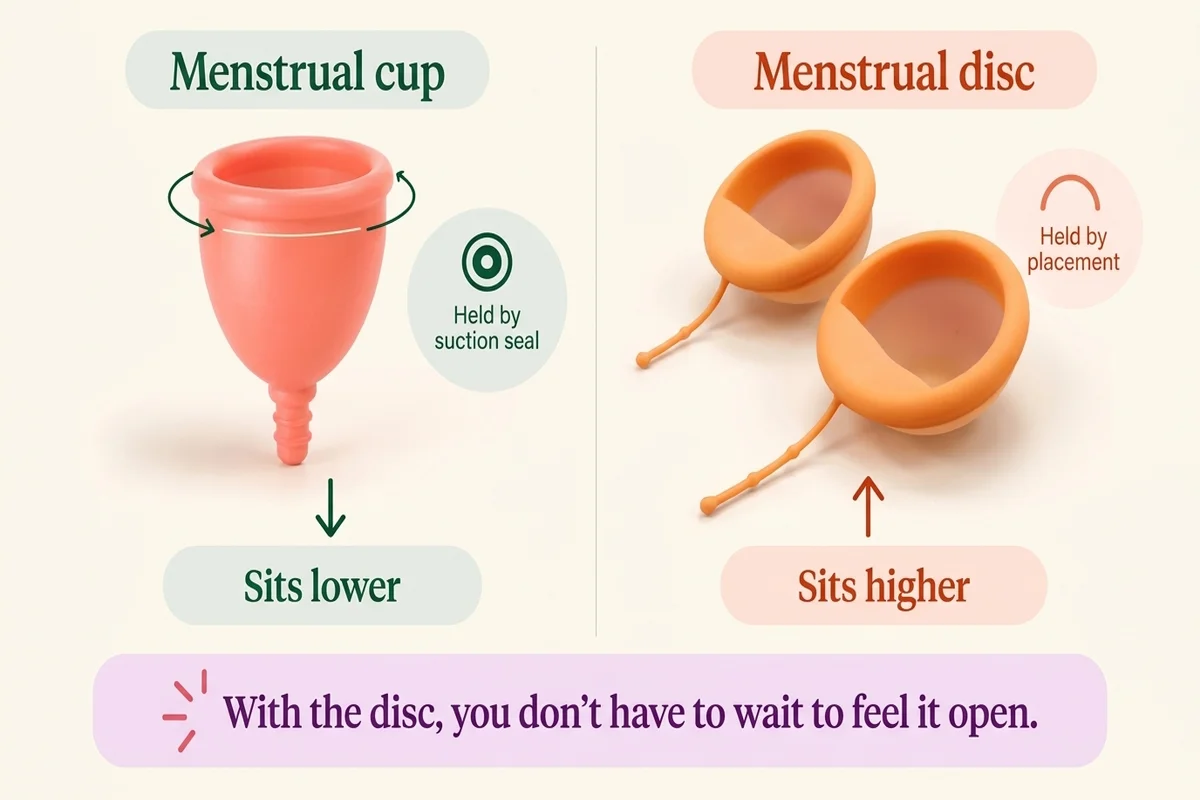
To understand what a menstrual disc is, it’s enough to know where it goes and what holds it in place. It is positioned higher than the cup, in the vaginal fornix, just below the cervix, which sits inside the disc. The front rim rests behind the pubic bone, and that’s what keeps it in place. There’s no suction, as we explain in what the menstrual disc is and how it works, and with that idea in mind, almost everything else becomes clear. You can see our PapayaDisc menstrual disc in sizes S and L.
"I had been using a cup for nine years and thought I was an expert. On the first day with the disc, I waited to feel it open, and since I didn’t feel anything, I took it out and put it back in three times. It was fine from the start."
Marisa, 38 years old, Valencia
Cup habits you’ll need to stop doing with the disc
Looking for the feeling of a seal
With the cup, you learned to trust a signal: the small "plop" when it opens, the resistance when pulling the stem. The menstrual disc never gives that signal because it doesn’t create a seal, and those coming from the cup often think something has gone wrong. The check now is about positioning: the front rim should be felt behind the pubic bone, and once in place, you shouldn’t feel it.
Leaving it low in the vaginal canal
The cup sits at mid-height, and the habit is to release it as soon as it passes the entrance. If you do the same with the menstrual disc, it will be left halfway. We explain this in our manual: if it feels bent or pressed, it’s probably not positioned correctly. That pressure indicates it needs to be pushed all the way in.
Pincing the base to remove it
With the cup, pinching the base breaks the seal before pulling it out. The menstrual disc has no base to pinch and no seal to break, and if you look for it, you’ll only find the soft center, which slips. What you need to do is reach the front rim with a finger, hook it, and remove it horizontally.
Getting scared of the self-emptying
When pushing on the toilet, the disc may shift a bit and release some blood. Some users experience this, and in our article on how the menstrual disc works, we call it self-emptying. It does not indicate that it is incorrectly positioned. In our manual, we state that it is not necessary to remove it to urinate or defecate; afterward, just check with a clean finger that the rim is still behind the pubic bone, and if it has moved, reposition it.
What you did with the cup and what to do with the disc
"What I found most difficult was removing it. My hand instinctively went to pinch the base, and there was nothing there. It wasn't until the third day that I remembered to look for the rim."
Clara, 31 years old, Gijón
The new gesture that didn't exist with the cup, fitting the rim behind the pubic bone
There is no equivalent with the cup, so practice it slowly. The menstrual disc sits across the bottom, with the back part under the cervix and the front part secured behind the pubis. Here’s how to insert the menstrual disc following our PapayaDisc manual:
How to insert the menstrual disc if you are coming from the cup
Three fingers of water in the sterilizer and 3 minutes in the microwave, no more, to avoid damaging the silicone.
Wash your hands and place one foot on the toilet.
Squeeze the sides of the disc to make it narrow.
Insert it towards the anus and push it all the way back before releasing it.
Lift the front rim with your finger until it is hooked behind the pubic bone.
Run your finger around the rim. If you feel it bent or pressing, start over; a little water or lubricant helps.
Outside of our website, in this article from La Cadera de Eva about menstrual disc and cup, Victoria Michel, founder of the Mexican Foundation for Menstrual Health, explains that the disc is positioned tilted near the cervix, while the cup adapts to the vaginal canal.
How to remove it when your hand still thinks of a cup
As we explain in the manual, gently pull the tab until you reach the edge, then hold the edge and remove it horizontally. If you find it hard to reach, squat and apply slight downward pressure. And if after several attempts it doesn’t come out, seek medical help: the menstrual disc cannot get lost inside the body.
Size and first cycles with the disc
The cup size is not a useful reference. In our size guide for the menstrual disc, we explain that the height of the cervix is what matters most here. Generally, we recommend size S for a low cervix, those under 30 years old, or those without vaginal births, and size L for a high cervix, those over 30, or those with vaginal births. These are guidelines. If you can easily reach your cervix during your period, it is likely low; if you can barely reach it, it is high.
If in doubt, the comfort pack of 2 menstrual discs S+L with sterilizer allows you to try both in different cycles. And our advice: use the menstrual disc with a tab for at least three cycles before trimming it, as it makes removal easier, and once cut, it cannot be reattached.
| Cycle | What to pay attention to | Tip |
|---|---|---|
| First cycle | Push it all the way in and fit the edge, without seeking emptiness | Practice at home on a calm day, with a menstrual panty for support |
| Second cycle | Remove it by the edge and horizontally | Use the tab only to reach the edge |
| Third cycle | Empty it every 8 to 12 hours and check it after using the bathroom | From here, decide if you want to trim the tab |
What the disc is telling you in the first days
During the first cycles, keep a menstrual panty handy. Learning is often easier when using just the disc for a few consecutive days, although in the long run, combining products according to the day of the cycle is valid, as Victoria Michel recommends. The benefits of the menstrual disc that are most mentioned, such as having penetrative intercourse (with PapayaDisc, trimming the tab beforehand), are truly enjoyed when placing it becomes second nature.
"In the first cycle, I had a couple of leaks because I kept it low. By the second, I was pushing it all the way in without thinking, and since the third, I don’t even remember I have it in. I gave the cup to my sister."
Lucía, 34 years old, Granada
Your first disc, with a tab to learn without stress
PapayaDisc comes in sizes S and L, with a textured pull tab that guides you to the edge as you get used to it.
- ✓ Sizes S and L according to your cervix
- ✓ Textured pull tab that you can trim
- ✓ Up to 12 hours of use
- ✓ S+L pack with sterilizer
Frequently Asked Questions about Switching from Menstrual Cup to Menstrual Disc
How long does it take to get used to the disc if you come from the cup?
It depends on the individual. The most challenging part is learning how to remove the menstrual disc, as your hand instinctively looks for the base like with the cup.
How do I know if the disc is properly placed if it doesn't create suction?
Run your finger around the edge: the front rim should be behind the pubic bone and you shouldn't feel it. If it feels bent or pressing, remove it and reinsert it.
Can I use the same size menstrual disc as I do with the cup?
There is no direct equivalence. The height of the cervix primarily determines the disc size, along with age and vaginal births, according to our sizing guide.
Is it normal to see blood when going to the bathroom with the disc in?
It can happen, and it doesn't mean it's improperly placed. When you push, the disc shifts slightly and releases some blood. Afterward, check with a clean finger that the edge is still in place and reposition it if necessary.
How do I insert the menstrual disc if I have a low cervix?
The technique is the same, pushing back and then fitting the edge behind the pubis. With a low cervix, we usually recommend size S, and the pull tab might rub beforehand; in that case, our manual explains how to partially trim it.
Can I continue using the cup on some days of my cycle?
Yes. While you learn, it might be easier to use just the menstrual disc for a few consecutive days, but combining both depending on the day of your cycle is perfectly fine.
Transitioning from a cup to a menstrual disc is more about unlearning than learning. Once you stop expecting suction and remove it by the edge, the rest comes naturally, and that's when you notice the benefits of the menstrual disc. At papayacup.com, you can find our PapayaDisc in both sizes, along with the manual and guide to choose yours.