



Menstrual cup: who should think twice before using it?
31 de August de 2026
How to break the seal of the menstrual cup without pain
31 de August de 2026
You have been using the cup for months, maybe years, and at some point, the same question has crossed your mind: is it good for my vaginal microbiota? It’s one of the most common inquiries we receive via social media and email, and it deserves a clear answer, backed by evidence and without ambiguity.
Inhaltsverzeichnis
- Menstrual Cup and Vaginal Flora: Why They Get Along Better Than You Think
- What is Vaginal Flora and Why Does It Matter for Your Cup?
- How the Menstrual Cup Influences Your Intimate Balance: The Real Mechanism
- Menstrual cup and vaginal flora: real advantages and disadvantages
- Practical guide: how to care for your intimate balance using the cup
- Designed for your intimate balance
- Frequently asked questions about menstrual cups and vaginal flora
Menstrual Cup and Vaginal Flora: Why They Get Along Better Than You Think
In this article, we will debunk myths, review what the latest science says about the relationship between the menstrual cup and your intimate balance, and provide you with concrete guidelines to ensure your cycle is comfortable, safe, and respectful of your protective bacteria. Spoiler: when used correctly, the cup is usually an ally of your vaginal health, not a threat.
What is Vaginal Flora and Why Does It Matter for Your Cup?
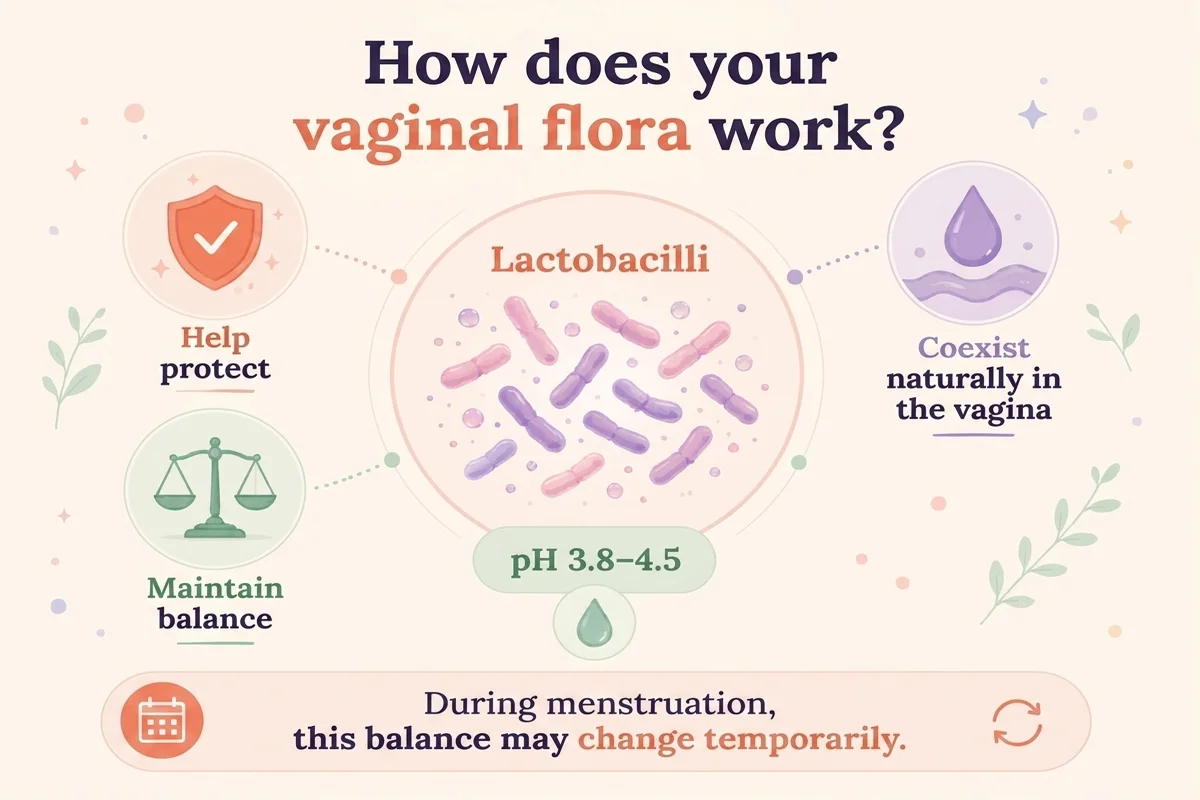
The vaginal flora, also known as vaginal microbiota, is the collection of microorganisms —mainly lactobacilli— that naturally coexist in the vagina. These protective bacteria maintain an acidic pH, between 3.8 and 4.5, which acts as a barrier against unwanted fungi and bacteria. When that balance is disrupted, discomforts such as itching, unusual odor, or changes in discharge can occur.
During your period, the microbiota undergoes natural variations: bleeding slightly raises the pH and can temporarily promote the growth of certain microorganisms. That’s why the product you choose during those days —cup, tampon, or pad— plays a real role in how your intimate balance recovers afterward. If you want to understand what is considered a healthy cycle, we explain it in detail in our guide on what a normal period is, and we delve into the care of this microbiota in our women's intimate health guide.
How the Menstrual Cup Influences Your Intimate Balance: The Real Mechanism
The key lies in the material and the mechanism. A medical-grade silicone cup is a non-porous material: it does not absorb moisture or natural secretions, it only collects the flow. This is the exact opposite of what a tampon does, which absorbs both blood and the moisture that protects your mucous membranes, more easily altering the vaginal pH.
Additionally, the cup does not contain fibers or bleaches, two elements that have been linked to increased irritation of the mucosa in conventional tampons. That’s why many users who switch to our menstrual cups notice less dryness and fewer alterations in their microbiota throughout the cycle.
Not all silicone is the same. The certified medical grade silicone is hypoallergenic, non-porous, and free of BPA, phthalates, and latex, three substances that can cause sensitivity in some mucous membranes. Before purchasing any cup, it’s advisable to check that it has this certification: not all materials sold as "silicone" truly meet these standards.
What Science Says
For years, this relationship was primarily supported by scattered testimonials. Today, we have studies that provide concrete data. An analysis published in PLOS Medicine, conducted within a randomized clinical trial with over 4,000 women in Kenya, compared the use of the menstrual cup against traditional menstrual hygiene methods. Cup users showed a notable reduction in bacterial vaginosis, an increase in the presence of lactobacilli — the foundation of a healthy microbiome — and fewer sexually transmitted infections associated with unsafe menstrual practices.
Another study, published in Frontiers in Reproductive Health, analyzed in the lab how vaginal lactobacilli inhibit the formation of biofilms of unwanted bacteria on the silicone of the cup, and confirmed that a proper wash with soap and water drastically reduces their presence. In other words: when your microbiome is healthy and you clean the cup properly, your own vaginal ecosystem helps maintain a safe surface.
None of these studies suggest that the cup is perfect for everyone in all circumstances, but they do change the conversation: for years it was assumed that any internal product was, by definition, riskier than an external one, and the available data nuance that idea considerably when the material is appropriate and hygiene is respected.
"I switched to the cup two years ago and what I noticed the most, aside from the comfort, is that I stopped having those irritations that tampons gave me every month. I recommend it to all my friends."
Laura, 31 years old, Barcelona
Menstrual cup and vaginal flora: real advantages and disadvantages
Evidence-backed advantages
Compared to other menstrual hygiene methods, the cup has several advantages that are scientifically supported, starting with its relationship with the microbiome:
| Method | Material | Contact with the microbiome | Hours of use |
|---|---|---|---|
| Cup | Non-porous medical silicone | Minimal: collects, does not absorb natural moisture | Up to 12 h |
| Tampon | Absorbent fibers | Absorbs flow and natural moisture from the vaginal canal | 4-8 h |
| Pad | External surface | No internal contact, but can alter the moisture and pH of the vulva | 4-6 h |
The difference in hours of use is not a minor detail: each change involves handling, and the fewer times a day you have to touch yourself, wash your hands, and reinsert the product, the fewer opportunities there are to introduce bacteria that weren't there. That's why the margin of up to 12 hours for the cup, compared to 4-8 for the tampon, also counts in favor of your intimate balance, beyond the evident comfort of not having to depend on the bathroom in the middle of a meeting or a long trip.
Myths worth debunking
There are quite a few beliefs circulating around this topic that should be clarified with data, not fear:
| Myth | Reality |
|---|---|
| "The cup dries out the vaginal mucosa" | Medical silicone does not absorb natural moisture, unlike the tampon |
| "Using it increases the risk of infections" | Available evidence points to less bacterial vaginosis with correct use and hygiene |
| "It needs to be sterilized with bleach or alcohol" | Just water and neutral intimate soap are enough; between cycles, boil in water for a few minutes |
| "If the flow smells different, something is wrong" | Contact with air can slightly modify the smell without it being a problem |
"At first, I was afraid that the cup would disrupt my microbiota, especially because I tend to get yeast infections. With the cleaning routine they explained to me, I’ve gone a year without a single episode."
Nerea, 26 years old, Bilbao
Warning signs to watch for
Using the cup does not make you immune to imbalances in your microbiota: they can still occur due to stress, antibiotics, hormonal changes, or inadequate hygiene.
Vaginal yeast infection: intense itching, thick white discharge (similar to cottage cheese), and irritation of the vulva. It is usually due to an overgrowth of fungi, not bacteria, and is not caused by the use of the cup itself.
Bacterial vaginosis: grayish discharge, characteristic odor —often more intense after intercourse— and lower presence of protective lactobacilli. This is precisely the imbalance that studies on this topic have shown to decrease with proper use of the cup.
Neither of the two appears "out of nowhere" from using the cup: both have their own triggers (fungi in one case, bacterial imbalance in the other) that existed long before this product became popular. What can influence is poor hygiene of the cup itself, which is why it’s important not to skip the basic cleaning steps even if you’re in a hurry one day.
"After years of recurrent infections from tampons, my gynecologist recommended I try the cup. It completely changed my relationship with my period and my intimate well-being."
Carla, 34 years old, Sevilla
Practical guide: how to care for your intimate balance using the cup
6 habits to protect your intimate balance
Correct size: check the size guide before purchasing to avoid friction and leaks.
Clean hands before each change, to avoid introducing external bacteria.
Neutral intimate soap: avoid aggressive or perfumed antibacterial gels.
Change it every 8-12 hours to keep the environment clean and comfortable.
Sterilize it between cycles with boiling water; the step-by-step is in the user manual.
Let it dry well before storing it in its cloth pouch.
Designed for your intimate balance
If you want to care for your intimate balance without sacrificing comfort, this is what your cup should meet.
- ✓ Certified medical silicone, latex-free
- ✓ Up to 12 hours of protection
- ✓ Various sizes and firmness available
- ✓ Size guide to get it right the first time
Frequently asked questions about menstrual cups and vaginal flora
Does the cup affect vaginal flora?
If used and sanitized correctly, it does not negatively alter it. By not absorbing natural moisture, it better respects the pH than other absorbent methods.
Can the cup cause candidiasis or vaginosis?
Not directly. The risk increases if it is not cleaned properly between uses or if the size is not correct, not because of the material itself.
How should I clean the cup to care for my microbiota?
With water and neutral intimate soap between each change, and with boiling water at the beginning and end of each cycle.
Is it normal to notice more flow when using the cup?
Yes, it is common to notice it more clearly, as the cup does not absorb it like a tampon. It does not indicate any problem with your microbiota.
Is it compatible with the IUD without affecting my vaginal balance?
Yes, as long as it is removed correctly and the position of the string is checked with your gynecologist the first few times you use it with the IUD.
How often should I sterilize the cup?
At the beginning and end of each menstrual cycle, boiling it in water for 3 to 5 minutes.
The relationship between the cup and your vaginal flora is no longer a mystery: the available evidence and the experience of thousands of users point in the same direction. Chosen in the correct size, sanitized properly, and listening to your body's signals, the cup can become a great ally for your intimate balance. At papayacup.com, you have the entire range of sizes and firmness to find yours, and our team is happy to answer any questions you may have about size, material, or cleaning routine before you decide to take the step.