



Female libido: how it changes and what factors influence it
5 de March de 2026
Complete guide to pubic hair removal without irritation
5 de March de 2026
Have you ever wondered why there are days when you feel unstoppable and others when even getting off the couch seems like a feat? The answer, in large part, lies in a small molecule that your brain produces naturally: dopamine. This neurotransmitter plays a key role in your motivation, your ability to concentrate, and even in how you experience pleasure. Understanding what dopamine is and how it works can help you take better care of your emotional and physical well-being on a daily basis.
Inhaltsverzeichnis
- What is dopamine exactly
- How dopamine is produced in your body
- The role of dopamine in motivation
- What happens when you have low dopamine levels
- Dopamine and the menstrual cycle: a connection you should know
- How to Naturally Boost Dopamine
- The "Thieves" of Dopamine You Should Avoid
- The Importance of Understanding Your Body
What is dopamine exactly
Dopamine is a neurotransmitter, meaning it is a chemical substance that neurons use to communicate with each other. It belongs to the catecholamine family and is primarily produced in two areas of the brain: the ventral tegmental area and the substantia nigra. Although it is often referred to as "the happiness molecule," the reality is much more complex and fascinating.
Dopamine is not only responsible for making you feel good. It is involved in diverse functions such as movement, working memory, learning, and mood regulation. Essentially, it is the reward system that your brain uses to motivate you to perform actions it considers beneficial for your survival and well-being.
How dopamine is produced in your body
Your body synthesizes dopamine from an amino acid called tyrosine, which you obtain through your diet. Tyrosine is first converted into L-DOPA and then into dopamine through an enzymatic process. This process depends on several factors, including nutrient availability, adequate rest, and stress levels.
Foods rich in tyrosine such as eggs, bananas, almonds, avocados, or dark chocolate can help your body have the necessary raw materials to produce dopamine. If you're interested in delving deeper into the relationship between diet and emotional well-being, we recommend our article on foods that make you happy, where we explore which nutrients can naturally improve your mood.
The role of dopamine in motivation
This is where things get really interesting. For a long time, it was thought that dopamine was directly responsible for pleasure, but recent neuroscientific research has nuanced this idea. Dopamine does not generate pleasure itself; what it does is anticipate the reward. In other words, it is released before you obtain what you desire, driving you to act to achieve it.
Think of it this way: when you see something you really want (a delicious dish, an exciting professional challenge, or simply planning a vacation), your brain releases dopamine. That release is not the pleasure of having it, but the motivation to go get it. That’s why dopamine is so linked with energy, initiative, and the desire to do things.
What happens when you have low dopamine levels
When dopamine levels are insufficient, you may experience a range of symptoms that directly affect your quality of life:
- Lack of motivation and widespread apathy
- Difficulty concentrating on everyday tasks
- Persistent fatigue that does not improve with rest
- Changes in mood, including irritability
- Difficulty feeling pleasure from activities you once enjoyed
- Memory problems and "brain fog"
These symptoms can intensify at certain times during the menstrual cycle, as reproductive hormones directly influence dopamine production and reception. If you notice that your motivation and energy fluctuate throughout the month, the connection between your hormonal cycle and dopamine may have a lot to do with it.
Dopamine and the menstrual cycle: a connection you should know
The menstrual cycle does not only affect the reproductive system. Estrogens and progesterone interact directly with the dopaminergic system, meaning your dopamine levels can vary significantly throughout the different phases of the cycle.
Follicular phase (after menstruation)
During this phase, estrogen levels progressively increase. Estrogens stimulate dopamine production and enhance the sensitivity of dopamine receptors. That’s why many women experience more energy, greater motivation, and an overall sense of well-being during the first half of their cycle. It’s a good time to start new projects, establish habits, or tackle tasks that require concentration.
Luteal phase (after ovulation)
After ovulation, progesterone levels rise while estrogen levels gradually decline. This can translate into a reduction in dopaminergic activity, which explains why the days leading up to menstruation are often accompanied by lower motivation, more fatigue, and a greater need for comfort foods (your brain seeks quick sources of dopamine).
Understanding these fluctuations allows you to adapt your routines and expectations to each phase of the cycle. If you want to learn more about how to manage your energy according to the time of the month, you might be interested in our article on the phases of the cycle and stress management.
How to Naturally Boost Dopamine
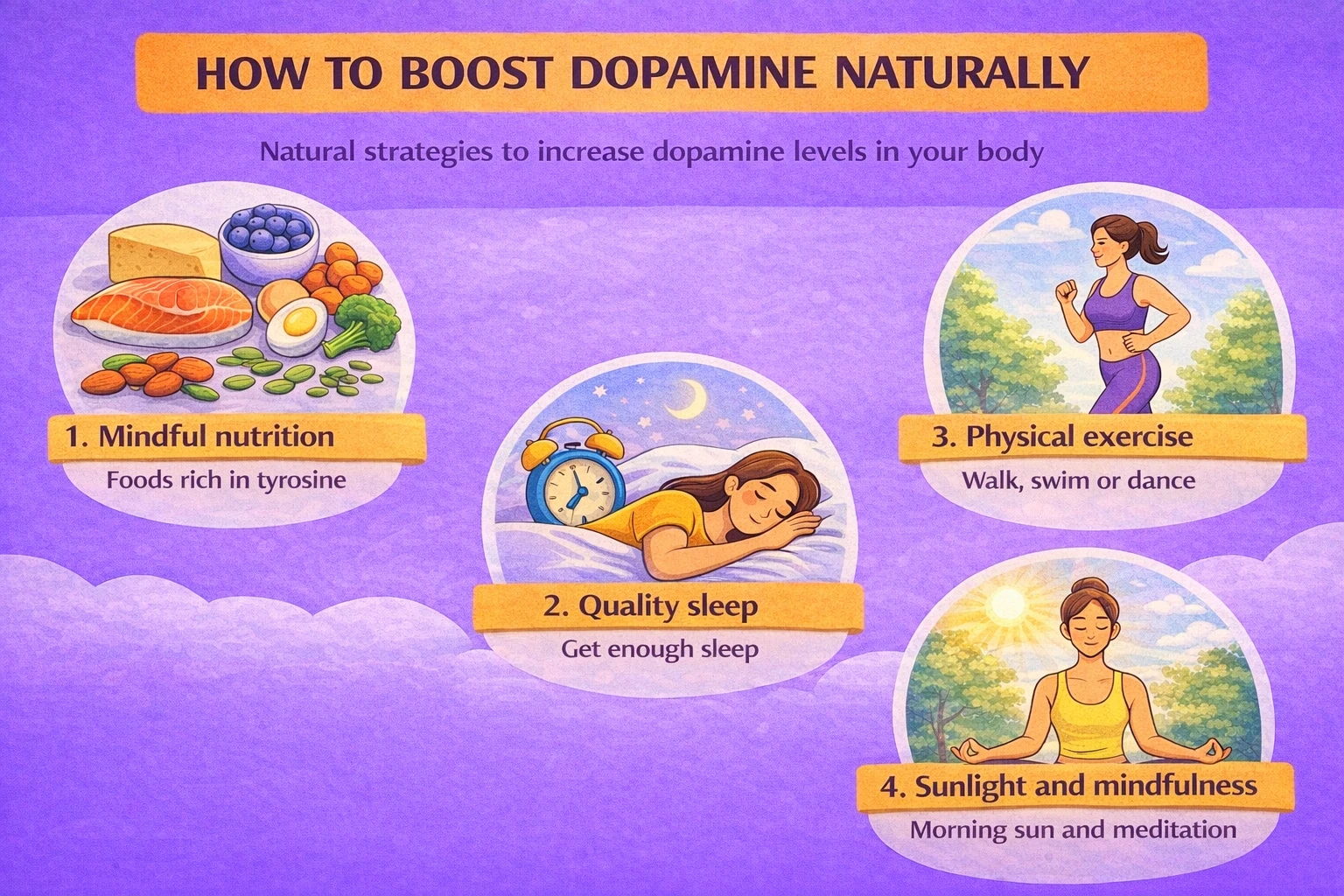
You don't need to rely on artificial stimuli to maintain healthy dopamine levels. Your body is designed to produce it naturally, as long as you provide the right conditions. Here are some of the most evidence-backed strategies.
Mindful Eating
As mentioned earlier, tyrosine is the precursor to dopamine. Including foods rich in this amino acid in your diet is an important first step. Dairy products, legumes, nuts, fatty fish, and pumpkin seeds are excellent options. Additionally, foods high in antioxidants (brightly colored fruits and vegetables) help protect dopaminergic neurons from oxidative damage.
Regular Physical Exercise
Exercise is one of the most powerful natural stimulants of dopamine. It doesn't have to be intense: walking briskly for 30 minutes, dancing, swimming, or practicing yoga can already produce a significant increase in the levels of this neurotransmitter. The effect is cumulative, meaning that regular exercise improves dopaminergic function in the long term.
Quality Rest
Restorative sleep is crucial for dopamine regulation. During the night, your brain recalibrates dopamine receptors, so chronic sleep deprivation can significantly reduce your sensitivity to dopamine. Try to maintain regular sleep schedules and create an environment conducive to rest.
Exposure to Sunlight
Natural light, especially in the morning, stimulates dopamine production and helps synchronize your circadian rhythm. Going for a walk during the first 30 minutes after waking up is one of the simplest and most effective ways to give your brain's reward system a boost.
Meditation and Mindfulness
Neuroimaging studies have shown that regular meditation practice increases dopamine availability in the brain. You don't need long sessions: even 10 minutes of daily mindfulness can lead to measurable changes in dopaminergic activity.
The "Thieves" of Dopamine You Should Avoid
Just as there are habits that enhance dopamine, others progressively deplete it. Identifying them is important to protect your motivation and energy.
- Digital Overstimulation: Social media, constant notifications, and compulsive content consumption create quick spikes in dopamine followed by sharp drops. Over time, your brain needs increasingly intense stimuli to feel the same satisfaction, known as dopaminergic tolerance.
- Excess Sugar and Ultra-Processed Foods: Ultra-processed foods high in sugar and refined fats produce intense but brief releases of dopamine. This pattern of stimulation can disrupt the reward system, creating a cycle of cravings that is hard to break, especially during the premenstrual phase.
- Chronic Stress: Cortisol, the stress hormone, directly interferes with dopamine production and reception. When you live in a state of constant stress, your dopaminergic system suffers, and you start to notice a gradual loss of motivation and enjoyment.
The Importance of Understanding Your Body
Knowing how dopamine works is not just a scientific curiosity exercise. It's a practical tool to understand why you feel a certain way at different times and, more importantly, to make decisions that favor your well-being.
When you understand that your motivation has a biochemical basis and that factors like diet, exercise, rest, and your own menstrual cycle influence it, you stop blaming yourself for those days when you don't perform as well. Instead, you learn to listen to your body and adapt to its natural rhythms.
At PapayaCup, we believe that knowing your body is the first step to taking better care of it. Understanding aspects like the fundamental data of menstruation or knowing what options you have to live your cycle comfortably, whether with a menstrual cup or a menstrual disc, is part of that journey of self-knowledge that allows you to live with more awareness and less stress.
FAQ: What is Dopamine?
It is a neurotransmitter that regulates motivation, pleasure, attention, and learning. When its levels are balanced, you feel more energetic and eager to face the day.
Yes. Estrogens stimulate its production, so during the follicular phase, levels are usually higher. In the luteal phase, they drop, which explains the lower motivation and cravings before your period.
Those rich in tyrosine: eggs, bananas, almonds, avocados, legumes, fatty fish, and dark chocolate. Antioxidants (berries, spinach, green tea) also help protect dopaminergic neurons.
Yes. Walking, running, swimming, or practicing yoga produce a significant increase. The benefit accumulates with regular practice.
Feeling comfortable during your period influences your mood and energy. At PapayaCup, we design products like the menstrual cup and menstrual disc to help you experience your cycle without discomfort, taking care of your body and emotional balance.
This is often due to a drop in dopamine caused by stress, lack of sleep, poor diet, digital overstimulation, or hormonal fluctuations of the cycle. Identifying the cause is the first step to finding a solution.