



Headache and migraine during period – why they occur and what really helps
10 de December de 2025
Menstrual Blood: What the Different Colors Mean
25 de December de 2025
An irregular period can be unsettling.
Your body responds to stress, hormones, nutrition, or life changes. In this article, you'll learn what lies behind menstrual cycle disorders and how you can gently support your hormonal balance.
Inhaltsverzeichnis
- What does an irregular period actually mean?
- Why is my period irregular? An overview of common causes
- Spotting: When is it normal, and when is it not?
- Missed period: What does it mean and what can you do?
- How to better understand your irregular cycle
- What helps with an irregular period? Gentle ways to support cycle stability
- Insight into your cycle: What specialists say about irregular periods
- When should you seek medical advice?
- Compact overview: nutrition, movement, self-care
- Conclusion: Your irregular period deserves understanding, not worry
- FAQ: Your questions about irregular periods
- Note:
An irregular period can feel unsettling. Maybe your bleeding shifts from month to month, maybe it skips a cycle, or maybe it arrives earlier than expected. Many people then wonder whether something is wrong or whether their body is simply going through an unusual moment. The good news is: your menstrual cycle is a sensitive system that responds to internal and external influences. An irregular period does not automatically mean that something serious is behind it. Sometimes your body is simply showing you that it currently has a different priority, needs more energy, or has become hormonally imbalanced.
In this detailed guide, you’ll find solid cycle knowledge, clarity amid the confusion, and gentle ways to rebuild a sense of stability. You’ll learn how diverse the causes can be, why spotting occurs, what an irregular cycle after childbirth means, and why stress can affect the body almost like a “disruption.” All with the goal of helping you understand your body better and regain a sense of confidence.
What does an irregular period actually mean?
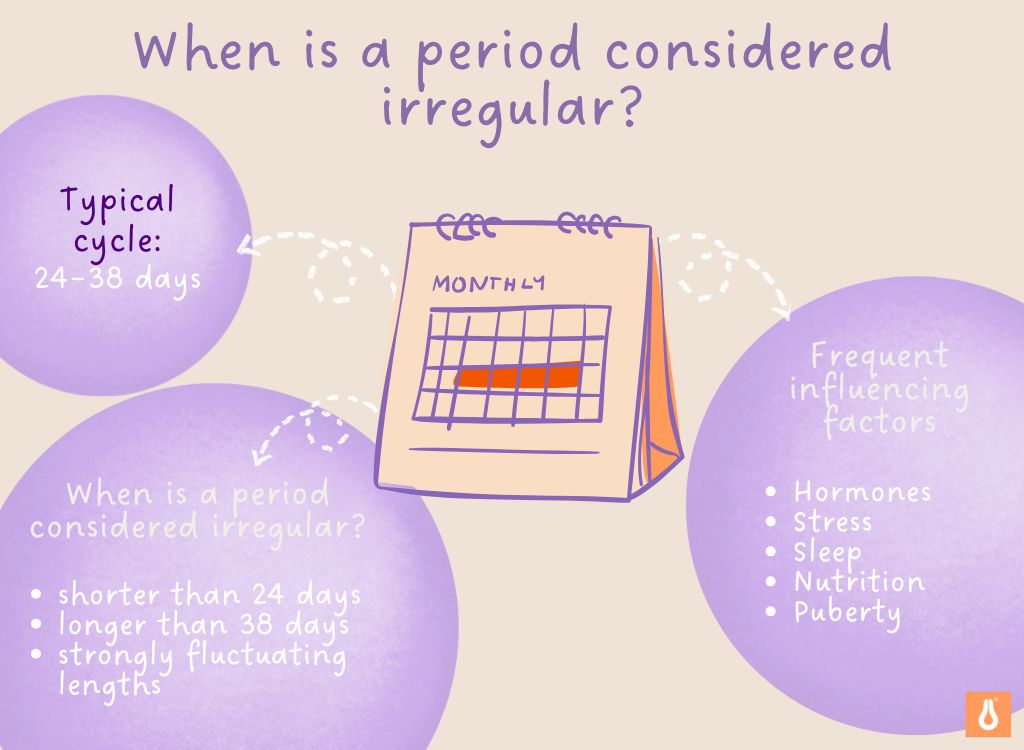
A period is considered irregular when the time between two bleeds frequently falls outside the typical range. Many gynecological guidelines describe a cycle of about 24 to 38 days as normal. If your cycle consistently falls above or below that range, it may be classified as “irregular.” The same applies if your bleeding lasts unusually long or short, or suddenly stops altogether — this is also considered a cycle irregularity.
However, cycle researchers emphasize that mild fluctuations are completely normal. Sleep, nutrition, stress, physical strain, or hormonal shifts can cause your cycle to adjust. Irregularity does not automatically mean you’re ill. It more often signals that your body is responding to something.
The menstrual cycle as a reflection of your overall health
Your cycle is a sensitive marker of your hormonal balance. Many users report that they notice early signs of imbalance through changes in their period. Your body communicates through your cycle. Understanding these signals helps you feel more secure and notice changes more consciously.
Source: American College of Obstetricians and Gynecologists (ACOG)
Why is my period irregular? An overview of common causes
An irregular period can have many reasons. Here is an overview of the most scientifically documented causes:
1. Stress and everyday pressure
Stress is one of the most common reasons for a fluctuating cycle. Your body uses stress hormones like cortisol to protect you in demanding situations. In doing so, the hormonal axis that regulates your cycle can temporarily slow down.
Many people report that even an exam period, work-related pressure, or family issues are enough to lengthen the cycle or cause a missed period.
What’s behind it
The so-called HPO axis connects your brain, pituitary gland, and ovaries. Stress alters the signals within this system. Ovulation may shift or fail to occur, causing your period to arrive later.
2. Hormonal changes: the pill, puberty, perimenopause
Your hormonal balance changes several times throughout your life. That’s why irregular cycles are especially common during certain phases:
Puberty
During the first years after menarche, it is completely normal for cycles to fluctuate between 21 and 45 days. The body is still finding its rhythm.
After stopping the pill
Many users report that the first cycle after stopping the pill is longer. Your body needs time to stabilize its own hormone production again. This can take several months.
Perimenopause
In the years before menopause, hormones become more unpredictable. Cycles may vary between 14 and 50 days. Spotting also becomes more common.
3. Irregular cycle after childbirth
After giving birth, the body undergoes profound changes. Hormone levels need time to recalibrate. Breastfeeding also increases prolactin levels, which suppress ovulation. Many people report that their period initially stops altogether, then suddenly returns, and only stabilizes after several months.
This is normal and does not mean that anything is wrong. Your body is in an intense recovery phase.
4. PCOS and hormonal disorders
Polycystic Ovary Syndrome is one of the most common hormonal causes of irregular periods. With PCOS, the ovaries produce increased androgens, which leads to infrequent or absent ovulation.
Typical accompanying signs include:
- Cycle lengths longer than 35 days
- Acne
- Increased hair growth
- Hair loss
Not everyone shows all symptoms. This is why medical evaluation is worthwhile if your cycle is consistently irregular.
Thyroid disorders can also influence the cycle because they affect your metabolism and hormonal axis.
5. Weight fluctuations and nutrition
Underweight or significant weight gain can affect hormone production. Fat tissue produces hormones and directly influences your cycle.
Malnutrition, dieting, or excessive exercise can also delay or stop the cycle.
6. Travel, shift work, and sleep deprivation
The body responds strongly to external rhythms. Jet lag, shift work, or irregular sleep can disrupt your internal clock.
Many users report that their period shifts after travel or intense weeks.
Spotting: When is it normal, and when is it not?
Spotting can be unsettling, but it’s more common than many think. Typical harmless triggers include:
- Hormonal changes
- Ovulation
- Stress
- Starting or stopping hormonal contraception
- Minor changes in the uterine lining
As long as spotting occurs occasionally and stops quickly, it’s usually not a concern.
However, if it happens frequently or is very heavy, a medical check-up is recommended.
Missed period: What does it mean and what can you do?
A missed period can have many different causes. Pregnancy is one of them. If you can safely rule that out, hormonal or psychological factors often play a role.
Many people report feeling anxious when their period doesn’t come. It’s important to know that a missing cycle is not automatically a warning sign.

PapayaCup tip
In this phase, make sure you get enough sleep, eat regular meals, and include gentle movement. Your body responds to balance.
How to better understand your irregular cycle
An irregular cycle can make it harder to predict your period. But especially then, it can be helpful to observe your body more consciously. Your cycle is not a fixed mechanism. It reacts to stress, recovery, hormones, and energy availability. When you understand which factors play a role for you, your cycle feels less chaotic and more like a personal rhythm.
Tracking your cycle – an important pillar of your health
Cycle tracking helps you recognize patterns. Many users report that only through regular tracking did they understand how their body actually behaves. You can track, for example:
- Start and end of your period
- Mood and energy levels
- Sleep quality
- Cervical mucus or temperature
Just a few months of tracking are enough to see which factors stabilize or disrupt your cycle.
What helps with an irregular period? Gentle ways to support cycle stability
Many changes cannot be “fixed” instantly because your body needs time. But there are gentle, natural ways to support your cycle.
Nutrition for hormonal harmony
A balanced diet has a direct impact on your cycle. Your body needs nutrients to produce hormones. Particularly helpful are:
- Magnesium
- Vitamin B6
- Vitamin D
- Omega-3 fatty acids
- complex carbohydrates
- plant-based proteins
Many users report that even small adjustments can make a noticeable difference. If your period is often very heavy, it can be helpful to focus on iron-rich foods.
Movement and self-care
Gentle movement often has a stabilizing effect. Yoga, walks, or light workouts support hormonal balance. The body thrives on rituals and regular activity.
Meditation, breathing exercises, or deliberate pauses can help reduce stress. Many people report that their cycle becomes more regular once everyday life becomes calmer again.
Natural support through herbs
Some herbs such as lady’s mantle, yarrow, or chasteberry have traditionally been used for cycle-related symptoms.
The PapayaCup hormone tea can also be a natural companion. It contains selected herbs that may support hormonal balance without synthetic hormones.
Period products that support your cycle
Many people with irregular periods appreciate reusable products because they are reliable, gentle on the mucosa, and sustainable.
PapayaCup menstrual cups and the PapayaDisc menstrual disc are made from medical-grade silicone, are pH-neutral, and can be worn for up to 12 hours. They work for both light and heavy bleeding and help you feel secure even when your cycle is unpredictable.
Insight into your cycle: What specialists say about irregular periods
Many questions about irregular periods become easier to understand when you see how your body works internally. Here you will find an informative video from a US gynecologist specializing in reproductive medicine. She explains clearly and calmly what happens in your body, how hormones regulate your cycle, and when a medical evaluation is recommended. If you feel like your cycle is completely off balance, this video can help you understand the underlying mechanisms and strengthen your body awareness.
When should you seek medical advice?
An irregular cycle is often harmless. Sometimes, however, it indicates that your body needs support. You should speak with your doctor if:
- Your cycles suddenly vary widely
- Your period is absent for more than 90 days
- You experience severe pain or unusual bleeding
- You suspect PCOS or a thyroid disorder
- You want to conceive and your cycle is very unpredictable
A medical evaluation provides clarity and helps rule out underlying causes.
Compact overview: nutrition, movement, self-care
Area | Tip | Effect |
Nutrition | Magnesium, vitamin B6, complex carbohydrates | Supports hormone production |
Movement | Yoga, walks, gentle workouts | Promotes stress relief and circulation |
Self-care | Sleep, breathing exercises, meditation | Regulates cortisol, stabilizes the HPO axis |
Herbs | Lady’s mantle, yarrow, hormone tea | May ease PMS and cycle irregularities |
Conclusion: Your irregular period deserves understanding, not worry
Irregular periods are common and often a normal reaction to stress, hormonal changes, or life phases such as puberty, breastfeeding, or the years leading up to menopause. What matters is taking your body seriously without developing fear. Your cycle is an inner messenger. Once you learn to interpret it, you gain a sense of trust and self-agency.
With mindful attention to your nutrition, stress levels, and gentle support from herbs, tracking, and body-friendly period products, you can do a great deal for your cycle health. And if your intuition tells you that something feels off, seeking a medical opinion is always a step towards clarity and safety.
If you want to understand your body better, PapayaCup offers helpful guides, instructions, and tools on menstrual health. Take a look and discover what supports you.

FAQ: Your questions about irregular periods
Note:
This article and the video included do not replace medical advice. Every person and every cycle is unique. If your period is very irregular over a longer period of time, if you experience severe pain, or if you are worried, a gynecological check-up may be helpful. A healthcare professional can work with you to find out what your body needs and which type of support is right for you.