



Anti-inflammatory Diet for Women: What Benefits Does It Bring to Your Cycle, Your Skin and Your Gut?
30 de November de 2025
Hashimoto symptoms in women: an overview of the most important signs
5 de December de 2025
The first period is an important milestone in puberty. In this article, you’ll learn which signs are typical, what the first bleeding usually looks like, and what can help teenagers and parents feel more confident during this time.
Inhaltsverzeichnis
- When do you get your first period
- Signs before the first period
- What does the first period look like?
- How long does the first period last?
- What to do when the first period starts?
- Which period products are suitable for beginners?
- How the cycle regulates itself after the first period
- First period: tips for nutrition, movement, and self-care
- First period: when medical advice is helpful
- Your puberty belongs to you
- FAQ: Your questions about irregular periods
- Important note:
The first period is a special moment in a girl’s life. For some, it feels exciting and almost grown-up, while others feel unsure or don’t really understand what is happening. Maybe you’re waiting for your first period and wondering when it will finally start. Or you’re supporting your child through puberty and want to give them a sense of security.
No matter how you experience this transition: menarche, the first period, is a natural step in development and a sign that the body is beginning to change.
To help you feel well prepared, this article explains when the first period typically starts, which signs point to it, what the first bleeding usually looks like, and what can support young people during this time. You’ll also learn how the cycle regulates itself after menarche, which period products are suitable in the beginning, and how nutrition, movement, and self-care can help during this phase.
This article is based on medically recognized information as well as the experiences many users have shared with us. That way, you not only receive knowledge but also the feeling of truly being understood.
When do you get your first period
There is no specific age at which the first period has to start. Every body has its own rhythm. Menarche begins once enough hormones are present and the internal coordination between the brain, ovaries, and uterus is ready.
Many girls get their first period within a similar age range, but the variation is completely normal and shows one thing above all: bodies develop differently — and that is a good thing.
To give you an idea of how varied this timing can be, here is a study showing when young people got their first period. It highlights just how different the start of menstruation can be:
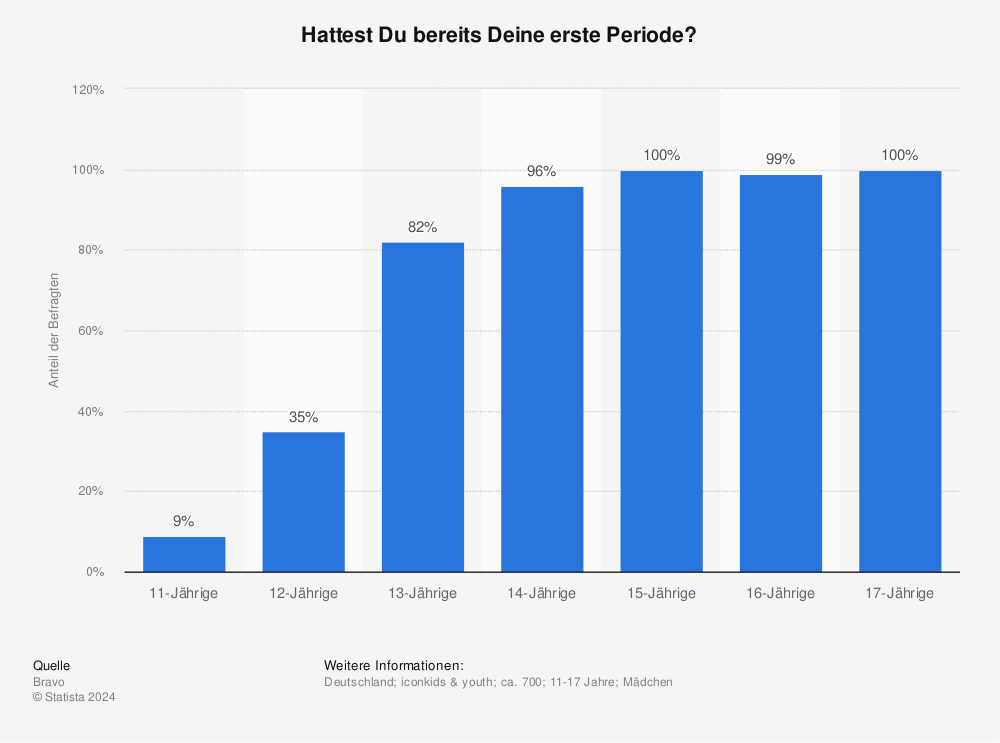
Source: Statista
Important to understand:
The body does not follow a fixed schedule. Puberty is individual. Some get their period earlier, others later. Both are normal and healthy.
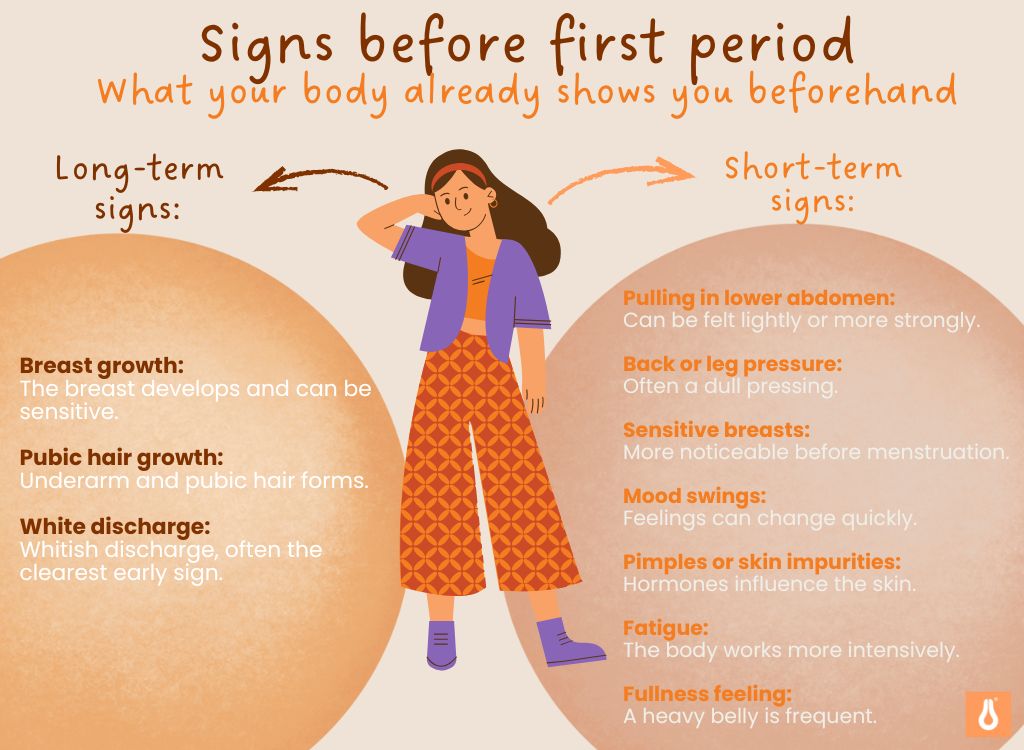
Signs before the first period
The first period rarely comes out of nowhere. The body usually prepares long before menarche, and puberty often begins several years beforehand. Many changes happen gradually and show that your body is entering a new stage.
Long-term signs
Some signs appear months or even years before the first bleeding:
Breast development
The breasts begin to develop. They may feel tender or slightly sore, which is due to increasing estrogen levels.
Growth of pubic hair
Hair under the arms and in the pubic area is a typical sign that puberty is beginning. Many girls find this change unfamiliar, but it is a completely natural part of development.
Vaginal discharge
A white or transparent discharge in the underwear is one of the clearest early signs. Discharge often appears about a year before the first period and shows that the body is becoming more active. It protects the vaginal flora and helps maintain a healthy, slightly acidic environment.

Papaya tip:
If you notice that your discharge is increasing, period underwear or soft pantyliners can give you an extra sense of security.
Short-term signs
Some changes appear only a few days before the first period. These can include:
- a slight pulling sensation in the lower abdomen
- a feeling of pressure in the back or legs
- tender or swollen breasts
- mood swings
- pimples or skin blemishes
- fatigue
- a feeling of fullness in the belly
Not everyone feels these signs with the same intensity. However, many report that they felt “different” without being able to pinpoint why. That vague feeling is often a sign that the first period is not far away.
What does the first period look like?
The first menstrual period is often lighter than later ones. Many girls first notice only a small sign, such as a brownish stain in their underwear or a few red drops on toilet paper. For others, the first bleeding is a little more noticeable. All of these variations are normal, because every body follows its own rhythm.
Why the first period sometimes looks brown
Many get startled the first time because the blood is not bright red right away. This is completely normal. The blood often takes a bit longer to leave the body in the beginning, mixes with discharge, and therefore looks brownish. That color is a very typical sign that the body is just starting its menstrual cycle for the first time.
How long does the first period last?
The duration can vary widely. Many report that their first period lasted only one to three days, while others experience bleeding over several days. Anything between two and seven days is normal.
Especially in the beginning, the cycle is still developing. It may be irregular for the first one to two years — sometimes shorter, sometimes longer, sometimes heavier or lighter. The body needs time to adjust its hormonal processes, and that requires patience.
What to do when the first period starts?
When you notice your first bleeding, the moment may feel unfamiliar or exciting:
- Take a moment to breathe
- Look for a pad or period underwear
- If you’re not at home: ask a trusted person for period products
From the outside, no one can tell that you’ve gotten your first period. Even if everything feels new inside, you are safe. Your body is doing exactly what it is meant to do.
How parents can support their daughter during her first period
Some teenagers want space during this time, while others want to talk about everything. Both reactions are completely normal. Parents can make this moment easier by staying open and empathetic.
- Listen: You don’t need to give long explanations right away. Sometimes a simple “I’m here if you have questions” is enough to create a sense of safety.
- Share experiences: Many girls feel more at ease when they hear how it was for their mother, sister, aunt, or another trusted person. These stories show that every first period looks different and help reduce uncertainty.
- Provide reassurance: Show your child how period products work without pressure or judgment. Pads or period underwear are often a good starting point. Later — when your daughter feels ready — you can also explain how menstrual cups or discs work.
Knowing that there are different options often gives young people more confidence.
Which period products are suitable for beginners?
When the first period begins, everything feels new. The question which period product is the best fit can feel overwhelming. The good news: there is no right or wrong choice. Your body will tell you what feels comfortable and safe. Many try different products in the beginning until they find what works for them.
To help you or your daughter figure out what feels right, here’s a simple overview of products that are especially suitable in the early cycles.
1. Pads and period underwear – ideal for the first cycles
For most girls, pads or period underwear are the gentlest way to start. They are easy to use, comfortable, and help you ease into this new experience.
Why they’re a good fit
- They are worn on the outside, so the body doesn’t have to get used to insertion.
- They provide a secure feeling, especially when bleeding is still irregular.
- Period underwear is reusable and feels like normal underwear.
- Perfect for teens who feel unsure or sensitive at first.
For the very first periods, both options are reliable and stress-free.
2. Menstrual cups – when you feel ready
A menstrual cup is a sustainable, body-friendly way to collect menstrual blood. Many start using them later, but some are curious early on — both are completely okay.
Why a cup can be a great option later
- Made from 100% medical-grade silicone, pH-neutral and very gentle on the vaginal lining.
- Allows 8–12 hours of wear (maximum 12 hours).
- Doesn’t dry out the vagina like some tampons can.
- Reusable and eco-friendly in the long run.
Important for beginners
Your body should be ready — physically and mentally. Many try a menstrual cup once they feel more comfortable with their body or their cycle becomes more regular.
3. Menstrual discs – especially gentle and without suction
A menstrual disc is flexible and sits high in the body, just below the cervix. For some teens, it’s an especially comfortable alternative because it feels different from a cup.
Benefits for beginners
- No suction seal, making it very gentle to insert and remove.
- Adapts to the individual anatomy because it’s flat and flexible.
- Great freedom of movement — many love using it during sports or daily life.
- Reusable and made from medical-grade silicone.
Especially for girls with a sensitive pelvic floor or anyone who prefers a very neutral body sensation, a disc can be a great option.
Which products are suitable for heavier days?
Many girls say they feel increasingly confident using menstrual cups or discs over time. Both products hold more fluid than many pads or tampons and can therefore be reliable even on heavier days.
What many users report
- A menstrual cup sits securely in the vaginal canal and holds a good amount of blood.
- A disc often holds even more and is barely noticeable when worn.
But: You don’t need to try any of this right away. Your body will tell you when the time is right.
How the cycle regulates itself after the first period
After the first period, the body needs time to find its rhythm. That’s why the menstrual cycle is often irregular at first. This is completely normal. Early cycles can last anywhere between 21 and 45 days. Only after about one to two years do most cycles become more stable.
This is because the hormonal systems first need to learn to work together regularly. The brain, ovaries, and uterus coordinate step by step. Every girl experiences this at her own pace.
What happens in the body during this time
To better understand why fluctuations are completely normal, here’s a look at the internal process:
- Maturation of an egg: Each cycle, an egg begins to mature in the ovaries — a process controlled by hormones like FSH and estrogen.
- Ovulation: Once enough estrogen has been produced, ovulation occurs. In the early years, this moment may shift or sometimes not happen at all, because the body is not yet ovulating regularly.
- Thickening of the uterine lining: Meanwhile, the uterus prepares to receive a fertilized egg. The lining becomes thicker and more supplied with blood.
- If no fertilization occurs: The uterine lining sheds — this is what we see as the period.
The fact that this process is unstable at first doesn’t mean anything is wrong — it simply shows that the body is developing and moving toward its own rhythm.
External sources:
WHO Puberty Guidance
Charité Berlin – Puberty Development
First period: tips for nutrition, movement, and self-care
Puberty is a time of major change. Many young people feel physical sensations more intensely than adults. The good news: you can actively support your body during this phase. A balanced diet, gentle movement and small self-care rituals help many feel more grounded and confident in their bodies.
What supports your body during this time
Here is a clear overview of the things that have proven effective in practice and according to expert sources.
Area | What helps | Why it helps |
Nutrition | Fruit, vegetables, whole grains, omega-3 sources such as nuts or flaxseed | These nutrients reduce inflammation, stabilize energy levels, and support hormonal balance. |
Hydration | Water and mild herbal teas, e.g., Papaya hormone tea | Good hydration can ease cramps, stabilize circulation, and support digestion. |
Movement | Walking, gentle yoga, stretching | Movement relaxes the pelvic area, reduces stress hormones, and helps prevent tension-related discomfort. |
Heat | A hot water bottle or a warm bath | Heat relaxes muscles, boosts circulation, and has a calming effect on the whole body. |
Self-care | Rest, journaling, breathing exercises | Small rituals help process emotions, reduce stress, and strengthen body awareness. |
First period: when medical advice is helpful
Although puberty naturally unfolds very individually, there are some situations where an additional check-in with a healthcare professional can be useful:
- when severe pain occurs that significantly affects daily life
- when the first period has not started by the 16th birthday
- when bleeding is extremely heavy or very frequent
- when pain occurs that is not related to the menstrual cycle
Many teens feel more at ease after speaking with a doctor once. This step does not mean anything is wrong – it simply helps clarify uncertainties and build trust in their own body.
Your puberty belongs to you
The first period is more than just bleeding. It is a sign that your body is beginning to find its own rhythm. You are allowed to be curious. You are allowed to feel unsure. You are allowed to ask anything that’s on your mind. None of it is embarrassing or wrong.
It’s your journey, your body, and your pace.
If you or your child would like to learn more about the menstrual cycle, you’ll find gentle, trustworthy support in our PapayaCup guides. There we explain step by step how menstrual cups and menstrual discs work, how to find the right size, and how to feel more confident in your body:
- PapayaCup menstrual cup manual
- Menstrual disc manual
- Menstrual cup size guide
- Menstrual disc size guide
No matter how your first period unfolds: you are not alone. Your body knows exactly what it’s doing. And you can trust it.
FAQ: Your questions about irregular periods
Important note:
We explain everything here as clearly and carefully as possible. However, this information cannot replace personalised medical advice. If something feels unusual or you experience severe pain, a healthcare professional is the best support.